






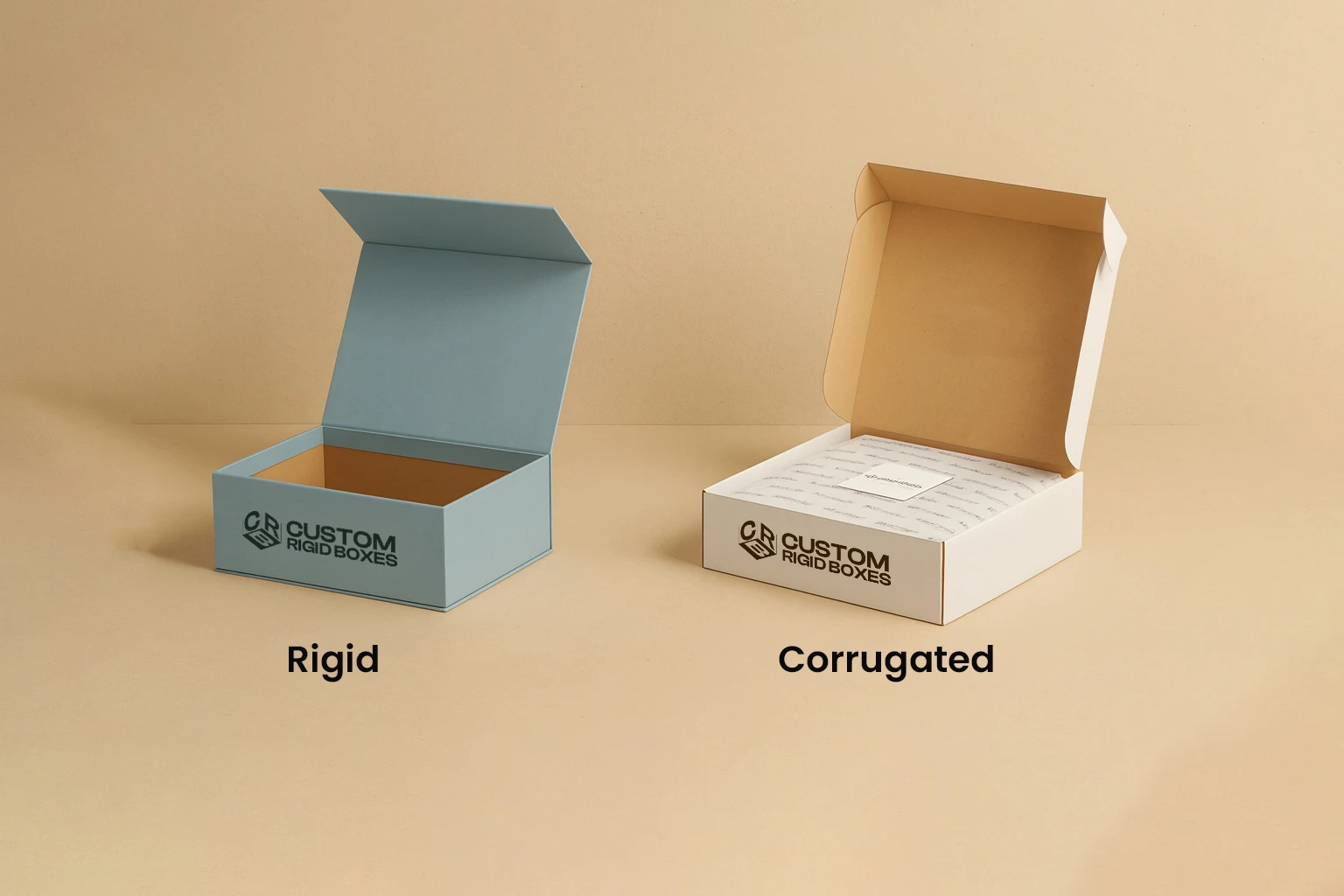
UK retailers weighing up packaging formats for a new product often reach a fork between rigid board and corrugated cardboard, and increasingly the sustainability question factors into that decision as heavily as cost or appearance. Both materials start from paper fibre, but they differ enough in structure, production and typical finishing that the greener choice is not always the obvious one on first glance.
This comparison looks at rigid vs corrugated packaging UK retailers actually choose between, covering material efficiency, recyclability, protective performance and the situations where one genuinely outperforms the other on environmental grounds, not just on appearance or brand positioning.
How the two materials are actually made
Rigid board is a dense, compressed paperboard, usually chipboard, wrapped in a separate printed paper layer and bonded together with adhesive. Corrugated cardboard, by contrast, uses a fluted inner layer sandwiched between two flat liner sheets, a structure that achieves strength through shape rather than density, using considerably less raw material by weight to achieve comparable rigidity.
That difference in material efficiency is corrugated’s clearest environmental advantage. A corrugated box typically uses less paper fibre per unit of strength than an equivalent rigid box, which translates into a smaller raw material footprint before any consideration of finishing or transport is factored in.
Weight differences also affect shipping emissions, an often-overlooked part of the comparison. A lighter corrugated box adds less to the overall shipment weight than a rigid equivalent, which can translate into a modest reduction in transport-related emissions across a large volume of shipments, particularly for products sent via UK courier networks charging by weight.
Recyclability and end-of-life comparison
Both materials are fundamentally recyclable through standard UK paper and cardboard collection, provided finishes and coatings do not interfere with the process. Corrugated cardboard has a practical edge here too, since it is rarely finished with the laminates and foils common on premium rigid boxes, making an unprinted or simply printed corrugated box one of the most straightforwardly recyclable packaging formats available.
Rigid boxes can match this recyclability with the right specification, using uncoated board and water-based inks as covered in other guides on sustainable rigid packaging, but doing so requires a deliberate choice rather than being the default outcome of most standard rigid box specifications on the UK market.
It is also worth noting that mixed-material packaging, such as a rigid box combined with a plastic display window, complicates recycling for both formats equally. Retailers focused on genuine recyclability should treat added components, not just the base material, as part of the environmental assessment regardless of whether the underlying box is rigid or corrugated.
Where rigid packaging still makes environmental sense
Material efficiency and default recyclability do not settle the comparison entirely, because a full environmental picture also has to account for product protection and reuse. A rigid box’s superior rigidity reduces the risk of product damage during transit, and a damaged product, along with its replacement and the packaging used to ship that replacement, carries its own environmental cost that a lighter corrugated box might not have prevented.
Rigid boxes are also more likely to be reused by customers as storage, particularly for jewellery, keepsakes and gifts, extending the material’s useful life well beyond the original packaging function. A corrugated shipping box, by contrast, is typically discarded or recycled immediately after unpacking, giving it a shorter functional lifespan even though its initial material footprint is lighter.
There is also a returns and damage dimension worth quantifying rather than assuming. UK retailers who have compared return rates between rigid and standard corrugated packaging for the same fragile product often find the rigid option pays back its heavier material footprint through meaningfully fewer damaged-in-transit returns, each of which carries its own additional packaging, transport and disposal impact.
Matching the format to the actual use case
For UK retailers shipping lower-cost, higher-volume products where protection needs are modest and packaging is unlikely to be kept, corrugated cardboard is generally the greener and more cost-effective choice, particularly when specified with minimal or no plastic-based finishing.
For premium, gift-oriented or fragile products where damage risk is higher and reuse is likely, a well-specified rigid box, using recycled board, water-based finishing and a card rather than foam insert, can offer a comparable or even stronger environmental case once the full lifecycle, including damage prevention and reuse, is taken into account rather than raw material weight alone.
Some UK retailers selling a broad product range use both formats deliberately, corrugated for lower-value, high-volume shipping and rigid for a smaller premium or gift-led line, rather than trying to force a single packaging format across an entire catalogue with very different product needs.
Questions worth asking before choosing between formats
Retailers uncertain which format suits a specific product should start with three questions. First, how likely is the product to be damaged in transit in a lighter corrugated format, and what would replacing a damaged unit cost environmentally as well as financially? Second, how likely is a customer to keep or reuse the box afterwards, extending its functional life?
Third, what finishing does the product genuinely need to convey its intended positioning, and can that finishing be achieved with lower-impact materials regardless of which base format is chosen? Answering these honestly, rather than defaulting to whichever format a brand has always used, produces a more genuinely sustainable outcome than assuming one material is automatically greener than the other in every situation.
Getting a fair comparison from a supplier
UK packaging suppliers who offer both rigid and corrugated options are generally well placed to give an honest comparison for a specific product, since they are not limited to promoting whichever format they happen to specialise in. Asking a supplier directly for a side-by-side environmental and cost comparison for a specific product, rather than a generic overview of both materials, produces a far more useful basis for the decision.
Ultimately, the rigid vs corrugated packaging UK question does not have a single universal answer. The right choice depends on the specific product, how it travels, and what happens to the box after the sale, and a retailer who works through those factors deliberately will make a better environmental decision than one guided purely by which format looks more premium on a shelf.
For most UK retailers, the practical path forward is running exactly this assessment on a per-product basis rather than adopting a single packaging policy across the whole business, since the product mix that suits corrugated for one line and rigid for another is common even within a single, focused brand.
About The Author