


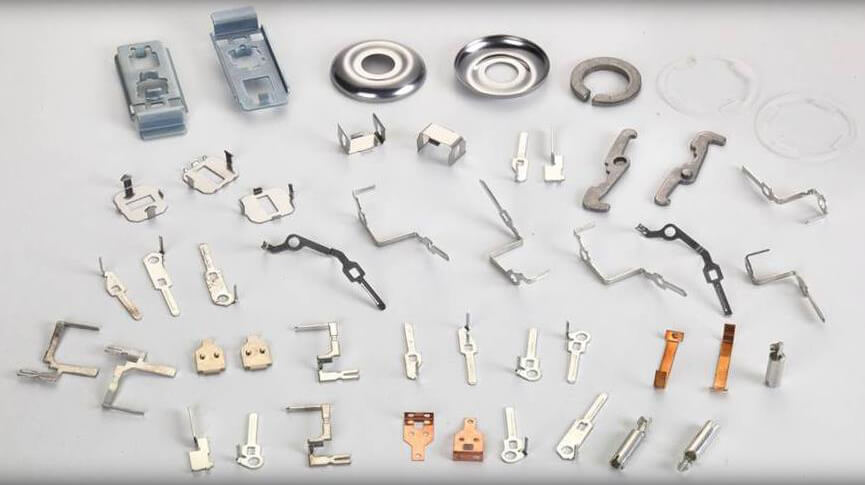
Every sourcing manager eventually runs into the same tension: the tooling that makes stamped parts cheap at high volume is expensive to build, and the tooling that’s cheap to build doesn’t hold tolerance once you’re running six-figure quantities. Getting this trade-off right (rather than defaulting to whatever tooling approach a supplier happens to already own) is often the single biggest lever on total program cost.
Volume Changes the Right Answer
At low volumes, simple single-station or compound dies win on almost every metric that matters. Setup is quick, tooling cost is a fraction of a progressive die build, and design changes are cheap to implement because you’re not redesigning a multi-station sequence. The trade-off is throughput: single-hit stamping processes one operation per stroke, so cycle times climb fast as part complexity increases.
Once volumes move into the tens or hundreds of thousands, the economics flip. Progressive dies combine punching, forming, and cut-off into one continuous strip-fed process, running at speeds of hundreds of parts per minute with a single operator able to oversee multiple unattended presses.
The tooling investment is higher upfront, but per-part cost drops sharply because labour, handling, and scrap are all reduced simultaneously. Manufacturers who’ve made this comparison directly with clients often find the breakeven point lands well before six figures in annual volume; a 500,000-piece annual bracket order, for example, can see per-part savings exceeding 40% once the progressive tool is amortised.
Repeatability Is a Tooling Problem, Not a Press Problem
It’s tempting to think repeatability is mostly about press quality, tonnage, servo control, and feed accuracy. Those matter, but the bigger driver is how many times a part gets repositioned between operations. Every handoff between a separate blanking step, a separate forming step, and a separate piercing step introduces its own tolerance stack-up.
Precision stamping parts intended for tight-fit assemblies (connector housings, EV busbar components, structural brackets) benefit enormously from staying in one continuous die set from coil to finished part, because all the critical features are controlled within the same tooling structure rather than accumulating error across multiple setups.
This is also why CPK data matters more than a single first-article inspection report. A part that measures perfectly on sample #1 tells you almost nothing about whether it will still be in tolerance on sample #50,000. Buyers evaluating stamped parts suppliers should be asking for dimensional capability studies on springback-sensitive features before production launch, not after a quality escape.
Material Choice Complicates the Cost Curve
Steel and aluminium don’t behave the same way under a press, and that changes both cost and repeatability. Aluminium’s lower formability relative to mild steel typically means slower production speeds and different lubrication and tooling material requirements, which is worth knowing before quoting a program against steel-based cost assumptions.
Copper, increasingly common in EV and power electronics stamped components, adds its own die-wear considerations because of its softness and conductivity requirements, which can affect how strip layout and coining operations are designed.
Where Cost Actually Gets Saved
The instinct in a cost review is often to push on piece price. In practice, the bigger savings usually sit upstream of that number:
- Strip layout efficiency: a well-nested strip layout reduces scrap and increases parts-per-coil, which lowers material cost without touching the quoted piece price at all.
- Reduced secondary operations: every deburring, cleaning or secondary forming step done off-press adds labour cost that doesn’t show up in the stamping quote but shows up in the landed part cost.
- Die maintenance discipline: a poorly maintained die drifts out of tolerance gradually, generating scrap and rework that’s easy to miss until a customer audit flags it.
A Practical Approach to Sourcing
For buyers evaluating suppliers of stamped parts, the useful question isn’t “what’s your piece price”; it’s “walk me through how you’d tool this part for my actual annual volume, and show me the CPK data from a comparable prior program.” Suppliers who can answer that concretely, rather than defaulting to a generic tooling recommendation, are usually the ones who’ve actually done the volume-versus-tooling trade-off analysis rather than guessing at it.
Eigen Engineering approaches new stamping programs this way, sizing tooling investment against real annual volume projections rather than a one-size-fits-all die strategy, and backing that with dimensional capability data rather than a single inspection sheet. At scale, that discipline is usually worth more to a buyer’s total cost of ownership than a marginally lower quoted piece price.
About The Author