

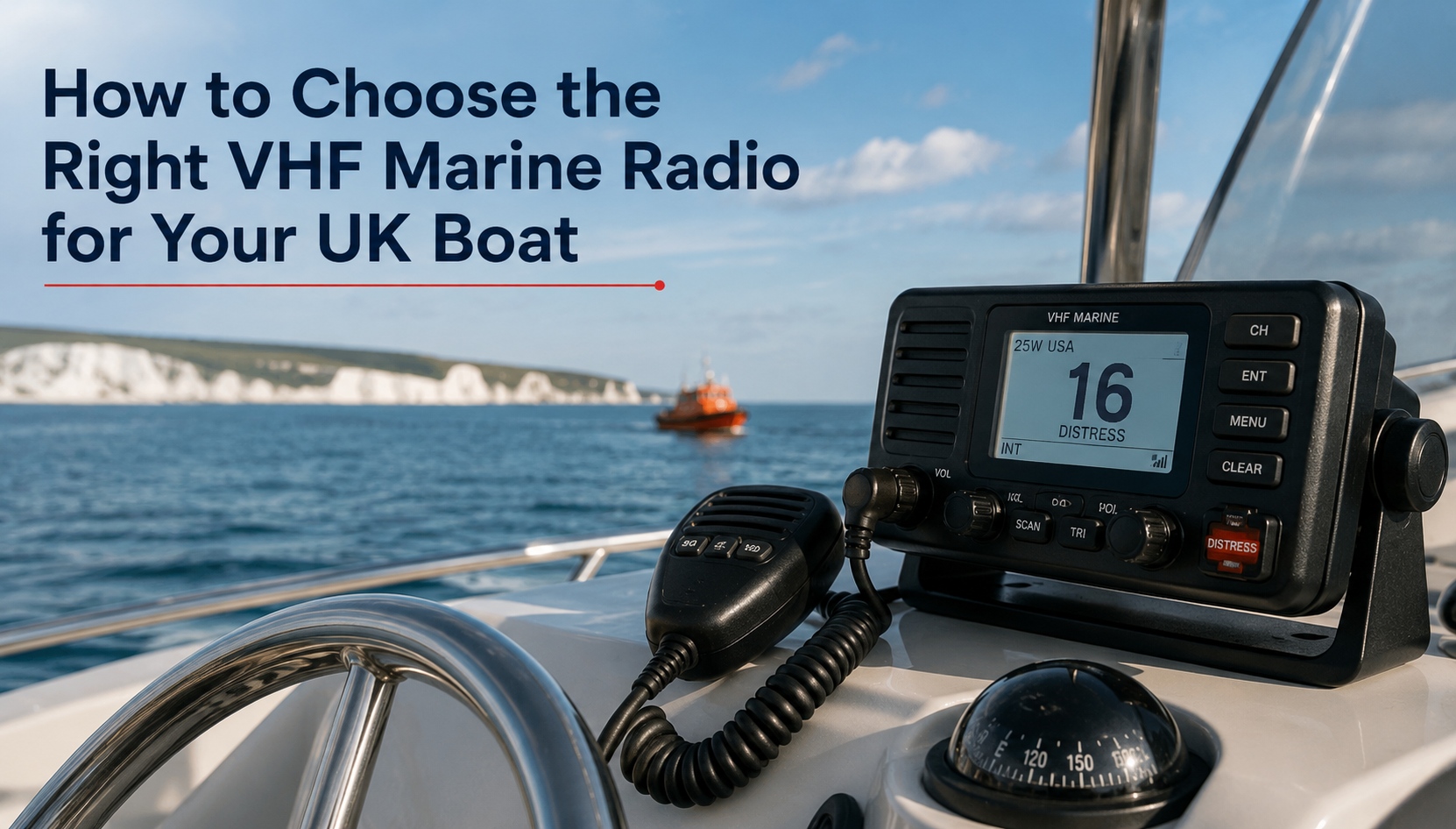
When you’re heading out on UK waters, reliable communication is not something you want to think about only when something goes wrong. A good VHF Marine Radio gives you a dependable way to communicate with other vessels, marinas, harbour authorities and emergency services.
Whether you own a sailing yacht, run a fishing vessel, operate a commercial boat or manage a fleet, choosing the right radio depends on more than price. Your boat size, operating area, range requirements, installation options and the features you actually need should all influence your decision.
A VHF radio should also be considered as part of your wider Marine Safety Equipment, rather than as a standalone purchase. Here’s what UK boat owners and operators should consider before choosing one.
Why Do You Need a VHF Marine Radio on a UK Boat?
A mobile phone can be useful on land, but it isn’t a dependable substitute for marine radio. Mobile coverage can disappear offshore, while VHF is specifically designed for communication on the water.
The RYA recommends carrying a VHF for UK pleasure vessels and notes that a fixed VHF can provide substantially greater range than a handheld when properly installed.
A VHF Marine Radio can be used to:
- Communicate with nearby vessels
- Contact marinas and harbour authorities
- Make safety and urgency calls
- Send a distress alert when properly configured
- Communicate with relevant coast stations
- Coordinate movements in busy waterways
- Support emergency response
For commercial and fishing vessels, dependable communication becomes even more important because crews may spend longer periods operating away from shore.
Handheld vs Fixed VHF Marine Radio: Which Is Better?
One of the first decisions is whether you need a handheld radio, a fixed installation or both.
Handheld VHF Marine Radio
A handheld radio is compact, portable and easy to carry around the boat. It can be particularly useful for smaller vessels, tenders and crew working away from the helm.
Look for:
- Waterproof construction
- Good battery life
- Clear display
- Easy-to-use controls
- DSC capability where appropriate
- GPS functionality
- A rechargeable battery
- Buoyancy or floating capability
A handheld also makes an excellent backup. If the boat loses electrical power or the fixed radio becomes unavailable, having a charged handheld can provide an important alternative means of communication.
Fixed VHF Marine Radio
A fixed radio is generally the better choice for larger yachts, commercial vessels and boats regularly operating offshore.
Because it connects to an external antenna mounted at height, a fixed installation can provide considerably more range than a handheld. The RYA notes that a fixed VHF may communicate over approximately 20 to 40 miles depending on installation and conditions.
A fixed radio may also offer:
- Higher transmit power
- Better audio
- External antenna connection
- Remote microphone support
- GPS integration
- DSC
- AIS integration
- Hailer or foghorn functions
For many boat owners, the best approach is not choosing between the two. A fixed radio can serve as the primary system, while a waterproof handheld provides valuable backup capability.
8 Features to Look for in a VHF Marine Radio
Not every boat needs the most advanced radio available. Instead, concentrate on features that match how and where you use your vessel.
1. Digital Selective Calling
Digital Selective Calling, commonly known as DSC, is an important feature to consider.
Rather than relying entirely on a voice transmission, DSC can be used to send digital alerts and calls. When correctly configured, a distress alert can include identifying and positional information.
This makes DSC particularly valuable as part of an emergency communication setup.
2. GPS
Built-in GPS can make a VHF Marine Radio considerably more useful, particularly when DSC is involved.
A GPS-enabled radio can provide position information for appropriate digital calls and help reduce the amount of information that needs to be communicated manually during an emergency.
3. AIS Integration
Automatic Identification System, or AIS, can provide information about suitably equipped vessels in the area.
Some VHF radios can receive AIS information directly, allowing boaters to see useful information about nearby vessels without needing a separate display.
For yachts, commercial operators and vessels travelling through busy areas, this can be a worthwhile feature.
4. Waterproofing and Buoyancy
Water exposure is inevitable on a boat, so durability matters.
If you’re choosing a handheld, check its waterproof rating and consider whether a floating design would be useful. A radio that ends up at the bottom of the sea isn’t much help during an emergency.
5. Battery Life and Charging
Battery performance is particularly important for handheld radios.
Think about how long you typically spend on the water and whether the radio will be used as a primary or backup communication device.
It is good practice to keep the battery charged before departure and consider how you would recharge it during longer trips.
6. Range and Transmit Power
Don’t choose a radio simply because its packaging claims an impressive range.
VHF range depends on several factors, including antenna height, installation, transmit power, surrounding terrain and atmospheric conditions. The RYA specifically recommends positioning the antenna as high as possible to maximise communication range.
For a fixed radio, proper antenna installation can therefore be just as important as the radio itself.
7. Ease of Use
A radio with dozens of complicated functions isn’t necessarily the best radio.
When you’re dealing with poor weather, engine noise or an emergency, you want controls that are easy to understand.
Look for:
- Clear buttons
- Readable screens
- Simple channel selection
- Good audio
- Easy volume and squelch controls
- Straightforward distress functions
8. Connectivity and Additional Features
Depending on your vessel, additional features such as NMEA connectivity, remote microphones, hailer functions and foghorn capabilities may be useful.
Commercial operators and larger yacht owners may benefit more from these integrations than someone operating a small recreational boat close to shore.
What Type of VHF Marine Radio Does Your Boat Need?
Your ideal setup will depend heavily on how you use your boat.
| Boat or User | Possible VHF Setup |
| Small leisure boat | Handheld VHF |
| RIB or day boat | Waterproof handheld |
| Sailing yacht | Fixed VHF with handheld backup |
| Motor yacht | Fixed VHF with optional handheld |
| Fishing vessel | Robust fixed system plus backup |
| Commercial vessel | Fixed VHF suited to operational requirements |
| Sailing club | Combination of fixed and handheld radios |
This isn’t a one-size-fits-all decision. A boat operating close to shore has different requirements from a vessel spending long periods offshore.
Do You Need a VHF Licence in the UK?
This is an important point that should not be overlooked.
In the UK, maritime radio equipment is subject to licensing requirements administered by Ofcom. A Ship Radio Licence or Ship Portable Radio Licence may be applicable depending on the equipment and how it is used. Ofcom also issues MMSI numbers through the relevant licensing process.
Operators also need the appropriate training and certification for using marine VHF. The RYA’s marine radio guidance covers radio procedures, installation, maintenance and licensing.
Before using a new radio, check the current Ofcom requirements and make sure your equipment and operator certification are appropriate for your situation.
VHF Marine Radio Channels UK Boaters Should Know
Understanding how marine channels work is just as important as owning the equipment.
Channel 16 is internationally recognised for voice distress, safety and calling, while Channel 70 is associated with DSC functions.
However, simply knowing channel numbers isn’t enough. Boat owners and crew should understand proper radio procedure and know how to make appropriate distress, urgency and safety calls.
This is particularly important for commercial crews, fishing vessel operators and anyone responsible for other people on board.
Common Mistakes When Buying a VHF Marine Radio
A few simple mistakes can result in buying equipment that isn’t suitable for your boat.
Avoid:
- Choosing solely on the lowest price
- Buying a handheld without considering its limited range
- Ignoring antenna installation
- Overlooking battery performance
- Buying features you will never use
- Failing to check DSC and GPS compatibility
- Forgetting about licensing requirements
- Treating the radio as a replacement for other safety equipment
The last point is particularly important. A VHF should complement your overall safety setup, not replace it.
How Much Should You Spend on a VHF Marine Radio?
There isn’t one correct budget.
A basic handheld may be perfectly suitable for a small boat that mainly operates close to shore. A larger yacht or commercial vessel may need a fixed installation with DSC, GPS, AIS integration, remote microphones and other features.
Instead of asking, “What is the most expensive radio I can buy?”, ask:
“What equipment does my vessel and operating area actually require?”
That approach usually leads to a more practical purchase.
VHF Marine Radio as Part of Your Marine Safety Equipment
A radio is only one part of a responsible onboard safety setup.
Your wider Marine Safety Equipment may include:
- Lifejackets
- Liferafts
- EPIRBs
- PLBs
- Flares or alternative distress equipment
- First-aid kits
- Emergency lighting
- Navigation equipment
- Fire safety equipment
The RYA’s guidance similarly places VHF alongside other recommended onboard safety and navigation equipment.
The right combination depends on your vessel and operating conditions, but the principle is simple: communication, detection, flotation and emergency equipment should work together.
Choosing a VHF Marine Radio from ADEC Marine
For UK boat owners, operators and marine professionals, choosing the right supplier is also part of the purchasing decision.
ADEC Marine provides marine equipment for customers who need dependable solutions for use on the water. When comparing VHF options, consider the radio’s specifications alongside your vessel type, operating area, installation requirements and wider Marine Safety Equipment needs.
Rather than choosing a radio based on a single feature, look at the complete setup and how it will perform as part of your onboard safety system.
VHF Marine Radio Buying Checklist
Before purchasing, run through this quick checklist:
- Is a handheld or fixed radio more suitable?
- Do you need both?
- Does it support DSC?
- Does it have GPS?
- Would AIS integration be useful?
- Is the handheld waterproof and suitably durable?
- Is the battery capacity sufficient?
- Is the antenna suitable for your installation?
- Are the controls easy to use?
- Does the equipment meet relevant UK requirements?
- Do you have the appropriate licence and operator certification?
- Does it complement your wider Marine Safety Equipment?
Final Thoughts
Choosing the right VHF Marine Radio isn’t simply about finding the radio with the longest range or the most features. The best choice depends on your boat, where you operate, how often you sail and what you need the radio to do.
For smaller boats, a reliable waterproof handheld may be enough. Larger yachts, fishing vessels and commercial operators may benefit from a fixed installation with GPS, DSC and other integrated features, supported by a handheld backup.
Most importantly, treat your VHF as part of a wider Marine Safety Equipment strategy. With the right equipment, proper installation and appropriate training, your radio can become one of the most useful communication tools on board.
For UK boat owners and marine professionals comparing options, ADEC Marine can be considered alongside your vessel’s specific communication and safety requirements.
About The Author