



Manufacturing lines have changed pace over the past decade. Cycle times are shorter, tolerances are tighter, and machine shops are expected to move from raw stock to finished parts with fewer manual interventions. In this environment, cutting tools that once seemed like a minor line item now carry real weight in production planning. The slitting saw is one of them.
A slitting saw is a thin, circular blade mounted on an arbor and used on milling machines, horizontal mills, and dedicated slitting equipment to cut narrow slots, part off material, or separate components cleanly from a workpiece. Unlike a general-purpose saw blade, it is built for accuracy over a fixed diameter and thickness, which makes it suited to repetitive, high-volume work rather than one-off jobs. That distinction is exactly why the tool has become more relevant, not less, as production lines have sped up.
The Shift Toward Faster, Leaner Cutting Operations
High-speed manufacturing does not simply mean running spindles faster. It means reducing the number of steps between raw material and finished part, cutting down changeover time, and minimizing scrap. A slitting saw fits into that goal because it performs a single, well-defined operation with minimal setup once it is mounted correctly.
Compare this to alternative methods such as band sawing or abrasive cutting. Band saws are versatile but slower for thin, precise cuts, and abrasive wheels wear unevenly and generate more heat. A slitting saw, by contrast, is ground to a consistent tooth geometry and thickness, so the same cut can be repeated hundreds or thousands of times with predictable results. For plants running multiple shifts, that consistency reduces the need for constant operator adjustment, which is a meaningful factor when labor time is one of the more expensive parts of a production run.
Where Slitting Saws Fit Into Modern Production
Slitting saws show up across several industrial contexts, not just one narrow niche:
- Screw and fastener manufacturing – milling slots into screw heads requires a flat-ground blade capable of holding a clean edge across long runs.
- Tube and pipe fabrication – cutting tubing to length or separating sections often calls for a blade with a tooth form suited to thin-wall material, where burring and deformation are common problems.
- Slotting and grooving in metal components – parts that require internal keyways, spacers, or narrow channels rely on the same basic principle of controlled, shallow cutting.
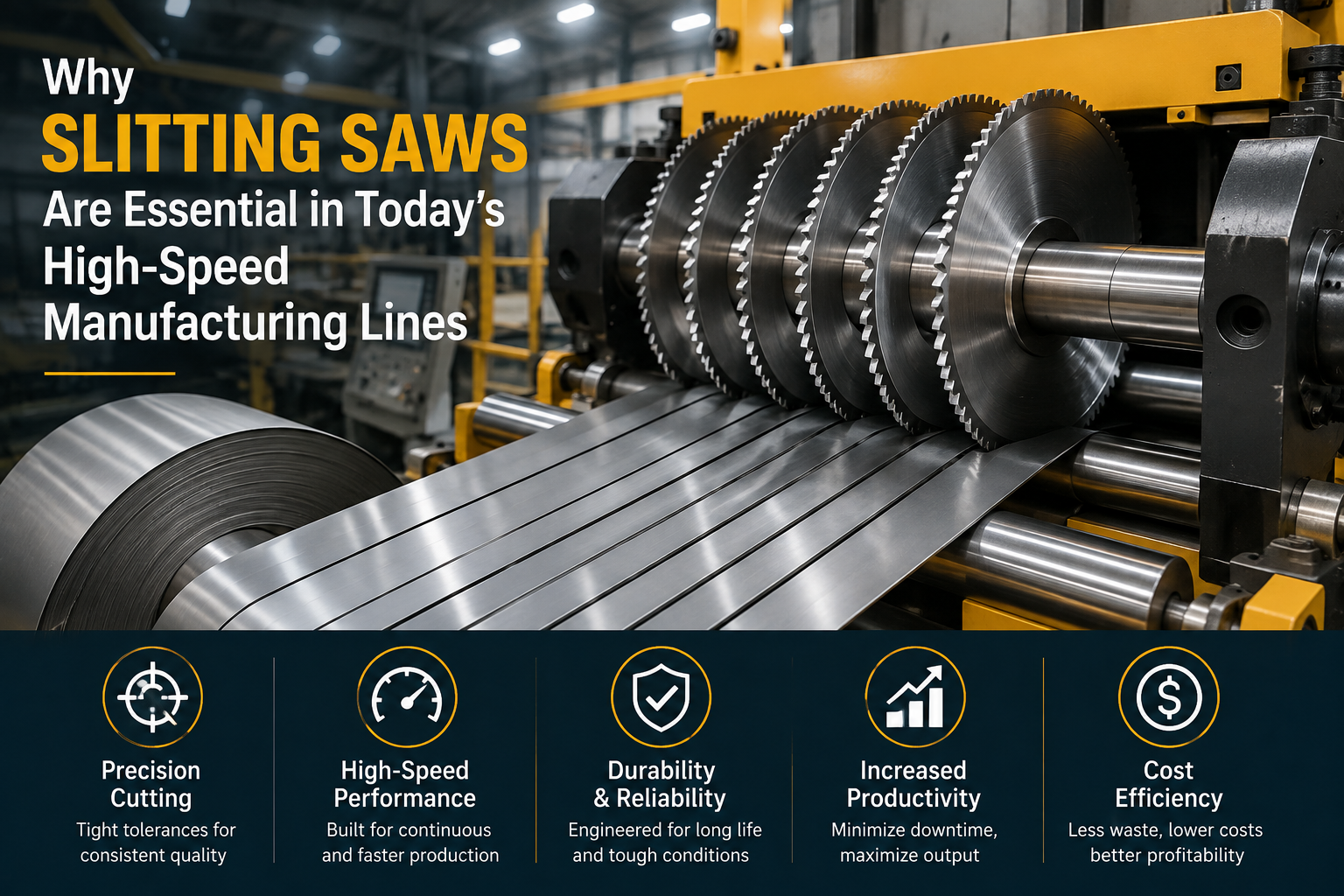
- Sheet and coil processing – some slitting operations are integrated directly into coil lines, where material is slit into narrower strips as part of continuous processing rather than as a secondary operation.
Because the tool serves such different applications, tooth form matters as much as diameter. Form “A” teeth, which are flat-ground, are generally chosen for fine, precise work such as screw slitting. Form “B” and staggered-tooth designs are better suited to deeper cuts or coarser feeds, since the alternating tooth angles create shearing action and leave more room for chip clearance. Choosing the wrong tooth form for the job is one of the more common reasons a blade underperforms, even when the blade itself is properly manufactured.
Material Selection and Blade Life
Most slitting saws used in metalworking are made from high-speed steel, commonly designated M2, M35, or M42, each offering a different balance of hardness, toughness, and heat resistance. M2 is a general-purpose grade suitable for a wide range of steels and non-ferrous metals. M35 adds cobalt content, which improves heat resistance and makes it more suitable for harder alloys. M42, with a higher cobalt content still, is typically reserved for the most demanding materials where edge retention under heat is a priority.
Blade life depends on more than the steel grade alone. Several factors influence how long a slitting saw stays productive before it needs sharpening or replacement:
- Feed rate and spindle speed – running too fast for the material being cut accelerates edge wear and can cause chatter.
- Coolant application – inconsistent or insufficient coolant flow leads to localized heat buildup, which softens the cutting edge over time.
- Material hardness variability – inconsistent stock hardness, common in some cold-rolled and hot-rolled steels, causes uneven wear across the tooth line.
- Arbor fit and runout – a loose or misaligned arbor introduces vibration, which shows up as poor surface finish and premature tooth chipping.
- Chip evacuation – blades used for deep grooving without adequate chip clearance tend to reload chips into the cut, increasing friction and heat.
Plants that track these variables tend to get more consistent tool life out of their slitting saws, regardless of which manufacturer supplies the blade.
Common Causes of Poor Cutting Performance
When cut quality drops or blade wear accelerates faster than expected, the cause is often traceable to a handful of recurring issues rather than a defect in the blade itself:
- Incorrect tooth form for the material or cut depth
- Coolant not reaching the actual point of contact
- Spindle speed set for a different material than what is being cut
- Blade mounted with excessive runout
- Feed rate increased to compensate for a dull blade, which worsens the problem
Diagnosing these issues before replacing a blade often resolves performance complaints without any change in tooling.
Safety and Handling Considerations
Slitting saws are thin relative to their diameter, which makes them efficient cutters but also more sensitive to mishandling than thicker blades. Operators should check for consistent tooth condition before mounting, confirm the arbor is properly torqued, and avoid exceeding the manufacturer’s rated speed for the blade diameter and material. Storage matters as well; blades left loose in a drawer are prone to chipped teeth, which then result in inconsistent cuts once mounted.
Where Sourcing and Specification Come Into Play
Because slitting saws are specified by diameter, thickness, bore size, and tooth form, procurement teams often work from technical drawings rather than general descriptions. Manufacturers such as Maxwell Slitter Industries produce slitting saws across these specification ranges, including the M2, M35, and M42 grades referenced above, which reflects how tightly this category of tooling is tied to exact application requirements rather than a one-size-fits-all product. For plants running high-mix production, having access to a range of slitting saw configurations reduces the need to redesign a process around whatever blade happens to be in stock.
Conclusion
The slitting saw is not a new tool. Still, its role in high-speed manufacturing has become more defined as production lines demand repeatability, shorter cycle times, and fewer manual corrections. Its value comes from precision and consistency rather than versatility, which is exactly what high-volume operations need. Selecting the right tooth form, matching the steel grade to the material being cut, and maintaining proper feed, speed, and coolant conditions all play a larger role in performance than the blade brand alone.
Frequently Asked Questions
What is the difference between a slitting saw and a regular saw blade?
A slitting saw is a thin, precision-ground circular blade designed for milling machines, used for narrow, repeatable cuts. General-purpose saw blades are typically thicker and less suited to tight-tolerance work.
What tooth form should be used for deep grooving?
Staggered tooth designs are generally better suited to deep cuts, since the alternating angles improve chip clearance and reduce heat buildup compared to plain-tooth forms.
Why does a slitting saw wear out faster in some applications than others?
Wear rate depends on material hardness, feed and speed settings, coolant delivery, and arbor alignment, not solely on the blade’s steel grade.
Can the same slitting saw be used across different materials?
It depends on the steel grade and tooth form. A blade suited to mild steel may not perform well on harder alloys without adjusting feed rate and coolant strategy, and in some cases a different grade such as M35 or M42 is more appropriate.
Does blade diameter affect cutting accuracy?
Yes. Larger diameters can introduce more runout if not properly mounted, so bore fit and arbor alignment become more critical as diameter increases.
About The Author