




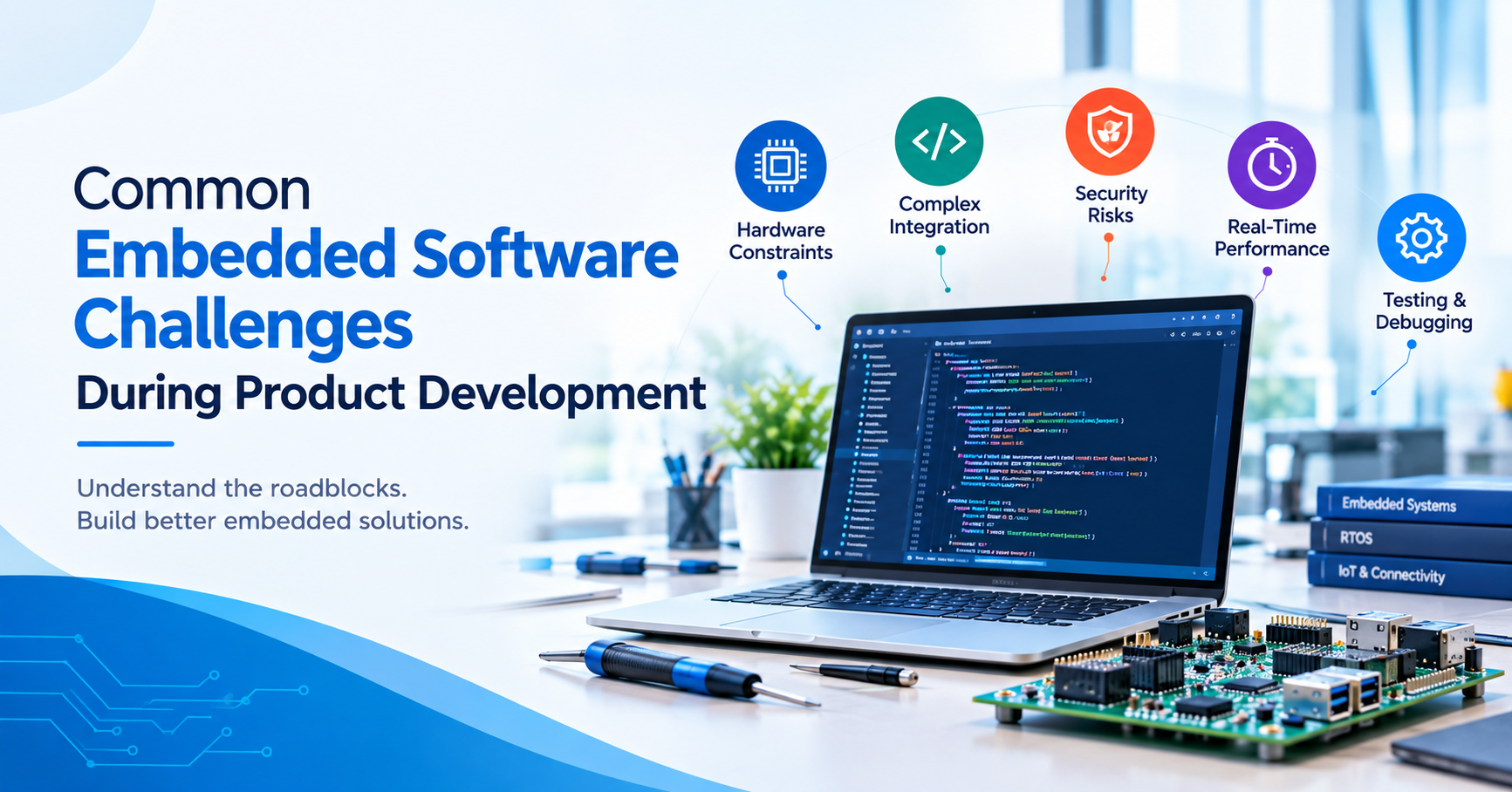
Only about 44% of embedded systems projects ship on time, according to Design News’ analysis of engineering survey data from Beningo Embedded Group. That number has barely moved in two decades, even as microcontrollers got faster and development tools got smarter. For a CTO, CIO, or business owner building a connected device, industrial controller, or piece of medical equipment, this isn’t a trivia stat. It’s a budget line and a launch date.
Embedded software sits underneath almost everything a smart product does: reading sensors, driving motors, managing wireless connections, keeping data secure. When that layer breaks or slips behind schedule, no amount of good industrial design or a polished mobile app can save the launch. This article looks at where embedded projects actually go wrong, why in-house teams struggle to fix them alone, and how the right embedded software development consulting services partner keeps hardware programs on schedule.
Where Embedded Software Projects Actually Go Wrong
Embedded development is not the same discipline as building a web app or a mobile client. The constraints are physical, not just logical, and that changes how projects fail.
Hardware and Software Move on Different Clocks
Firmware teams often start writing code before the final PCB revision exists. When a pin mapping changes or a sensor gets swapped for a cheaper part late in the design cycle, software has to catch up fast. Businesses that treat hardware and firmware as separate workstreams, handed off sequentially instead of developed together, tend to absorb these changes as costly rework instead of minor adjustments.
Real-Time Performance Has No Room for Guesswork
A payment terminal, an industrial sensor, or an EV battery management unit cannot tolerate a missed timing window the way a web server can shrug off a slow response. Engineers have to account for interrupt latency, memory constraints measured in kilobytes, and power budgets down to the milliamp. Teams without deep real-time operating system experience frequently discover these constraints only after the first hardware prototype starts misbehaving under load.
Skill Gaps and Fragmented Toolchains
Embedded work spans Embedded-C, RTOS platforms like FreeRTOS and Zephyr, board support packages, and protocol stacks such as CAN, I2C, and BLE. Few in-house teams carry deep bench strength across all of it. VDC Research has flagged this exact pattern for years: specification changes, application complexity, and thin engineering headcount are consistently among the top reasons embedded schedules slip.
Security and Compliance Are Now Table Stakes
A connected medical device or industrial controller has to defend against firmware tampering, insecure over-the-air updates, and unauthorized access, while also meeting standards like IEC 62304 or ISO 26262 depending on the industry. One mid-size medical device manufacturer we’ve seen in the field learned this the hard way: a rushed OTA update mechanism without signed firmware verification led to a field recall that cost far more than proper security architecture would have upfront.
Testing Only Goes So Far in Simulation
Unit tests on a desktop simulator catch logic bugs, but they miss the failure modes that show up on real silicon: voltage sag, electromagnetic interference, thermal drift. Hardware-in-the-loop testing is expensive to set up, so many internal teams skip it until late in the cycle, when problems are hardest and most expensive to fix.
Legacy Code and Undocumented Systems
Plenty of industrial and automotive businesses are not starting from a blank slate. They’re maintaining a codebase written a decade ago by an engineer who has since left the company, with sparse comments and no test coverage. Extending that code safely, without introducing a regression that bricks a device already deployed in the field, takes a different skill set than greenfield development. Reverse-engineering intent from undocumented C code, then wrapping it in tests before touching it, is slow and easy to underestimate when scoping a project.
How Professional Embedded Development Solves These Problems
A team that lives in this discipline day to day approaches the same constraints differently. Structured embedded software development work builds in the safeguards that ad hoc internal efforts usually skip.
Board support package specialists port and optimize the bootloader and kernel for your specific silicon instead of forcing a generic reference design to work. Firmware architects design around your actual timing budget from day one, running hardware-in-the-loop tests before the design is locked, not after. Security is built into the architecture: signed firmware, dual-bank bootloaders for rollback protection, and encrypted communication channels, rather than added as an afterthought once auditors start asking questions.
This is also where domain-specific engineering experience pays off. A firm that has already shipped BLE-connected wearables, industrial IIoT gateways, or automotive telematics units has already hit the edge cases your team hasn’t encountered yet. That experience compresses the debugging cycle from weeks to days.
Legacy systems get the same disciplined treatment. Rather than rewriting an aging codebase from scratch, an experienced team profiles it first, builds a regression test harness around the existing behavior, then refactors incrementally. That approach protects a product already generating revenue while still paying down technical debt, instead of forcing a risky big-bang rewrite that can stall a business for a year or more.
Business Benefits and Outcomes
The value of getting embedded software right shows up in numbers a CFO cares about, not just in engineering satisfaction.
- Faster time to market. Parallel hardware and firmware development, instead of sequential handoffs, can cut months off a product’s path to launch.
- Lower field failure costs. A single firmware recall on a connected device, especially in medical or automotive, routinely runs into six or seven figures once you count logistics, support, and reputational damage. Getting OTA and security architecture right the first time avoids that bill entirely.
- Predictable engineering spend. Fixed-scope or dedicated-team engagement models with an outside partner replace the unpredictable cost curve of an in-house team improvising its way through unfamiliar toolchains.
- Scalability built in from day one. Middleware and modular driver architecture designed by experienced embedded development services teams make it far cheaper to add a new sensor, port to a new chip family, or support a second product SKU later.
- Regulatory readiness. MISRA-C compliance, static analysis, and documented traceability aren’t retrofitted at audit time; they’re part of the build process from the start, which shortens certification timelines for regulated industries.
- Longer product lifespan. Devices architected with clean hardware abstraction layers and modular drivers are easier to patch and extend for years, instead of being scrapped for a full redesign the moment a single component goes end-of-life.
Global demand backs this up. The embedded software market was valued near $20.7 billion in 2024 and is projected to grow at roughly 9.6% annually through 2034, according to Global Market Insights, driven largely by IoT, medical devices, and Industry 4.0 automation. Businesses that get embedded execution right now are positioning themselves for a market that keeps expanding.
Implementation Considerations Before You Start
Before committing budget to an embedded software initiative, a few decisions shape the entire project and are worth settling early.
- Define your RTOS and processor architecture first. Whether you’re on bare-metal C, FreeRTOS, Zephyr, or embedded Linux changes the entire engineering approach and the skill set you need on the project.
- Decide who owns firmware IP and source code. This should be spelled out in the contract before development starts, not negotiated after the product ships.
- Plan your OTA and field-update strategy up front. Retrofitting secure update capability into a device already in the field is far more expensive than designing it in from the first firmware build.
- Budget for hardware-in-the-loop testing. It costs more early, but it catches the failure modes that simulation environments cannot.
- Map compliance requirements to your industry. Medical, automotive, and industrial applications each carry different certification paths (IEC 62304, ISO 26262, IEC 61508), and the engineering approach should reflect that from the architecture phase, not just at final testing.
Why the Right Technology Partner Matters
Not every software vendor that lists “embedded” on their website has actually shipped a certified medical device or an automotive-grade CAN bus stack, and choosing embedded services based on a sales pitch alone is how businesses end up back at square one six months in. When you’re evaluating an embedded company, a few things separate a real partner from a generic shop.
Look for engineers who can talk fluently about board support packages, not just application-layer code. Ask for examples of products they’ve taken from prototype to production, including what went wrong and how they handled it. Confirm they have hands-on experience with the specific processor architecture and RTOS your product needs, whether that’s ARM Cortex-M, ESP32, or a custom silicon platform. And check whether their process includes security architecture and compliance testing as a built-in step, not a bolt-on service added after a client asks.
A partner worth keeping long-term will also be transparent about trade-offs. If a vendor claims every architecture decision is easy or every timeline is flexible, that’s usually a sign they haven’t shipped enough real hardware to know better.
Final Thoughts
Embedded software challenges are not going away as products get smarter and more connected. What changes is how prepared a business is to handle them. Teams that treat firmware as a first-class engineering discipline, backed by the right partner and the right process, consistently ship faster, spend less on field failures, and scale their products with far less friction.
If your team is weighing whether to build embedded capability in-house or bring in outside expertise, it’s worth a conversation before the next hardware revision locks in. The right partner should be able to walk through your specific architecture and timeline constraints and give you a candid read on where the risk actually sits.
About The Author