



Moving heavy equipment, carts, racks, worktables, and industrial containers becomes much easier when the right caster is installed. Although casters may look like simple wheels, their design directly affects how smoothly an object moves, how much weight it can safely carry, and how well it performs on a particular floor surface.
Choosing a caster based only on wheel size or price can create problems later. A poorly matched caster may make equipment difficult to push, damage flooring, create excessive noise, or fail prematurely under repeated loads. Understanding the basic components and selection criteria makes it much easier to choose a setup that performs reliably.
What Is a Caster and How Does It Work?
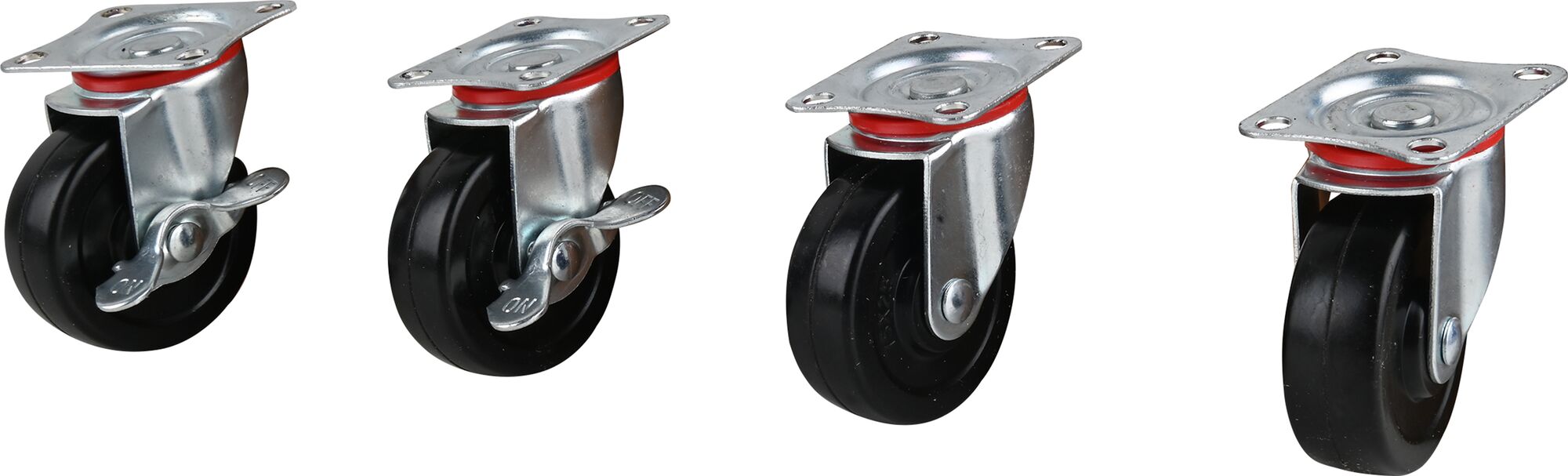
A caster is a wheel assembly attached to the bottom of equipment to allow it to roll instead of being dragged or lifted. Casters are commonly found on warehouse carts, medical equipment, industrial workstations, tool cabinets, material-handling equipment, furniture, and mobile platforms.
A typical caster consists of several important components:
- Wheel: The part that contacts the floor and supports the load.
- Mounting plate or stem: Connects the caster to the equipment.
- Fork or bracket: Holds the wheel in position.
- Swivel mechanism: Allows the wheel assembly to rotate when maneuvering.
- Brake: Prevents movement when the equipment needs to remain stationary.
There are two broad categories: rigid casters and swivel casters. A rigid caster moves in a straight line, while a swivel caster can rotate, making it useful when equipment needs to change direction frequently. Many carts use a combination of both.
How to Select the Right Caster Step by Step
Selecting a caster should start with the application rather than the wheel itself. The following process can help narrow down the appropriate design.
1. Determine the Total Load
First, calculate the combined weight of the equipment and everything it will carry.
For example, suppose a mobile workbench weighs 200 pounds and regularly carries 600 pounds of tools and materials. The working load is 800 pounds.
If the equipment uses four casters, dividing 800 by four gives 200 pounds per caster. However, it is generally unwise to select casters rated at exactly 200 pounds each. Uneven floors, sudden impacts, and uneven weight distribution can place substantially more force on an individual wheel.
A safety margin is therefore important. Selecting a caster with a higher load rating can improve reliability and reduce premature wear.
2. Evaluate the Floor Surface
Floor conditions have a major influence on caster performance.
Smooth concrete, tile, sealed floors, carpeting, and rough industrial surfaces all create different rolling conditions. Hard wheels may perform well on smooth surfaces but transmit more vibration and potentially damage sensitive flooring.
For environments where floor protection and quiet operation matter, resilient rubber or polyurethane wheels may be more appropriate. In demanding industrial environments, materials such as nylon, steel, or specialized polyurethane can provide different combinations of durability, load capacity, and resistance to chemicals.
The important question is not simply, “Which wheel is strongest?” It is, “Which wheel material fits this floor and application?”
3. Consider Wheel Diameter
Wheel diameter affects how easily equipment rolls over obstacles and uneven surfaces.
Larger wheels generally roll more easily over cracks, thresholds, debris, and small floor imperfections. Smaller wheels can work well for compact equipment used on smooth floors where overall height is a concern.
For example, a small office cart used exclusively on smooth flooring may not need a large industrial wheel. A warehouse cart crossing expansion joints and rough concrete, however, can benefit significantly from additional wheel diameter.
4. Choose Between Swivel and Rigid Casters
Think about how the equipment will move.
If the cart primarily travels along a straight path, rigid casters can provide stable directional movement. If it needs to maneuver around workstations, shelving, or machinery, swivel casters make directional changes easier.
A common configuration uses two rigid casters and two swivel casters. Other applications may benefit from four swivel casters, particularly where tight maneuverability is more important than straight-line tracking.
5. Decide Whether Brakes Are Necessary
Brakes are useful when equipment must remain securely positioned during loading, unloading, or use.
A wheel brake typically prevents the wheel from rolling, while a total-locking swivel brake can also prevent the caster from rotating. This distinction matters for equipment such as mobile workstations where the operator needs the platform to stay firmly in place.
A brake should not be considered a substitute for proper equipment stabilization. Heavy or elevated equipment may require additional safety measures.
Common Caster Mistakes and Challenges
One of the most common mistakes is selecting a caster based solely on its advertised load capacity. Laboratory or manufacturer ratings may be based on specific test conditions that do not perfectly represent real-world use.
Another mistake is ignoring push force. A cart can technically support its load but still be unpleasant or unsafe to move. Wheel material, diameter, bearings, floor condition, and load distribution all affect how much force an operator needs.
Height is another frequently overlooked factor. Replacing a small caster with a larger one can raise the equipment several inches. That may affect countertop height, center of gravity, clearance, or access to surrounding equipment.
Environmental conditions also matter. Exposure to water, oils, chemicals, extreme temperatures, or outdoor conditions can affect wheel materials and metal components. A caster suitable for a dry warehouse may not be appropriate for a washdown area.
Practical Tips for Better Caster Performance
Start by observing how the equipment is actually used. If workers frequently push carts across thresholds, prioritize wheel diameter and rolling performance. If the equipment remains stationary most of the time, locking mechanisms may deserve greater attention.
Distribute weight as evenly as possible. A cart carrying most of its load on one side can create uneven stress even when the total weight appears to be within the caster specifications.
Inspect casters regularly. Look for:
- Flat spots or damaged wheels
- Excessive tread wear
- Loose mounting hardware
- Noisy or rough bearings
- Bent forks
- Brake mechanisms that no longer hold properly
- Debris wrapped around the wheel or axle
Cleaning can also make a noticeable difference. Hair, wire, packaging material, and other debris can accumulate around axles and interfere with smooth rotation.
For frequently moved equipment, consider the operator’s experience as part of the selection process. A caster that requires excessive pushing force can contribute to fatigue, particularly when employees move the same equipment repeatedly throughout a shift.
Conclusion
The right caster is more than a wheel attached to the bottom of a cart. Its wheel material, diameter, load capacity, mounting design, swivel behavior, and braking system all influence safety and usability.
A reliable selection process starts with the total load, floor conditions, movement requirements, available clearance, and operating environment. From there, the appropriate wheel and mounting configuration can be chosen with a reasonable safety margin.
Whether the application involves a lightweight utility cart or heavy industrial equipment, taking time to match the caster to the actual working conditions can improve maneuverability, reduce maintenance, protect floors, and extend equipment life.
About The Author