




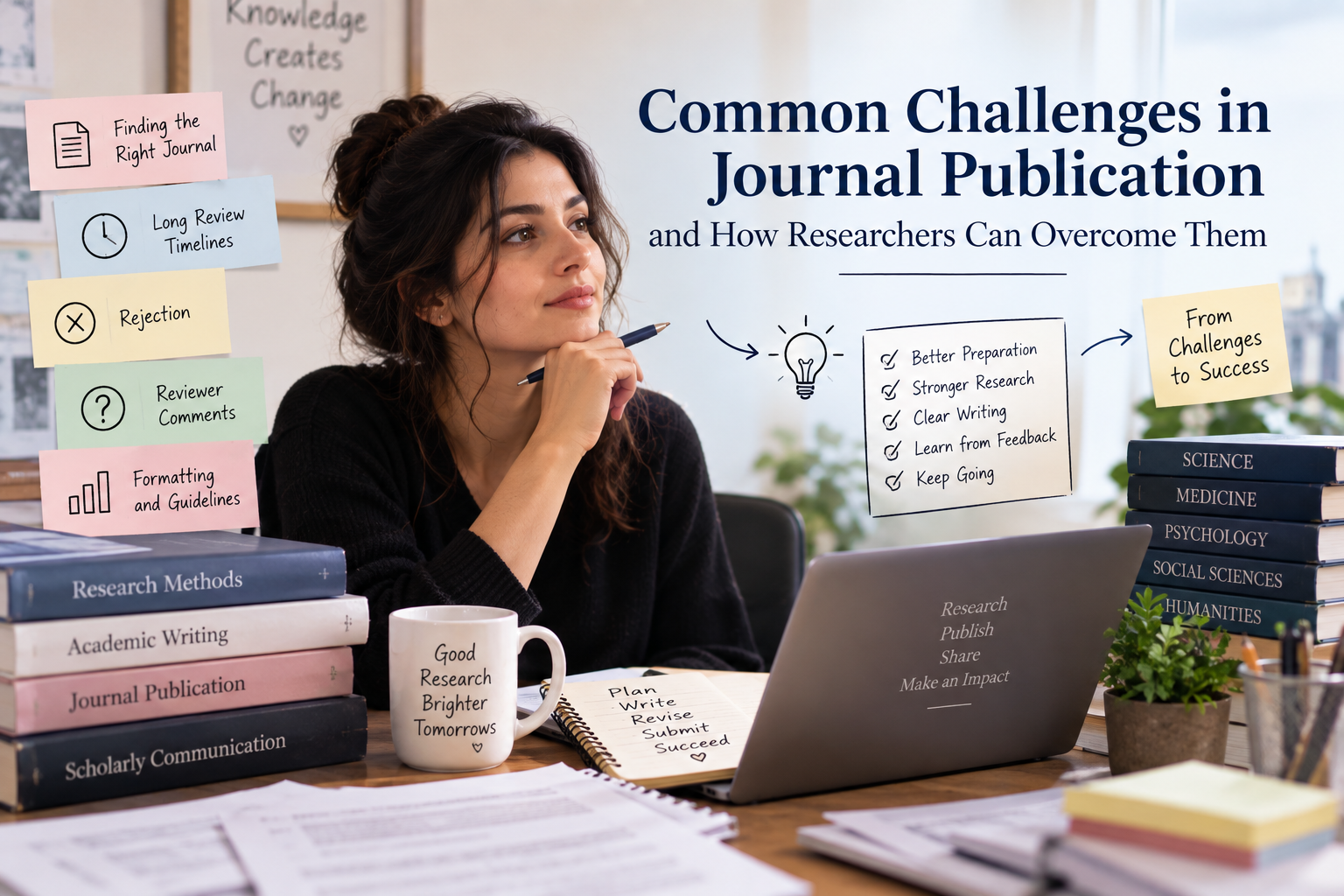
Having a complete research paper does not mean that you won’t face any challenges during the journal publication process. Most of the researchers trying to publish their research face some common challenges that are due to a lack of guidance, knowledge, or not knowing the correct steps to follow. In this blog, we are going to explain the common problems the researchers face and how they can overcome them and use publication services.
Finding the Right Journal
The first step in journal publication is finding the right journal. However, many people face challenges as they don’t have any idea how they can find the right journal and what simple steps are.
Mistake: Not Checking the Journal Scope
The biggest mistake is sending your manuscript to every journal you can find. A journal may be reputable, but it does not mean that it is the most suitable for your research paper.
Solution: Compare Your Research with the Journal
Always read the aims and scope of the journal before submitting it. You can also check the recent papers they have published and whether they cover the same topics as yours or not. You should also check the journal’s subject area, article type, and its target readers.
Checking Journal Credibility
The credibility of the journal is important if you want to get your research recognized and get cited by other researchers. Researchers also need to check that the journal’s claims about indexing and publication are accurate.
Mistake: Trusting Every Claim
Don’t trust the information that is displayed on the journal’s website. You need to be able to confirm if those claims are true or not.
Solution: Verify the Information
Verify indexing claims using the appropriate official database. The publisher, editorial board, peer-review procedure, publication history, and costs should all be examined. Journals that guarantee acceptance or promise exceptionally fast publication should be avoided.
Following Journal Guidelines
Preparing the paper in accordance with the journal’s standards is another frequent difficulty. Using the same structure for every submission could lead to issues because various journals may have different rules.
Mistake: Using the Same Format Everywhere
Without reviewing the most recent criteria of the publication, researchers may submit a work. The word count, references, figures, tables, and paper structure may all suffer as a result.
Solution: Read the Author Guidelines
Before submitting, review the journal’s requirements. Examine the word count, abstract format, file types, references, figures, tables, and necessary declarations. You can avoid basic formatting issues and keep your manuscript from being returned by adhering to these guidelines.
Dealing With Manuscript Rejection
Although it can be disheartening, rejection does not always indicate that your study is flawed. After some revisions or enhancements, your paper might still be appropriate for another publication.
Mistake: Treating Rejection as the End
After being rejected, some researchers believe their work is worthless. Some submit the same work to a different journal without reading the comments.
Solution: Understand the Reason
Carefully consider the editor’s choice. Try another appropriate journal if the paper doesn’t fit there. If reviewers discovered issues with the writing, analysis, or methodology, address them before resubmitting. You can also identify any shortcomings you may have overlooked with the help of reviewer input.
Managing Reviewer Comments
Research publication is also difficult because researchers are intimidated by the reviewers’ comments and the required changes. Reviewers can ask to add additional explanation or ask for different interpretations of the findings.
Mistake: Responding Without Understanding
Don’t make changes or reply to the reviewers in a rude tone without fully understanding the comments. Many researchers get disappointed by looking at a long list of changes, and they don’t go through with the publication process.
Solution: Address Each Comment
Read all the comments carefully and don’t reply immediately. Take time to understand one comment and cross-check it with your research. Then take time to patiently type a reply. When sending the revised manuscript, make sure to add an explanation about what was changed and where. Also add that if you disagree with a suggestion, then explain your side with proof. You can also get help from academic journal publication services if you feel this process is too complex or time-consuming.
Keeping Claims Within the Evidence
When a paper’s conclusions surpass its actual findings, it may have issues. Because they are confident in their findings, researchers might make more expansive assertions than the study can back up. It is crucial to base conclusions on the evidence and refrain from making assertions that the study cannot support.
Mistake: Making Very Broad Claims
For instance, the results of a study that uses small samples from a single university shouldn’t be used as proof for all college students. The findings might only be relevant to the group or environment under study.
Solution: Check Your Conclusions
Before turning in the paper, go over your findings and discussion. Make sure your main claims are supported by your findings. Describe your study’s limitations as well. Your research is not weak because of this. It demonstrates that you are aware of what your research can and cannot demonstrate.
Managing Publication Costs
Journals have publication fees that might create difficulty for some researchers. It is important to check the costs before submitting
Mistake: Checking Fees After Acceptance
Many researchers apply to journals and check the fee after getting accepted. Don’t make the mistake of going through such a long and time-consuming process only to end up not being able to afford the publication or article processing charges.
Solution: Check Costs Early
Check the journal’s official fee information. Find out the charges and article processing fee and whether there are any additional costs. Knowing this will help in making a practical decision.
Improving the Chances of Publication
There is not a single step that will guarantee publication. Even strong research papers get rejected if the journal is not the right fit. So instead of going through too much work, select the right journal. Also, make sure that you check their credibility and charges before submitting.
Conclusion
There are many challenges that come with journal publication, but many of them can be managed if the researchers have a proper plan and preparation. Choosing the right journal, following its guidelines, and getting help, when necessary, can make the process much easier. Never be disappointed by rejection but keep applying to appropriate journals.
About The Author