



Introduction
You may have searched for an event course ten times already and still feel confused. Diploma? PG diploma? Certificate? One-year program? And every institute seems to describe its course as the perfect career option.
Honestly, the names can make things more complicated than they need to be.
A diploma event management program can be a useful starting point if you want to understand how events are actually planned, organized, and executed.
But the course title isn’t what makes the training useful.
The syllabus, practical exposure, faculty, projects and industry experience matter much more. So, let’s look at what you should realistically expect from a course and where a post-graduate option fits in.
What Is an Event Management Diploma Really About?
At the simplest level, event management is about taking an idea and turning it into something that actually happens.
Sounds easy.
It isn’t always.
There could be a venue to arrange, vendors to coordinate, guests to manage, a budget to control, technical requirements to check and a client who changes their mind two days before the event.
A proper diploma event management program should introduce students to these different parts instead of focusing only on the creative side of events.
Current event-management curricula commonly cover planning, budgeting, marketing, production, logistics, public relations, sponsorship, hospitality, permissions and team management. AICTE’s model curriculum includes many of these areas, showing that event education is much broader than simply planning parties or weddings.
That’s an important distinction.
Event management is creative, yes. But it’s also operations, money, people and deadlines.
What Will You Actually Study?
The exact syllabus depends on the institute, but most useful programs have a few common areas.
You’ll learn event planning and concept development. Then you’ll move into budgeting, sponsorship and marketing.
After that comes the less glamorous stuff — logistics, production, permissions, hospitality and vendor coordination.
And you really need that part.
A current one-year diploma structure at NAEMD, for example, includes event planning, sponsorship and budgeting, marketing and branding, team management, production, logistics, hospitality, law, permissions, wedding planning and practical training.
These subjects connect with each other.
Imagine you’re organizing a corporate product launch.
The client wants a certain venue. The venue has timing restrictions. Your production team needs setup time. The caterer needs access. Sponsors want branding space. Guests need parking.
One decision affects five other decisions.
That’s what you’re really learning to manage.
Practical Training Is More Important Than It Sounds
Here’s where I’d be a little careful when comparing courses.
A brochure can say “practical training” very easily.
But what does that actually mean?
Does it mean students attend a few events? Do they work on a live project? Are they involved in planning? Do they create budgets and timelines? Is there an internship?
Those questions matter.
IGNOU’s Diploma in Event Management, for example, describes both theoretical and practical learning, and its practicum material specifically encourages learners to attend events and observe event companies as part of their practical activities.
That’s the kind of practical thinking beginners need.
You can read about event coordination for three months and still feel completely lost at your first live event.
Then you learn very quickly.
What Makes a Good Diploma Program?
A good diploma event management program should gradually move from basic concepts to practical decision-making.
You should understand how to prepare an event proposal.
You should know how a budget is built.
You should understand the relationship between a venue, vendor and production team.
You should be able to prepare a basic event timeline.
And you should know what happens before, during and after an event.
Communication deserves special attention too.
You might be technically excellent, but if you can’t explain a requirement to a vendor or handle a client’s question calmly, event work becomes difficult very quickly.
That’s why communication and presentation skills appear in many event-management course structures. NAEMD’s current diploma curriculum, for instance, includes communication, PR and presentation skills alongside planning and operations.
What About a Post Graduate Event Management Course?
This is where students often get confused.
A post graduate event management course is generally designed for people who have already completed graduation, although eligibility varies by institute.
The idea is usually to go deeper into event planning, management and industry operations.
For example, NAEMD’s PG diploma lists graduation in any stream as eligibility and includes areas such as event planning, sponsorship, budgeting, marketing, crew management, production, logistics, legal aspects, MICE and corporate events.
Other programs can have different structures.
NIPPS currently lists a 12-month PG Diploma in Event Management covering planning, budgeting, marketing, logistics, corporate and MICE events, weddings, event technology, risk management and legal considerations.
So if you’re a graduate, don’t automatically assume that a basic diploma is your only option.
Compare the level of the course with where you are academically and professionally.
Diploma vs Post Graduate Course
There isn’t one route that works for everyone.
| Typical entry point | Often after 12th | Usually after graduation |
| Learning level | Foundation to practical | More specialised |
| Main focus | Core event skills | Deeper management and operations |
| Suitable for | Beginners | Graduates / career switchers |
| Practical work | Depends on institute | Often includes projects or exposure |
| Career starting point | Entry-level roles | Entry-level to specialised roles |
Don’t read the table as “PG is automatically better.”
That’s not how education works.
If someone has just finished Class 12, a diploma may make perfect sense. A graduate looking for a career switch may prefer a postgraduate program.
Your starting point matters.
Can You Specialize in Weddings?
Yes, and plenty of people enter event management specifically because weddings interest them.
But wedding planning is not just choosing flowers and colour themes.
There’s guest management, vendor coordination, schedules, food, entertainment, transport, decor, photography and client communication.
One delayed vendor can affect the entire timeline.
A current diploma curriculum at NAEMD includes wedding planning and special events, while other event-management programs also include weddings as part of broader event training.
If weddings are your target, look for a course where you actually learn the operational side, not just wedding decoration.
Corporate Events Are a Different Game
Corporate events have their own rhythm.
Conferences, seminars, product launches, exhibitions and MICE events usually involve more formal client requirements, branding guidelines, schedules and stakeholder coordination.
You may have senior executives arriving at a particular time. Speakers need technical support. Branding has to be correct. Seating plans matter.
One small mistake can become very visible.
That’s why corporate event management usually requires strong organization and communication skills.
A good diploma event management program should at least introduce you to these different event categories so you can figure out where you fit.
Skills You’ll Need Beyond the Classroom
A certificate won’t teach you everything.
Some skills only become comfortable with repetition.
You need to get better at:
- Communication
- Time management
- Budgeting
- Negotiation
- Vendor coordination
- Team management
- Problem-solving
- Client handling
- Basic digital tools
- Event documentation
And there’s one more thing.
Stay calm.
Events can get chaotic. If you’re the person panicking every time something changes, the job becomes much harder.
That doesn’t mean you need to be naturally fearless. You just need to learn how to think when things don’t go according to plan.
Where Does iemworld Fit Into Your Research?
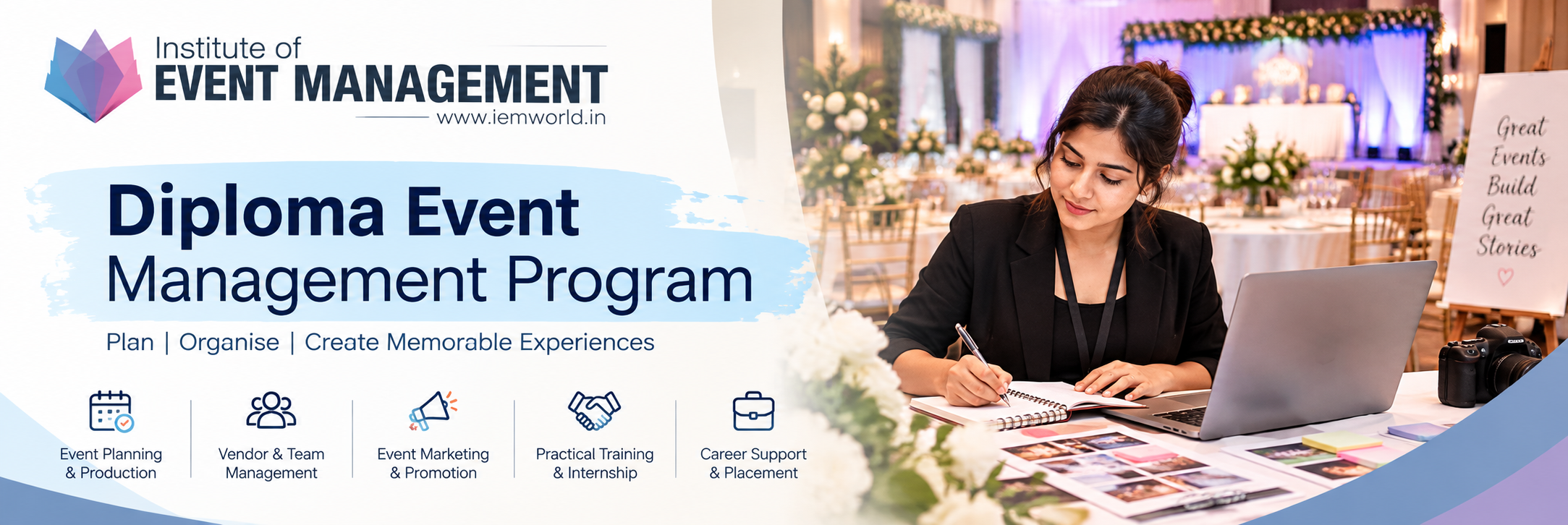
If you’re comparing event-management institutes, you may come across iemworld while researching different course options.
The same rule applies here as with any institute: don’t judge a course only by its name or promotional material.
Look at the syllabus.
Check the practical component.
Ask about internships and live projects. Understand the total fee. Find out who teaches the course and what kind of industry exposure students actually receive.
If you’re considering an IEM diploma program, make a simple comparison with two or three alternatives before enrolling.
It takes a little time.
Worth it.
What Kind of Jobs Can You Explore?
A diploma event management program can prepare you for entry-level roles in different areas of the industry.
You might begin as an event coordinator, event executive, production assistant, client servicing executive or wedding planning assistant.
Later, with experience, you can move toward event planning, production management, corporate events, exhibitions, weddings or brand activations.
IGNOU currently lists career areas including event planner, wedding planner, corporate event manager, venue manager and corporate event coordinator among the potential prospects for its diploma.
Don’t expect to walk into a senior event-manager position immediately after a course.
Realistically, you have to build experience.
And that’s okay.
The first few events are where you learn how the industry actually works.
What Should You Check Before Enrolling?
Before paying the fee, ask some very boring questions.
Boring is good here.
How long is the course?
What exactly is included?
How much practical work is there?
Is the internship compulsory?
Are live events part of the training?
What additional costs might come up?
What does “placement assistance” actually mean?
Can you see examples of previous student projects?
Don’t be shy about asking.
A current Delhi University short-term event-management course, for example, clearly separates theory and practical training and includes an event project as part of its assessment.
That kind of detail is much more useful than simply seeing the word “industry-oriented” on a webpage.
Expert Insight
“In event management, the plan is important, but your ability to adjust when the plan changes is what people remember.”
That’s something beginners usually understand only after their first few real events.
A Simple Way to Compare Courses
Don’t make your decision based only on course fees.
Create a small comparison sheet.
Write down the duration, syllabus, practical training, internship, faculty, projects and total cost for each institute.
Then look at what is actually missing.
One course might be cheaper but offer less practical exposure. Another might cost more but include structured industry training. A third might fit your schedule better.
There is no universal answer.
You need the option that makes sense for your starting point and career goal.
A Natural Next Step
If you’re serious about event management, shortlist a few institutes and speak to them directly.
Ask practical questions. Request the current syllabus. Understand what happens during the course, not just what happens at the end.
If you’re considering iemworld or an IEM diploma program, compare the details with other available programs before making your choice.
A little research now can prevent a lot of frustration later.
FAQs
What is a diploma event management program?
It is a structured course that teaches areas such as event planning, budgeting, marketing, production, logistics, coordination and event operations.
Can I join an event management diploma after 12th?
Yes. Many diploma programs accept students after Class 12, although eligibility depends on the institute and course. NAEMD’s current one-year diploma, for example, lists 10+2 as the eligibility requirement.
What is a post graduate event management course?
It is a postgraduate-level program for graduates that typically goes deeper into event planning, management, production, marketing, logistics and related areas.
Is practical training necessary in event management?
Very much. Events involve real people, deadlines, vendors and unexpected problems. Practical exposure makes the classroom knowledge easier to apply.
Can I become a wedding planner after a diploma?
Yes. Wedding planning is one possible career area, but you’ll also need practical experience, vendor knowledge, communication skills and strong organization.
What jobs can I get after an event management diploma?
Possible entry-level roles include event coordinator, event executive, production assistant, client servicing executive and wedding planning assistant.
Is an IEM diploma program suitable for beginners?
That depends on the specific program’s eligibility and curriculum. Check whether it starts with foundational concepts and how much practical training is included.
Conclusion
A diploma event management program could well be a rational option for joining the sector if you feel the need for practical and focused education, not academics again.
But don’t decide only based on the course name.
Instead, consider the practical assignments, internship opportunities, syllabus, the faculty, and exposure to the industry. If you are already a graduate, then weigh your choices between a post graduate event management course and a diploma.
And if you are exploring iemworld or IEM diploma program, apply the same logic. Compare first, ask questions, and then enroll.
About The Author