





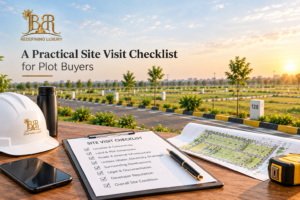
Quick answer: On a site visit, check the approach road, plot boundaries, drainage, nearby activity and the match between the plot and the layout plan. Carry documents, take photos and visit at more than one time of day.
Reading documents is only half the job. A visit shows what drawings cannot. This checklist helps you cover the basics.
Before you go
- Print the layout plan and mark your shortlisted plots.
- Note the RERA number to cross-check later.
- Charge your phone for photos and map pins.
- Carry a measuring tape if you can.
Reaching the site
- Note the route, the road condition and the travel time.
- Check whether the approach road is wide enough for construction vehicles.
- Observe traffic at the time you visit.
At the plot
- Locate the plot number on the ground and match it with the layout.
- Check the boundary markers on all sides.
- Look at the shape and level of the land.
- See where rainwater may collect.
- Check which side the road is on and its width.
Around the plot
- Note what is next to your plot: vacant land, other plots, open areas.
- Look for signs of building activity and utilities.
- Observe noise, dust and any nearby industry.
- Check how far schools, markets and hospitals are.
Development progress
- See the state of internal roads and drains.
- Look for electricity poles and water lines.
- Check whether the entry gate and boundary wall work is underway.
Talking to people
Speak with the site team about the schedule, and with nearby residents or shopkeepers about the area. Ask what has changed recently.
Documents to review on the spot
Ask to see the approved layout, RERA registration and a draft agreement. Check that the plot number, size and rate in these match.
Applying this at a specific project
If you are visiting a project such as the Kanvas Phase 1 project, check that the Phase 1 plot you like matches the layout, note the road in front of it, and compare the actual drive from NH27 with the distance you were told.
After the visit
Organise your photos and notes the same day. Compare your observations with the brochure and the documents. If anything is unclear, send questions by email.
Revisit before you decide
A second visit, at a different time of day and ideally during or after rain, gives you a more complete picture.
Final thought
A good site visit takes a couple of hours and can save you from costly surprises. Use this checklist, keep notes and revisit if needed. For project details to review before you go, see the Kanvas Phase 1 project on the developer’s website.
FAQs
What time is best for a visit? Daytime, with a second visit at a different hour.
Should I visit during rain? It is useful for checking drainage and access.
Can I bring a professional? Yes. An architect or engineer can give good advice.
How many visits are enough? At least two before you pay a token.
About The Author