





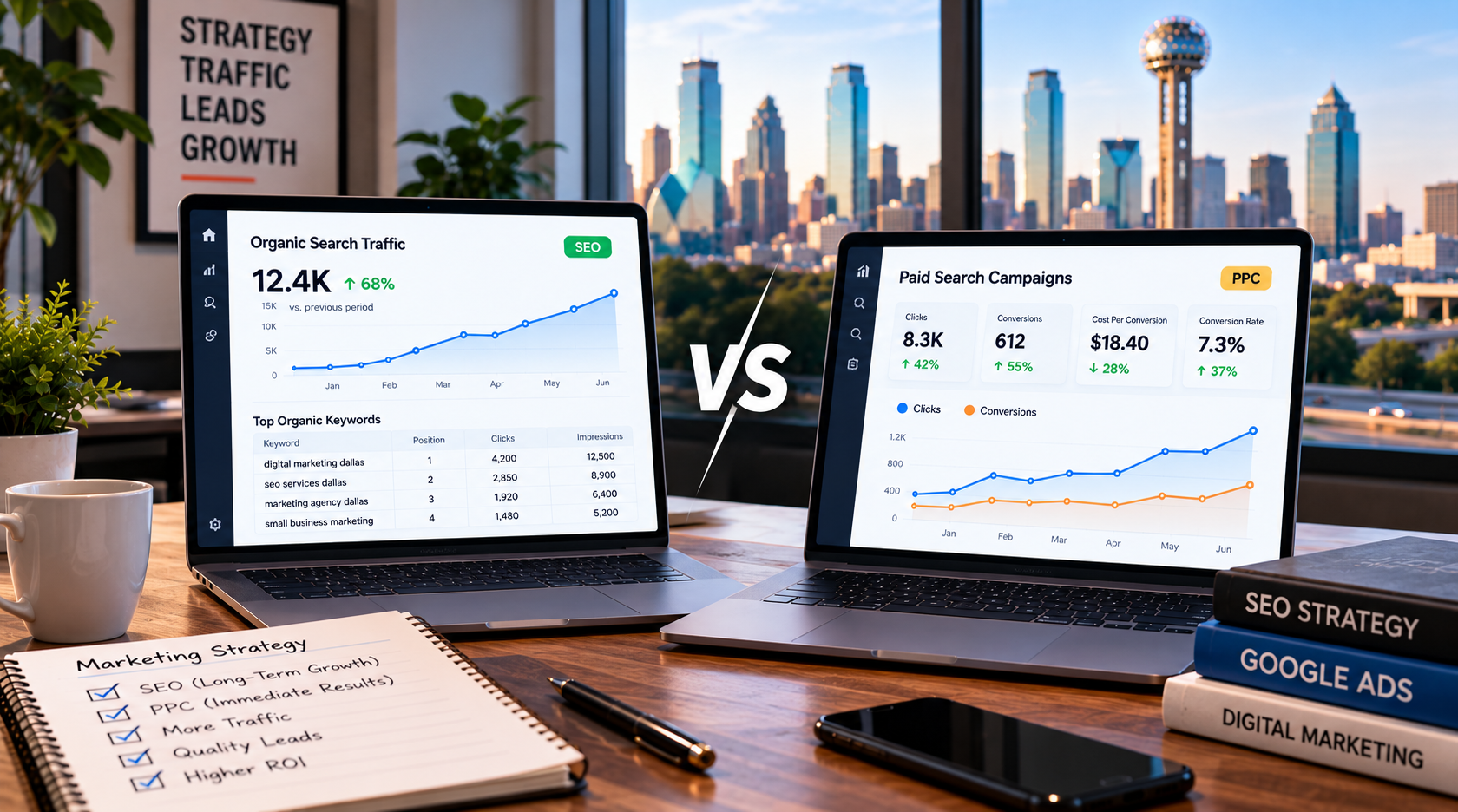
Businesses investing in online growth often face the same question: should they spend more on SEO or PPC? Both can generate traffic, leads, and revenue, but they work in very different ways. A professional digital marketing agency will usually recommend one or both based on your budget, goals, competition, sales cycle, and how quickly you need results.
SEO focuses on earning visibility in organic search results. PPC allows businesses to pay for immediate visibility through platforms such as Google Ads.
The better ROI does not come from choosing the channel with the lowest cost alone. It comes from understanding how much value each strategy generates compared with the time, budget, and resources required.
For many U.S. businesses, SEO becomes more efficient over time while PPC provides faster and more predictable access to high-intent search demand.
What Is SEO?
Search engine optimization is the process of improving a website so search engines can better understand its content and users can discover relevant pages through organic search.
SEO commonly includes:
- Keyword research
- Search intent analysis
- Technical SEO
- On-page optimization
- Content creation
- Internal linking
- Link building
- Local SEO
- Website performance improvements
Google describes SEO as helping search engines understand content and helping users find a website through search. Google also emphasizes helpful, reliable, people-first content, crawlable links, and technically accessible pages as important SEO practices.
Businesses wanting to understand the process in more detail can review this guide on how to rank your website on Google.
What Is PPC?
PPC, or pay-per-click advertising, is a model where advertisers pay to appear in sponsored placements.
Google Ads is one of the most common PPC platforms for search-driven businesses.
PPC campaigns can target:
- Keywords
- Locations
- Devices
- Audiences
- Demographics
- Customer lists
- Previous website visitors
The major advantage is speed.
Once a campaign is approved and active, businesses can begin appearing for relevant searches without waiting for organic rankings.
Google Ads also provides detailed conversion measurement so advertisers can identify which keywords, campaigns, and ads generate valuable customer activity.
SEO vs PPC: Quick Comparison
| Factor | SEO | PPC |
| Speed | Slower | Faster |
| Traffic cost | No direct cost per click | Pay per click |
| Long-term value | Can compound | Stops when spend stops |
| Control | Lower | High |
| Testing speed | Slower | Faster |
| Targeting | Search intent-based | Highly configurable |
| Measurement | Can be more complex | Highly measurable |
| Best for | Long-term growth | Immediate demand capture |
Both channels can generate strong returns.
The better choice depends on your objective.
1. Which Strategy Produces Results Faster?
PPC usually produces results faster.
A new Google Ads campaign can begin generating impressions, clicks, and conversions soon after launch.
SEO takes more time.
Google explicitly notes that SEO changes may take anywhere from a few hours to several months to be reflected in search results and recommends allowing time before assessing impact.
This makes PPC especially useful when a business needs:
- Immediate leads
- Product launches
- Seasonal campaigns
- New-market testing
- Short-term promotions
SEO is more suitable when the business is prepared to invest in long-term organic visibility.
2. Which Strategy Has Lower Long-Term Acquisition Costs?
SEO can become more cost-efficient over time because businesses do not pay Google every time someone clicks an organic listing.
However, SEO is not free.
Businesses still invest in:
- Content
- SEO specialists
- Technical improvements
- Development
- Research
- Link acquisition
- Tools
The difference is that successful pages can continue attracting visitors after the initial optimization work.
PPC behaves differently.
Traffic generally depends on continued advertising spend.
If you pause the campaign, paid traffic usually stops.
This is one reason SEO can create a compounding advantage over time.
Businesses considering investment levels can also review this guide to SEO services cost and benefits.
3. PPC Makes ROI Easier to Measure
One of PPC’s biggest advantages is attribution.
Google Ads can track actions such as:
- Purchases
- Leads
- Calls
- Sign-ups
Google recommends setting up conversion values so businesses can measure the total business value generated by campaigns rather than simply counting conversions.
Advertisers can then evaluate:
- Cost per conversion
- Conversion rate
- Conversion value
- ROAS
For ecommerce businesses, this can be particularly useful because individual purchases can be assigned transaction-specific revenue values.
This level of visibility makes PPC easier to optimize around a specific financial target.
4. SEO ROI Can Take Longer to Become Visible
SEO attribution is often more complicated.
A customer may:
- Discover your business through an informational search.
- Read a blog.
- Return later through another organic search.
- Visit again directly.
- Eventually convert.
Organic search may have played an important role without receiving all the conversion credit.
SEO should therefore be evaluated using multiple metrics, including:
- Organic leads
- Organic revenue
- Non-branded visibility
- Conversion rate
- Qualified traffic
- Search visibility
Looking only at rankings can create an incomplete picture.
5. Which Is Better for High-Intent Keywords?
PPC can be extremely effective for high-commercial-intent searches.
For example:
- personal injury lawyer near me
- enterprise CRM software
- HVAC repair Dallas
- commercial cleaning service
Businesses can bid directly on these searches and create advertisements specifically designed around customer intent.
SEO can also target high-intent keywords, but ranking organically may require significant time and authority.
For highly competitive industries, businesses often use PPC to capture immediate demand while building organic visibility in parallel.
6. Which Channel Provides More Control?
PPC offers greater short-term control.
Advertisers can adjust:
- Budget
- Keywords
- Geographic targeting
- Ad schedules
- Audiences
- Bids
- Landing pages
This makes it easier to test new markets and messaging.
SEO provides less direct control because organic rankings depend on search-engine systems and competitor activity.
Google explicitly states that following SEO best practices does not guarantee crawling, indexing, or rankings.
This does not make SEO unreliable.
It simply means that marketers cannot buy or guarantee organic positions.
7. SEO Can Build Broader Search Visibility
SEO can help businesses appear across many stages of the customer journey.
For example, one company can target:
Informational Searches
“What is conversion rate optimization?”
Comparison Searches
“SEO vs PPC”
Commercial Searches
“best SEO company for small business”
Transactional Searches
“digital marketing agency near me”
A well-structured content strategy can therefore attract prospects before they are ready to purchase.
Google recommends creating useful content around the words and questions users actually search for rather than focusing only on individual exact-match keywords.
8. PPC Is Excellent for Testing
PPC can provide useful market intelligence quickly.
A campaign can help businesses identify:
- High-converting keywords
- Strong offers
- Effective headlines
- High-value locations
- Profitable audience segments
This information can support broader marketing decisions.
For example, if one paid keyword consistently generates qualified leads, the business may decide to develop SEO content around the same customer need.
This makes PPC valuable even beyond immediate conversions.
9. SEO Can Create Long-Term Digital Assets
SEO investment often produces assets that continue providing value.
Examples include:
- Service pages
- Blog articles
- Guides
- Comparison pages
- Location pages
- Link authority
Once these assets perform well, they can continue attracting organic visitors without requiring direct payment for every click.
This is why SEO often becomes more financially attractive over longer time horizons.
However, content still needs maintenance.
Google recommends keeping published information current and useful rather than assuming successful pages can be ignored forever.
10. PPC ROI Depends Heavily on Conversion Tracking
A common PPC mistake is optimizing only for clicks.
Clicks do not equal revenue.
Google’s own ROI guidance recommends measuring conversions first so advertisers can identify whether campaigns, keywords, and ads generate valuable business activity.
For lead-generation companies, businesses should ideally track what happens after the form submission.
A cheap lead that never converts may be less valuable than an expensive lead that becomes a profitable customer.
Understanding high-quality lead generation can help businesses evaluate PPC more accurately.
11. ROAS vs ROI
ROAS and ROI are related but not identical.
ROAS usually measures advertising revenue relative to ad spend.
ROI considers broader profitability.
For example, a PPC campaign may produce a strong ROAS while still being less profitable after considering:
- Product costs
- Agency fees
- Creative costs
- Sales commissions
- Software
- Fulfillment
Google Ads allows advertisers to optimize campaigns around conversion value and Target ROAS when conversion values are configured correctly.
Businesses should therefore look beyond platform-reported numbers and evaluate actual profitability.
12. Which Is Better for Small Businesses?
The answer depends on circumstances.
SEO May Be Better When:
- You want sustainable organic growth
- Customers regularly search for your services
- You can invest for several months
- Content can influence buying decisions
- You want to reduce long-term dependence on ads
PPC May Be Better When:
- You need results quickly
- You have a defined advertising budget
- Your offers already convert
- You know customer lifetime value
- You need precise targeting
Many small businesses eventually benefit from both.
13. When Should You Use SEO and PPC Together?
SEO and PPC are often strongest when used as complementary strategies.
A business could use PPC immediately while SEO develops over time.
PPC can provide keyword and conversion data.
SEO can reduce long-term dependence on paid traffic.
For example:
Months 1–3: PPC captures immediate demand while technical SEO and content are developed.
Months 4–6: Organic visibility begins improving while paid campaigns continue targeting high-converting searches.
Long term: Budget can be allocated between organic and paid channels based on marginal return.
This creates a more diversified acquisition strategy.
14. How Should Businesses Measure SEO ROI?
Start by connecting organic traffic to actual business outcomes.
Useful metrics include:
- Organic conversions
- Organic revenue
- Qualified leads
- Customer acquisition cost
- Conversion rate
- Pipeline value
Avoid calculating SEO success based only on traffic.
An increase from 5,000 to 20,000 monthly visitors is not necessarily valuable if the additional users have no commercial relevance.
15. How Should Businesses Measure PPC ROI?
For PPC, track:
- Advertising spend
- Leads
- Purchases
- Conversion value
- Customer acquisition cost
- Revenue
- ROAS
Google recommends assigning values to conversions and using accurate first-party and CRM data where possible so campaigns can optimize toward high-value outcomes.
This is particularly important for businesses where leads have different values.
Common SEO and PPC Mistakes
Avoid:
- Choosing SEO solely because clicks appear free
- Choosing PPC solely because results are immediate
- Measuring traffic instead of revenue
- Ignoring landing-page quality
- Targeting irrelevant keywords
- Running PPC without conversion tracking
- Publishing SEO content without search intent
- Changing paid campaigns too frequently
- Expecting SEO results instantly
Google notes that Smart Bidding campaigns need a learning period and that frequent changes can delay optimization.
Both channels require patience, data, and continuous improvement.
So, Which Delivers Better ROI?
There is no universal answer.
SEO often provides stronger long-term efficiency because successful organic visibility can continue generating traffic without direct payment for each click.
PPC can produce faster ROI because businesses can immediately target users with strong commercial intent and measure performance in detail.
The strongest answer for many businesses is therefore not:
SEO or PPC?
It is:
Which channel should receive more investment at each stage of growth?
A new company may rely more heavily on PPC.
An established website with strong authority may generate excellent returns from SEO.
A mature digital strategy may use both.
Final Thoughts
SEO and PPC solve different problems.
SEO builds long-term search visibility and digital assets that can compound over time.
PPC provides speed, control, targeting, and detailed conversion measurement.
If your priority is immediate lead generation, PPC may create value faster.
If your priority is building sustainable organic acquisition and reducing reliance on paid clicks, SEO may offer stronger long-term economics.
For many U.S. businesses, the best strategy is to integrate both.
Use paid advertising to capture immediate demand and gather conversion data. Use SEO to build long-term authority and visibility. Then continuously shift budget toward the channels producing the strongest incremental business value.
That approach creates a more resilient acquisition system than relying entirely on one source of traffic.
FAQs
Is SEO or PPC better for ROI?
Neither is always better. PPC often produces faster and more measurable returns, while SEO can become more cost-efficient over the long term.
Is SEO cheaper than PPC?
SEO does not require payment for each organic click, but businesses still invest in content, technical work, tools, and specialists. PPC requires ongoing media spend.
How quickly can PPC generate results?
PPC can begin generating traffic and conversions shortly after a campaign launches, although optimization usually requires additional data and time.
How long does SEO take to work?
SEO timelines vary. Google notes that some changes may appear quickly while others can take several months to show meaningful impact.
Should a small business use SEO and PPC together?
Often, yes. PPC can capture immediate demand while SEO builds longer-term organic visibility, allowing the two strategies to support each other.
About The Author



