





Key Takeaways
- Streaming alone rarely sustains growth. Subscription churn, content costs and crowded catalogues squeeze margins.
- An entertainment super app joins video, payments, events, commerce and loyalty in one connected product.
- Modular, API-first architecture lets you add services in phases without rebuilding the core.
- Cross-platform development improves efficiency, but DRM and premium playback often need native modules.
- Diversified monetization (ads, rentals, bundles, ticketing, commerce) improves resilience against churn.
- Launch a focused MVP, measure retention and conversion, then expand where the data points.
- Arabic-English support, UAE compliance and family-safe controls are competitive requirements in Dubai.
Streaming changed how people find and watch entertainment. It also created a problem: everyone now competes for the same evening hours.
Subscription fatigue is real. Viewers rotate between services, cancel after one series, and expect more for less. Meanwhile, content licensing and infrastructure costs keep climbing. A video library, however good, is no longer a moat.
That’s why leading platforms are moving from standalone streaming apps to connected digital experiences. This is the idea behind entertainment super app development: a single app that combines video streaming with payments, event booking, merchandise, loyalty rewards and partner services.
Dubai is a natural testing ground. In January 2026, Dubai Media Incorporated launched Dubai+, a family-focused digital platform that, according to TradeArabia’s coverage, opened with more than 20 exclusive series, six original productions and over 170 international movies. Dubai Media described it as part of a broader strategy to build an integrated digital media ecosystem.
If you’re planning OTT app development in Dubai, this guide covers the opportunity, the architecture, the monetization options and the build decisions that matter, so you can judge what a connected entertainment platform would take for your business.
Why Standalone OTT Platforms Need a New Growth Strategy
Streaming remains the foundation of digital entertainment. The question is whether it can be the whole business. For many operators, the answer is increasingly no.
The Challenges of Subscription-Driven Streaming
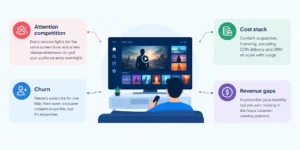
Four pressures show up repeatedly:
- Attention competition. Every service fights for the same screen time, and a new release elsewhere can pull your audience away overnight.
- Churn. Viewers subscribe for one title, then leave. Exclusive content slows this, but it’s expensive.
- Cost stack. Content acquisition, licensing, encoding, CDN delivery and DRM all scale with usage.
- Revenue gaps. A subscriber pays monthly, but you earn nothing in the hours between viewing sessions.
Why Content Libraries Alone Rarely Create Differentiation
Volume doesn’t equal loyalty. Discovery, interface quality and trust often decide whether a viewer returns on Friday night.
In the UAE, this includes localization. Bilingual Arabic-English interfaces, right-to-left layouts, region-relevant collections and parental controls shape adoption, especially for family households. Dubai+ is built around family-friendly content for exactly that reason.
The bigger opportunity is what happens beyond the video. A viewer who just watched a concert film is a likely buyer of tickets. A viewer following a cooking series may want the ingredients. Extending the relationship past playback is where new revenue sits.
What Dubai’s Evolving Media Landscape Tells Businesses
Dubai+ isn’t just a content launch. Dubai Media’s leadership has said future phases will expand the offering and deepen audience engagement. That signals sustained public investment in digital distribution.
For private media brands, telecom operators, retailers, hospitality groups and event organizers, that creates room to build complementary platforms. A growing number of businesses are looking at media and entertainment solutions Dubai teams can deliver end to end, covering streaming, commerce and engagement, rather than stitching vendors together.
OTT still provides the base layer. But businesses that add services around it can improve retention and diversify revenue.
What Is an Entertainment Super App and How Does It Work?
An entertainment super app is a single digital platform that combines video streaming with additional services such as payments, ticketing, shopping, loyalty and third-party offerings, all accessed through one account and one interface.
A conventional streaming app answers one question: what should I watch? A super app answers a wider one: what should I do tonight?
From a Video Streaming App to a Connected Entertainment Ecosystem
Under the hood, one platform can connect:
- Video-on-demand and live streaming
- Subscriptions and digital payments
- Event discovery and ticket booking
- Merchandise and shoppable content
- Loyalty rewards and partner services
- Creator channels and community features
This is how OTT super apps work in practice: a shared identity, wallet and recommendation layer sits underneath, and each service plugs in as a module.
OTT App vs. Entertainment Super App
| Capability | Traditional OTT app | Entertainment super app |
|---|---|---|
| Video streaming | Core feature | Core feature |
| Subscription management | Common | Common |
| Shopping and merchandise | Optional or external | Integrated where relevant |
| Event booking | Often external | Can be integrated |
| Loyalty and rewards | Limited or partner-based | Cross-service opportunities |
| Third-party services | Limited integrations | Modular partner ecosystem |
Which Businesses Can Benefit From This Model?
- Media companies that want revenue beyond subscriptions
- Telecom operators bundling entertainment with connectivity
- Hospitality brands linking in-stay content with bookings
- Retail groups connecting content to shopping and loyalty
- Event organizers selling tickets alongside promotional video
- Digital-first startups building a niche audience before scaling
Quick Question: “How is an entertainment super app different from an OTT app?”— An OTT app delivers video content. An entertainment super app delivers video plus connected services, such as payments, ticketing, shopping and loyalty, through one account. It keeps users engaged between viewing sessions and creates revenue sources beyond the subscription fee.
Essential Features of an Entertainment Super App
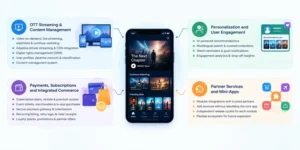
A long feature checklist doesn’t help anyone. What matters is which features drive retention, revenue and trust. Here are the ones that carry the weight.
OTT Streaming and Content Management
The streaming core has to be dependable before anything else gets added.
- Video-on-demand, live streaming, watchlists and continue-watching
- Adaptive bitrate streaming, so playback adjusts to network conditions
- CDN integration for consistent delivery across devices and locations
- Digital rights management (DRM) to protect licensed content
- User profiles, parental controls and content classification
- A content management system for publishing, scheduling and organizing media
Parental controls deserve special attention in Dubai. Family households are a primary audience, and visible, easy controls build trust quickly.
Payments, Subscriptions and Integrated Commerce
Payments turn a viewing app into a transaction platform. Plan for subscription tiers, rentals, premium access, event tickets, merchandise and in-app purchases, plus clear transaction histories.
If you’re researching how to integrate payments into OTT platforms, the practical sequence looks like this:
- Choose a payment gateway that supports local cards, wallets and your target currencies (including AED).
- Use tokenization so card data never touches your servers.
- Implement recurring billing, retry logic for failed renewals and clear receipts.
- Check platform rules. Apple and Google apply specific policies to digital goods sold inside apps, which differ from rules for physical goods and tickets.
- Test refunds, cancellations and edge cases before launch, not after.
Loyalty points, promotions and partner offers sit on top of the same wallet layer, which is why a clean payment architecture early on saves rework later.
Personalization and User Engagement
AI-powered personalization in streaming apps usually starts simple: recommendations based on viewing history, search behavior and interaction signals, used with appropriate consent.
Beyond recommendations, strong platforms offer:
- Multilingual search and curated collections
- Watch reminders and consent-based push notifications
- Engagement analytics showing where viewers drop off
That last item is underrated. Knowing that viewers abandon episode two at minute eleven tells you more than any survey.
Partner Services and Mini-Apps
Modular integrations let you add a ticketing partner, a food-delivery service or a retail loyalty scheme without rebuilding the app each time. Each partner becomes a contained module with its own release cycle, which keeps the core stable.
Super App Architecture for Media and Entertainment
Good architecture is mostly invisible to users and very visible to your future budget. Here’s how a scalable platform is typically organized.
The Core Technology Layers
- Experience layer: iOS, Android, web and supported smart TV interfaces
- OTT services layer: video delivery, content catalogues, user profiles and entitlements
- Commerce layer: payments, subscriptions, ticketing and merchandise
- Integration layer: APIs and third-party partner connections
- Data and intelligence layer: analytics, recommendations and reporting
- Security and operations layer: access control, monitoring, privacy and infrastructure management
Entitlements deserve a note. This is the logic deciding who can watch what, on which device, under which plan. In a super app it also decides who can redeem which loyalty offer. Getting it wrong creates both revenue leakage and support tickets.
Why Modular and API-First Architecture Matters
- Teams can build and update services independently.
- Streaming and commerce features depend on each other less, so a ticketing bug won’t stop playback.
- Third-party integrations become easier to manage and replace.
- Phased launches become realistic, with expansion planned in from day one.
Platforms of this scale usually need more than an off-the-shelf template. They benefit from custom software development in Dubai that fits your content rights, partner network and growth plans rather than forcing your business model into someone else’s product.
Security, Privacy and Content Protection
Cover the fundamentals from the start: authentication and authorization, encrypted data transmission, payment security, DRM, role-based access permissions and privacy-by-design.
Regulation matters here too. Depending on your business model and activities, you may need to consider UAE media licensing and content standards, as well as data-protection requirements such as the UAE Personal Data Protection Law (Federal Decree-Law No. 45 of 2021). Requirements differ by activity, so take legal advice early rather than during a pre-launch scramble.
Why Cross-Platform Development Is a Practical Choice for OTT Super Apps
Cross-platform engineering ties directly to business outcomes: speed, consistency and maintainability.
Benefits of Cross-Platform Development for OTT Apps
- Shared code and business logic where practical
- Consistent user journeys across supported mobile devices
- Less duplicated development and maintenance
- Faster iteration on common screens and features
One caution: results depend on app complexity and platform requirements. Anyone promising fixed savings before reviewing your scope is guessing.
This is also why the choice of partner matters. Experienced cross platform app developers Dubai businesses hire should be able to explain where sharing code helps and where it hurts, instead of defaulting to one framework for everything.
Flutter vs. React Native vs. Native Development
- Flutter: strong for consistent interfaces and shared UI across platforms.
- React Native: a natural fit for teams already working in the React and JavaScript ecosystem.
- Native (Swift/Kotlin): justified when specific device capabilities, performance targets or platform integrations demand it.
- Kotlin Multiplatform: worth considering when you want to share business logic but keep fully native interfaces.
When OTT Platforms Still Need Native Modules
Video is where cross-platform promises get tested. DRM, premium playback, offline downloads, picture-in-picture, casting and device compatibility often require platform-specific components. The sound approach is cross-platform for most screens, native modules for the playback-critical parts, and a technical assessment before you commit.
Quick Question: “Can a cross-platform app handle DRM-protected video?”— Yes, but usually with native help. Cross-platform frameworks typically handle the interface and business logic, while DRM and high-quality playback rely on native player components wrapped for the shared codebase. Confirm device and DRM support early in your technical assessment.

OTT Monetization Models Beyond Subscriptions
A super app lets you earn from more than one behavior. Here’s how the main models fit together.
Subscription, Advertising and Transactional Models
- SVOD: subscription video on demand, with predictable recurring revenue
- AVOD: ad-supported viewing, which lowers the entry barrier
- TVOD: pay-per-title rentals or purchases
- Hybrid plans: a free ad-supported tier plus a premium ad-free tier
- Pay-per-view: live events and premieres sold individually
Bundling and Partnership Revenue
Bundles shift acquisition costs onto someone else’s customer base. Telecom packages that include a streaming tier, hotel stays with premium content and retail loyalty programmes with entertainment rewards are all realistic structures in the UAE market.
Commerce, Events and Creator Monetization
Shoppable videos, merchandise, event ticketing, premium creator channels and brand partnerships all fit the model, provided they’re relevant to your audience. A Ramadan series, for example, can sit alongside seasonal offers and event bookings, since viewing patterns shift noticeably during the holy month.
Selecting the Right Monetization Mix
Don’t copy someone else’s mix. Let five factors decide:
- Audience behavior and device usage
- Content rights and territorial restrictions
- Customer acquisition cost
- Retention data
- Willingness to pay
Start with one primary revenue stream and one secondary. Add more only when your data supports it.
A Practical Roadmap for Building an Entertainment Super App in Dubai
The OTT app development process works best as a staged sequence. Overbuilding the first release is the most common and most expensive mistake.
Step 1: Validate the Audience and Business Model
Define your audience, the problem you solve, your content strategy and your primary revenue source. If you can’t say who pays and why, stop here.
Step 2: Define the OTT MVP and Platform Requirements
Prioritize streaming, accounts, content management, subscriptions and essential analytics. Everything else waits.
Step 3: Select the Architecture and Cross-Platform Strategy
Assess supported devices, integrations, performance needs, scalability and technology choices. This is also when to decide where native modules are required.
Step 4: Integrate Payments, Commerce and Partner Services
Add one or two high-value services after the core experience works. Launching every feature at once multiplies risk and hides which feature actually moved the numbers.
At this stage, working with an experienced OTT platform development company pays off, because decisions about DRM, entitlements and billing are expensive to reverse.
Step 5: Test, Launch and Optimize
Run device testing, streaming performance checks and security validation. Wire up analytics before launch so feedback has data behind it.
Step 6: Expand Based on Measurable Results
Let retention, conversion, viewing engagement and partner adoption decide what you add next. Expansion should follow evidence, not enthusiasm.
How SISGAIN Technologies Can Help Build Connected Entertainment Platforms
SISGAIN Technologies works as a technology development partner for businesses planning connected digital products. Here’s how that applies to entertainment.
OTT App Development Tailored to Business Requirements
An OTT project may involve streaming experiences, subscription workflows, content management, user profiles and integration with supporting systems. The scope follows your business model, not a fixed template.
Cross-Platform Development for Connected Audience Experiences
Shared mobile development, consistent user journeys and API integration, combined with platform-specific engineering where playback or device features demand it.
Super App Development for a Broader Digital Ecosystem
If you’re comparing super app development services in Dubai, look for a modular architecture that connects entertainment with payments, commerce, loyalty, bookings and partner services in phased releases. That approach keeps your first launch manageable and your roadmap open.
From Product Planning to Scalable Delivery
SISGAIN supports projects through requirements analysis, architecture planning, UI/UX design, development, integration, testing and ongoing improvement.
Have an OTT platform, cross-platform application or entertainment super app in mind? Discuss your entertainment app project with SISGAIN Technologies and start with a scoping conversation.
Conclusion
OTT remains the foundation of digital entertainment, but it doesn’t have to be the entire business model.
Connected experiences can bring streaming, commerce, events, loyalty and payments together when they solve real customer needs. A modular architecture and a carefully chosen cross-platform strategy let you plan for expansion without overbuilding version one.
Dubai’s media ecosystem, reinforced by launches like Dubai+, rewards businesses that pair relevant content with strong product experiences and sustainable monetization.
If you’re ready to explore entertainment super app development, OTT app development or cross-platform development, Talk to SISGAIN about your requirements.
Frequently Asked Questions
What is entertainment super app development?
It’s the process of building one app that combines video streaming with payments, ticketing, shopping, loyalty and partner services, so users access entertainment and related transactions through a single account.
How is a super app different from a standard OTT app?
A standard OTT app delivers video. A super app adds connected services like payments, event booking, merchandise and loyalty, keeping users engaged between viewing sessions and creating revenue beyond subscriptions.
Why does OTT app development in Dubai matter now?
Dubai is investing in digital media, as Dubai+ shows. Bilingual, family-focused audiences create new room for private platforms offering localized content, parental controls and connected services that fit local expectations.
What features should an entertainment super app include?
Core features include video-on-demand, live streaming, DRM, profiles with parental controls, secure payments, subscriptions, ticketing, loyalty rewards, personalized recommendations, analytics and modular partner integrations for adding new services later on
How do you integrate payments into an OTT platform?
Choose a gateway supporting local cards, wallets and AED, tokenize card data, build recurring billing with retry logic, follow Apple and Google in-app purchase rules, and test refunds before launch.
Is cross-platform development suitable for OTT apps?
Yes, for most screens and business logic. Playback-critical features like DRM, offline downloads and casting often need native modules, so assess technically before choosing Flutter, React Native or fully native.
What are the main OTT monetization models beyond subscriptions?
Options include advertising (AVOD), pay-per-title rentals (TVOD), hybrid free-and-premium plans, pay-per-view events, telecom and retail bundles, ticketing, merchandise, shoppable video, creator channels and brand partnerships, chosen to match audience behavior.
How long does it take to build an entertainment super app?
It depends on scope, devices, integrations and DRM needs. Launching a focused MVP first, then adding payments and partner services in phases, is usually less risky than building everything together.
What compliance should Dubai OTT platforms consider?
Depending on activities, consider UAE media licensing, content standards and data-protection rules such as the Personal Data Protection Law. Requirements vary by business model, so seek legal advice early on.
How can SISGAIN Technologies help with entertainment super app development?
SISGAIN acts as a development partner, supporting requirements analysis, architecture, UI/UX, cross-platform development, integrations, testing and ongoing improvement for OTT platforms and connected entertainment apps, tailored to your business goals.
About The Author



