



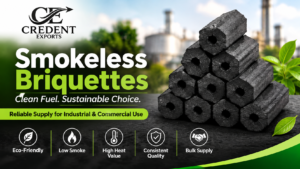
Industries and commercial establishments that depend on solid fuels are increasingly exploring alternative fuel options for their operational requirements. Biomass-based smokeless briquettes offer one approach by converting suitable agricultural and wood-processing residues into compact solid fuel. These briquettes are designed for applications where businesses require a manageable fuel format and consistent heating characteristics.
For wholesalers, procurement managers, distributors and industrial buyers, understanding the raw materials, production process, applications and supplier requirements is essential before selecting a fuel product.
What Are Smokeless Briquettes?
Smokeless briquettes are solid fuel blocks manufactured by processing and compressing suitable biomass and carbon-based materials. Common raw materials include rice husk, sawdust, bagasse, groundnut shells, wood chips, charcoal dust and carbonised biomass.
These materials undergo preparation and compression to form compact blocks with relatively uniform shapes and dimensions. The final product characteristics depend on the raw material composition, moisture content, particle size and manufacturing process.
Compared with loose biomass residues, compressed briquettes are generally easier to store, handle and transport. Businesses considering Smokeless Briquettes should evaluate the product according to their heating equipment, fuel requirements and intended application.
Raw Materials Used in Smokeless Briquette Manufacturing
Raw material selection plays an important role in determining the physical and combustion characteristics of the finished briquettes. Different agricultural and wood-processing residues can be used depending on availability and suitability.
Rice Husk
Rice husk is a by-product generated during rice milling. After suitable preparation, it can be used as a raw material for biomass briquette production.
Sawdust
Sawdust is generated through wood cutting and processing activities. Its availability makes it a commonly considered input for compressed biomass fuel products.
Bagasse
Bagasse is the fibrous residue left after extracting juice from sugarcane. It can be dried and processed before being used in briquette manufacturing.
Groundnut Shells
Groundnut shells are agricultural residues that can be converted into smaller particles and incorporated into suitable biomass formulations.
Wood Chips and Charcoal Dust
Wood chips and charcoal dust can also be used in certain production formulations. Carbonised biomass may be included depending on the intended product characteristics.
The exact raw material combination varies between manufacturers. Buyers should confirm the composition and specifications of the product they intend to purchase.
How Are Smokeless Briquettes Manufactured?
Manufacturing involves several stages, beginning with raw material preparation and ending with the packaging of finished briquettes. Proper processing helps manufacturers maintain consistency in product shape, density and moisture characteristics.
1. Raw Material Collection and Selection
The process begins with collecting suitable agricultural and wood-processing residues. Materials are checked before production to ensure they are appropriate for the intended briquette formulation.
2. Drying and Moisture Reduction
Collected biomass is dried to reduce excess moisture. Moisture management is important because the condition of the raw material influences compression and the combustion behaviour of the finished product.
3. Grinding and Particle Size Reduction
The dried material is passed through grinding equipment to obtain smaller particles. Relatively uniform particle sizes help prepare the material for the compression stage.
4. Compression Through Briquetting Machinery
The processed material is fed into a briquetting machine, where mechanical or hydraulic pressure is applied to form solid blocks. In some production methods, natural binding properties such as lignin present in biomass help hold the particles together without additional glue.
5. Cooling, Shaping and Packaging
After compression, the briquettes are cooled and prepared according to the required shape and product format. They are then packed for storage, transportation and distribution.
Each stage requires suitable process control to maintain the desired product characteristics.
Key Features of Smokeless Briquettes
Businesses evaluating solid fuel alternatives should understand the features that influence handling, storage and combustion.
- Compact structure: Compression converts loose biomass into solid blocks that are easier to handle and store.
- Uniform shape: Consistent dimensions can support organised storage and fuel-feeding arrangements.
- Biomass utilisation: Agricultural and wood-processing residues can be converted into useful fuel products.
- Heating applications: Suitable briquettes can be considered for compatible boilers, furnaces and kilns.
- Combustion characteristics: Moisture, density and raw material composition influence burning behaviour and smoke production.
The term smokeless refers to the intended low-smoke characteristics of the product. It should not be interpreted as a guarantee of zero emissions. Actual performance depends on fuel quality, combustion conditions, ventilation and equipment design.
Benefits of Using Biomass-Based Smokeless Briquettes
One of the important aspects of biomass briquette production is the utilisation of agricultural and wood-processing by-products. Suitable residues can be processed into a compact fuel instead of remaining unused.
Their compressed form also supports organised handling and storage. Businesses that purchase solid fuel regularly may find that consistent product dimensions simplify inventory management and transportation planning.
Another consideration is fuel procurement. Industries can compare briquettes with their existing fuel sources by reviewing purchase price, transportation expenses, moisture specifications, fuel consumption and equipment performance. The most suitable option depends on the total operating requirements rather than the purchase price alone.
For businesses interested in alternative fuel sourcing, it is important to assess the product through its actual specifications and intended application.
Industrial and Commercial Applications
Smokeless briquettes can be considered for different operations that require solid fuel. Their suitability depends on the equipment design and fuel specifications.
Industrial Boilers and Furnaces
Manufacturing facilities that require heat for production processes may evaluate compatible briquettes for industrial boilers and furnaces. Food-processing, textile and ceramic manufacturing operations are examples of sectors where solid fuel may be used.
Kilns and Heating Systems
Certain kilns and industrial heating systems can use briquettes when the product dimensions and combustion characteristics match the equipment requirements.
Food Processing Facilities
Food-processing businesses often require heat for different production activities. They can evaluate suitable briquettes based on their heating equipment and operating conditions.
Restaurants and Hotels
Commercial kitchens and hospitality establishments may consider suitable briquettes for compatible cooking and heating systems. Equipment requirements and ventilation should be checked before changing fuel types.
How to Choose Reliable Smokeless Briquettes Suppliers
Selecting a suitable supplier is an important part of bulk procurement. Buyers should look beyond the quoted price and review the product information, manufacturing practices and supply arrangements.
Before placing an order, consider the following points:
- Raw material composition: Confirm which biomass or carbon-based materials are used.
- Product specifications: Ask about dimensions, moisture content, density and other relevant characteristics.
- Quality control: Understand how the manufacturer checks product consistency.
- Packaging: Select packaging that suits storage, handling and transportation requirements.
- Order quantities: Confirm minimum order quantities and availability for bulk purchases.
- Delivery arrangements: Discuss dispatch schedules, transportation and delivery destinations.
- Export requirements: International buyers should clarify shipment arrangements and applicable documentation.
Businesses comparing Smokeless Briquettes Manufacturers can review Credent Exports and its product information when evaluating sourcing options. The company caters to industrial users, commercial businesses, wholesalers, distributors, traders and bulk consumers.
Smokeless Briquettes for Wholesale and Export Markets
Wholesale buyers and distributors often require dependable supply arrangements to manage their inventory and customer commitments. Before finalising a bulk purchase, they should discuss product specifications, order quantities, packaging and expected dispatch schedules with the supplier.
Export buyers may also need to review shipment documentation, packaging requirements, transportation arrangements and destination-market regulations. Clear communication before ordering helps establish expectations and supports smoother procurement planning.
For businesses sourcing from India, comparing suppliers on product suitability, quality practices and supply capabilities can help identify an appropriate long-term sourcing arrangement.
Conclusion
Smokeless briquettes provide an option for converting suitable agricultural and wood-processing residues into compact solid fuel. Their potential applications in boilers, furnaces, kilns, food-processing facilities and compatible commercial heating systems make them worth evaluating for businesses that use solid fuels.
A careful assessment of raw materials, manufacturing processes, product specifications and equipment compatibility can help buyers make informed decisions. Selecting a supplier with clear product information and suitable supply arrangements is equally important for consistent procurement.
Frequently Asked Questions
1. What are smokeless briquettes made from?
They can be manufactured using rice husk, sawdust, bagasse, groundnut shells, wood chips, charcoal dust and carbonised biomass. The exact composition depends on the manufacturer.
2. How are smokeless briquettes manufactured?
The raw materials are collected, dried, ground and compressed using a briquetting machine. The formed blocks are then cooled, shaped where required and packed.
3. Do smokeless briquettes produce zero smoke?
No fuel should be assumed to produce zero emissions. Smoke production depends on raw material composition, moisture, combustion conditions and equipment design.
4. Where can smokeless briquettes be used?
Suitable products can be considered for industrial boilers, furnaces, kilns, food-processing facilities, restaurants, hotels and compatible heating systems.
5. Are agricultural residues suitable for briquette production?
Yes. Rice husk, bagasse, groundnut shells and sawdust are examples of agricultural and wood-processing residues used in suitable briquette formulations.
6. What should bulk buyers check before purchasing smokeless briquettes?
Buyers should review raw material composition, dimensions, moisture specifications, density, packaging, quality-control practices, order quantities and delivery arrangements.
7. Can smokeless briquettes be exported from India?
Yes. Export procurement requires buyers and suppliers to confirm product specifications, packaging, shipment arrangements and applicable export documentation.
About The Author