



precision is an important requirement in electronics manufacturing. During PCB assembly and other industrial processes, materials such as adhesives, solder paste, flux and sealants may need to be applied in controlled quantities and at specific locations. The way these materials are dispensed can influence assembly quality, material consumption and production consistency. Fluid dispensing equipment provides manufacturers with a practical way to manage these applications.
Different production environments have different dispensing requirements. Some facilities perform small-volume applications and repair work, while others need equipment for repetitive production tasks. Manual and robotic dispensing systems can address different operating needs, depending on the material, process and production setup.
Accessories also play an important role in a complete dispensing arrangement. Items such as dispensing needles, syringes, barrels, adapters and tubing help deliver fluids from the equipment to the intended application area. Understanding the available equipment categories and their uses helps manufacturers plan a suitable dispensing process.
Product Specifications
Fluid dispensing equipment should be selected according to the application, fluid characteristics and production requirements. No single configuration is suitable for every material or manufacturing process. For example, a fluid with a different viscosity may require a different dispensing arrangement, accessory or operating setting.
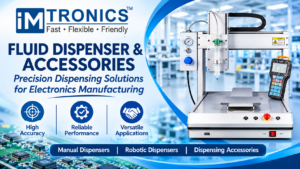
The Fluid Dispenser and Accessories range from IMTronics Technology includes manual dispensers, robotic dispensers and dispensing accessories. These categories can be considered for different fluid application requirements in electronics manufacturing and industrial assembly.
When evaluating a dispensing system, manufacturers should review several important parameters:
- Dispensing method: The operating mechanism should suit the material and application. Different systems may use different methods of controlling fluid delivery.
- Control arrangement: Timer-based or controller-based operation may be relevant depending on the equipment and process.
- Pressure requirements: The pressure setting should be appropriate for the fluid’s flow characteristics and the dispensing arrangement.
- Operating mode: Manual, semi-automatic or automatic operation should be considered according to production volume and process requirements.
- Dispensing quantity: The required amount of fluid per application should be established before selecting equipment.
- Fluid compatibility: Materials such as adhesives, solder paste, flux and sealants may have different handling requirements.
- Accessories: Needles, syringes, barrels and adapters should be compatible with the dispenser and the material being used.
Specifications, dimensions and features can vary by model and configuration. Buyers should verify the technical information for the specific equipment before purchasing or integrating it into a production process.
Objective
The main objective of a fluid dispensing system is to apply a required material in a controlled and repeatable manner. In electronics manufacturing, this can include adhesive application on printed circuit boards, component bonding, sealing and other assembly-related tasks.
A suitable dispensing arrangement can help production teams establish a defined method for applying materials. This is useful when an application needs to be repeated across several components or assemblies. The equipment should be selected after considering the fluid type, required quantity, application location and production frequency.
Manufacturers should also consider how the dispensing operation fits into the wider production workflow. The equipment may be used at an individual workstation or as part of a more organised assembly process. The objective is to select a system that matches the actual task rather than choosing equipment based only on general product descriptions.
Benefits
Fluid dispensing equipment can support several aspects of electronics and industrial manufacturing when selected and operated appropriately.
Controlled material application: A suitable system helps manage the amount and placement of fluids. This can be useful when applying adhesives, flux or other process materials to specific areas.
Repeatable dispensing operations: Consistent settings and suitable accessories can help production teams perform similar applications across repeated cycles.
Material management: Controlled dispensing can help avoid unnecessary over-application. This may support more efficient use of production materials.
Support for different applications: Manual and robotic dispensing categories offer options for different operating requirements, including smaller tasks and repetitive production processes.
Organised production workflow: A defined dispensing method can help employees follow a consistent procedure during assembly, repair and maintenance activities.
Businesses comparing Fluid Dispenser and Accessories Manufactures should assess equipment categories, technical information, accessory compatibility and suitability for their intended process. It is also useful to confirm the availability of the required configuration before procurement.
Availability
Fluid dispensing equipment is relevant to electronics manufacturing, industrial assembly, repair and maintenance environments. The appropriate product category depends on the intended use and the operating conditions of the facility.
Manual dispensers may be considered for applications where an operator controls the dispensing process. Robotic dispensers may be suitable for processes requiring repeated or automated material placement. Accessories such as needles and syringes should be selected according to the fluid, equipment and required application pattern.
Product availability and configuration may vary. Before placing an order, businesses should confirm the selected model, compatible accessories, dimensions and relevant technical details. This helps ensure that the equipment is appropriate for the planned application.
About Us
IMTronics Technology is an India-based provider of products and equipment for electronics manufacturing and assembly applications. Its product categories cover different requirements within the electronics production environment.
The Fluid Dispenser and Accessories range includes manual dispensers, robotic dispensers and dispensing accessories. These categories are relevant to fluid application tasks such as adhesive dispensing, PCB assembly, bonding and sealing, depending on the selected equipment and its suitability for the process.
IMTronics Technology provides product information to help businesses review available equipment categories and assess their requirements. Buyers should confirm model-specific specifications and application compatibility before making a purchasing decision.
Conclusion
Fluid dispensing is an important process in electronics manufacturing and industrial assembly. Selecting suitable equipment requires an understanding of the material, application, production volume and required dispensing control. Manual and robotic systems serve different operational needs, while compatible accessories help complete the dispensing arrangement. Reviewing specifications and following appropriate cleaning and maintenance practices can support consistent equipment operation and a more organised manufacturing process.
FAQs
1. What is a fluid dispenser used for in electronics manufacturing?
A fluid dispenser is used to apply controlled quantities of materials such as adhesives, solder paste and flux. It can support PCB assembly, bonding and other manufacturing applications.
2. What are the common types of fluid dispensers?
Common product categories include manual dispensers and robotic dispensers. The appropriate type depends on the application, production volume and level of automation required.
3. Which accessories are commonly used with fluid dispensers?
Accessories may include dispensing needles, syringes, barrels, adapters and tubing. The correct selection depends on the equipment, fluid and intended application.
4. Does fluid viscosity affect dispenser selection?
Yes. Viscosity affects how a material flows through the dispensing system. The equipment and accessories should be suitable for the fluid’s flow characteristics.
5. Can fluid dispensers be used for PCB adhesive application?
Fluid dispensing systems can be used for applying adhesives to PCBs when the selected equipment and accessories are suitable for the material and process.
6. What should buyers check before purchasing a fluid dispenser?
Buyers should review the dispensing method, control arrangement, pressure requirements, operating mode, fluid compatibility, accessories and model-specific specifications.
7. Why is cleaning important for dispensing equipment?
Cleaning helps prevent material buildup and blockage in dispensing tips and related components. Maintenance should follow the equipment and material manufacturer’s recommendations.
About The Author