



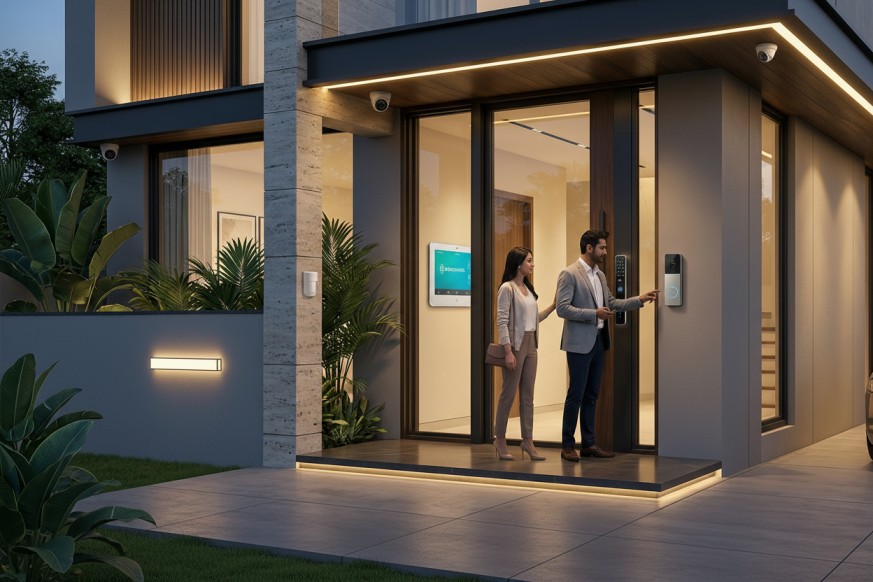
A smart home security system is an integrated network of sensors, cameras, smart locks, and AI-driven monitoring tools that protect your property in real time. Unlike traditional alarm systems, smart security delivers instant mobile alerts, remote access control, and automated deterrence — all manageable from a single app, regardless of where you are in the world.
Why Traditional Security is No Longer Enough for Indian Homes
For decades, Indian homes relied on physical locks, manual CCTV recorders, and security guards. These systems share three fundamental weaknesses — they react after a breach has occurred, they require human monitoring to be effective, and they leave significant blind spots in coverage.
Smart security flips this model entirely. Instead of reacting to incidents, it predicts and prevents them. Motion sensors trigger lighting before an intruder reaches the door. AI cameras distinguish between a stray dog and a human presence. Smart locks log every entry and exit with a timestamp.
In premium residential communities across Noida, Greater Noida, and Delhi NCR, where independent villas and high-rise apartments require layered protection, smart security has moved from a luxury to a practical necessity.
What Does a Smart Home Security System Include?
A professionally designed system integrates multiple layers of protection into one unified platform.
- IP CCTV Cameras — High-definition cameras with night vision, motion detection, and remote viewing via smartphone.
- Smart Door Locks — Keyless entry via fingerprint, PIN, RFID card, or mobile app. Full access logs with timestamps.
- Intrusion Detection System — Door/window sensors, glass break detectors, and PIR (Passive Infrared) motion sensors.
- Video Door Phone — Two-way audio and video communication with visitors before granting access.
- Access Control System — Manages who enters which zone of your property and when.
- Central Monitoring Hub — The brain of the system — connects all devices and sends real-time alerts to your phone.
- Integration Layer — Connects security with lighting, automation, and surveillance into one platform.
Types of Smart Security Cameras — Which One Do You Need?
Not all cameras serve the same purpose. Choosing the wrong type is one of the most common installation mistakes.
| Camera Type | Resolution | Best For | Night Vision | AI Features |
| Fixed IP Camera | 4K | Entry points, driveways | Yes | Motion detection |
| PTZ Camera | 4K | Large open areas, parking | Yes | Auto-tracking |
| Fisheye Camera | 4K | Room corners, lobbies | Yes | 360° coverage |
| Covert Camera | 1080p | Discreet indoor monitoring | Yes | Basic motion |
| Doorbell Camera | 2K | Main entrance | Yes | Face recognition |
Our recommendation for Indian villas: A combination of PTZ cameras for perimeter coverage and fixed 4K cameras at all entry and exit points delivers the most comprehensive protection.
Smart Door Locks — The End of Physical Keys
Physical keys have three critical vulnerabilities — they can be lost, duplicated without your knowledge, and they provide zero audit trail. A smart lock eliminates all three.
Types of Smart Lock Authentication
Fingerprint Recognition — The most commonly used in Indian homes. Stores up to 100 fingerprints. Response time under 0.5 seconds.
PIN Code — Generate temporary codes for domestic staff or guests. Set expiry times — the code becomes inactive after the designated period automatically.
RFID Card/Tag — Common in apartment complexes and gated communities. Cards can be deactivated instantly if lost.
Mobile App / Bluetooth — Unlock remotely when a trusted visitor arrives. Full access log visible on your phone.
Auto-Lock — Door locks automatically after a set duration — critical for Indian households where family members frequently forget to lock.
Intrusion Detection — How Smart Sensors Work
| Sensor Type | Technology | Trigger | Response Time |
| PIR Motion Sensor | Passive Infrared | Human body heat | < 1 second |
| Door/Window Sensor | Magnetic reed switch | Forced open | Instant |
| Glass Break Detector | Acoustic frequency | Glass shattering | Instant |
| Vibration Sensor | Accelerometer | Wall/door impact | < 0.5 seconds |
| Beam Sensor | IR beam | Beam interrupted | Instant |
When any sensor triggers, the system simultaneously sends a push notification to your phone, activates the alarm, and begins recording on all nearby cameras — all within under one second.
AI-Powered Surveillance — The 2026 Standard
Basic motion detection triggers false alarms constantly — a cat walking past, a tree swaying in wind, a vehicle passing on the street. AI-powered surveillance eliminates false alarms by distinguishing between relevant and irrelevant movement.
What AI Cameras Can Do in 2026
Human Detection — Identifies upright human movement and ignores animals, vehicles, and environmental noise.
Face Recognition — Recognizes registered faces and alerts you only when an unrecognized person approaches.
Loitering Detection — Triggers an alert if a person remains stationary near your property boundary for more than a set time.
License Plate Recognition (LPR) — Logs all vehicle number plates entering and exiting your premises. Essential for independent villas with large driveways.
Line Crossing Detection — Virtual boundaries drawn on the camera feed — any crossing triggers an immediate alert.
- In a recent project in DLF, Gurgaon — a 4,200 sq ft independent villa — the client was receiving over 40 false motion alerts per day from a basic system. After upgrading to AI-powered cameras with human detection and loitering alerts, false alarms dropped to zero within the first week.
Video Door Phone — Smart Visitor Management
A video door phone is no longer just a convenience — it is a critical security layer. Modern systems go far beyond a simple intercom.
Key Features to Look For
Two-Way Audio & Video — See and speak to visitors before opening the door.
Remote Unlock — Answer the door from your phone whether you are upstairs, at the office, or traveling.
Visitor Log — Every visitor is photographed automatically with a timestamp. Full history accessible on your phone.
Package Detection — Some AI systems alert you when a package is left at your door.
Night Vision — Essential for Indian homes where evening and early morning deliveries are common.
Storage Options — Local vs Cloud
Data storage is a critical decision that affects both privacy and reliability.
| Storage Type | Privacy | Cost | Reliability | Access |
| Local NVR/DVR | High | Low (one-time) | High | On-site only |
| Cloud Storage | Medium | Monthly subscription | High | Remote anywhere |
| Hybrid (Local + Cloud) | High | Medium | Highest | Both |
Our recommendation: A hybrid storage approach — primary recording on a local encrypted NVR with cloud backup for the last 7 days — delivers the best balance of privacy, reliability, and remote access for Indian homes.
Smart Security + Lighting Integration — The Deterrence Advantage
Security and lighting work together far more effectively than either does alone. Our security and surveillance systems at Brightmatic are designed to integrate directly with your architectural lighting and lighting control systems.
How Integration Works
Motion Triggered Lighting — When a perimeter sensor detects movement at 2 AM, all exterior lights instantly activate at 100% brightness. Most intruders abandon attempts when suddenly exposed by bright light.
Vacation Mode — When you are away, the system randomly turns lights on and off across different rooms at varied intervals — simulating occupancy to deter opportunistic intrusion.
Panic Scene — A single button triggers all exterior lights to maximum brightness, sounds an alarm, and sends an immediate alert to your phone and a trusted contact.
Planning Your Security System — Room by Room
Exterior / Perimeter
- PTZ cameras at all corners
- Beam sensors at boundary walls
- Smart lock on main gate
- Video doorbell at entrance
- Motion-activated floodlights
Ground Floor Entry Points
- Door/window sensors on all accessible points
- Fixed cameras covering driveway and parking
- Smart lock on main door
Interior
- Covert cameras in living areas (optional, per preference)
- PIR sensors in key zones
- Glass break detectors on ground floor windows
Common Areas (Apartments)
- Access control at lobby
- Camera coverage of lifts and corridors
- Video door phone at apartment entrance
Smart Security System — Budget Guide for India
| Tier | Budget | What You Get |
| Basic | ₹50,000 – ₹1.5L | 4 IP cameras, basic NVR, 2 smart locks, mobile app |
| Mid-Range | ₹1.5L – ₹4L | 8 AI cameras, hybrid storage, smart locks, video doorbell, motion sensors |
| Premium | ₹4L – ₹12L+ | Full AI surveillance, LPR, face recognition, access control, lighting integration, 24/7 monitoring |
Common Mistakes
1. Installing cameras only at the front door. Over 60% of residential intrusions in India occur through rear or side entry points. Full perimeter coverage is non-negotiable.
2. Using Wi-Fi only cameras for critical coverage points. Wi-Fi cameras are vulnerable to signal interference and deliberate jamming. Critical entry points should always use wired PoE (Power over Ethernet) cameras.
3. Storing footage only on cloud. If internet connectivity is disrupted during an incident, cloud-only systems lose recording continuity. Always maintain local backup.
4. Not integrating with lighting. A camera records an incident. A camera combined with motion-triggered lighting prevents it. Integration costs little extra but delivers dramatically better deterrence.
5. Buying consumer-grade equipment for villa security. Consumer cameras are designed for occasional home use. Professional-grade IP cameras with ONVIF compliance, PoE support, and rated IP67 weather protection are essential for permanent outdoor installations in India’s climate.
FAQ’s
1. What is the difference between a smart security system and a traditional CCTV system?
A traditional CCTV system records footage passively and requires someone to physically review recordings after an incident. A smart security system actively monitors in real time, sends instant alerts to your phone, integrates with smart locks and lighting, and uses AI to distinguish genuine threats from false triggers — all without requiring manual monitoring.
2. Can a smart security system work during power cuts in India?
Yes. Professional installations include UPS battery backup systems that keep cameras, sensors, and the central hub operational during power outages. Most systems provide 4–8 hours of backup depending on the UPS capacity installed. Critical entry point cameras are typically prioritized on the backup circuit.
3. Is my camera footage private with a cloud system?
Reputable professional systems use end-to-end encryption for all data transmission and storage. However, for maximum privacy, we recommend a hybrid system where primary footage is stored locally on an encrypted NVR — only accessible within your network — with cloud backup limited to alert clips rather than continuous recording.
4. How many cameras do I need for a 3BHK apartment in Noida?
A standard 3BHK apartment typically requires 3–4 cameras: one video doorbell at the entrance, one covering the main door corridor, one in the living area (optional), and one covering the rear balcony or utility area. Combined with door/window sensors and a smart lock, this provides comprehensive coverage.
5. Can I integrate my existing traditional cameras into a new smart system?
In many cases, yes — provided your existing cameras support ONVIF protocol and output at least 1080p resolution. Our team assesses your existing infrastructure before recommending a hybrid upgrade path that maximizes your existing investment while adding smart capabilities.
Originally Published at: https://www.brightmatic.in/insights/smart-home-security-systems-complete-guide-for-indian-homes
About The Author