

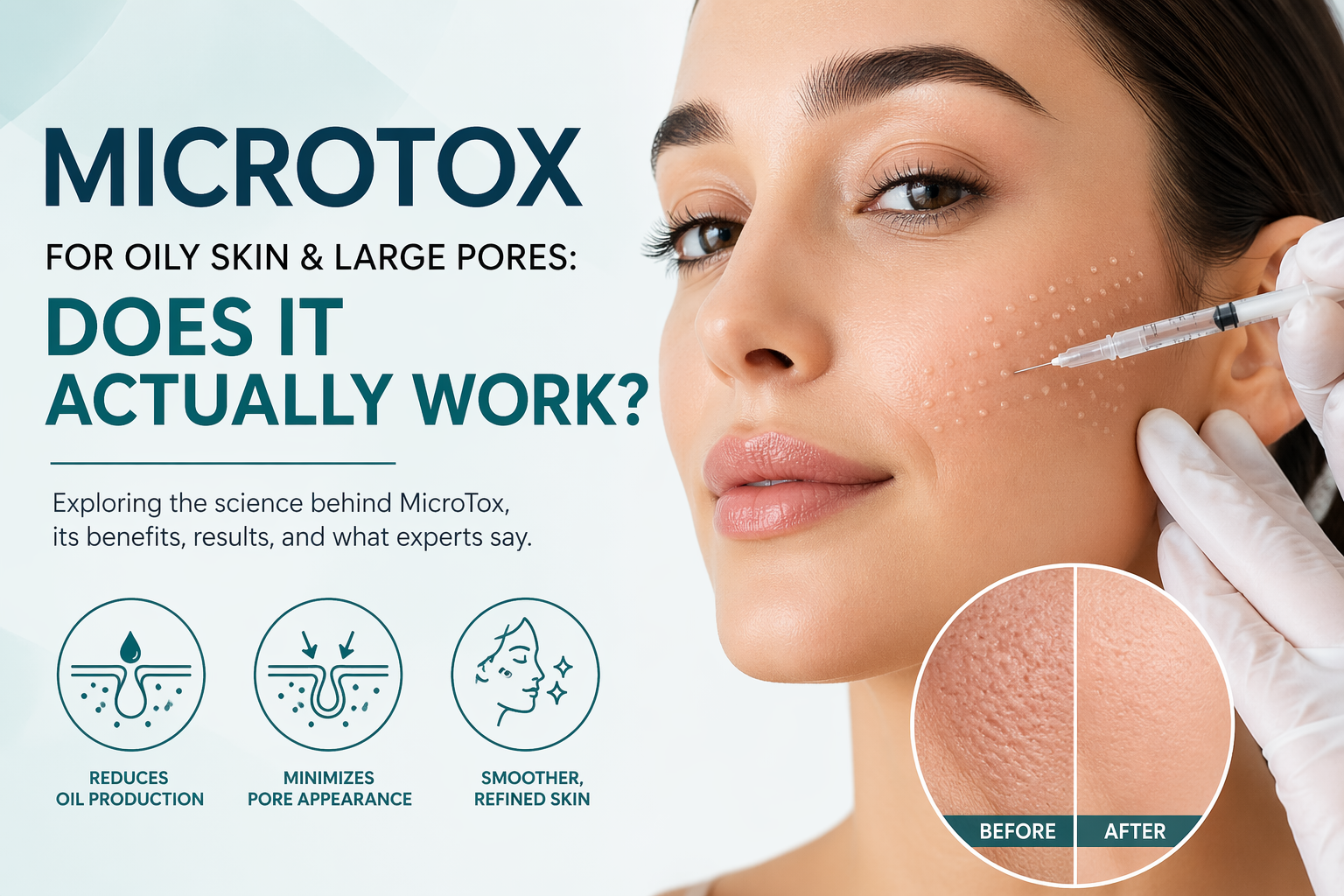
Oily skin and visibly enlarged pores are common dermatological concerns driven primarily by increased sebaceous gland activity and changes in skin structure over time. While topical treatments—such as retinoids, exfoliating acids, and oil-control formulations—can improve symptoms, they often provide limited or temporary results for individuals with persistent oil production.
In aesthetic dermatology, a technique known as MicroTox—also referred to as micro botox, microtox facial, or micro botox facial—has gained attention as a potential adjunctive approach for improving skin texture and reducing oil-related pore visibility. This method involves the superficial administration of diluted botulinum toxin to influence skin-level processes rather than deeper muscle activity.
This article provides a medically grounded, evidence-aligned overview of microtox for oily skin and pores, explaining how it works, what outcomes can realistically be expected, and how it compares with established dermatological treatments.
What Is MicroTox?
MicroTox treatment is a clinical technique involving the injection of highly diluted botulinum toxin into the superficial dermis using microdroplet delivery. Unlike traditional botulinum toxin treatments, which are injected into muscles to reduce dynamic wrinkles, this approach targets the upper skin layers.
Botulinum toxin itself is a purified neurotoxic protein that temporarily blocks nerve signaling. For a foundational understanding, see Botulinum toxin.
Key Characteristics of MicroTox:
- Superficial (intradermal) injection technique
- Use of diluted neuromodulator formulations
- Focus on skin quality rather than muscle movement
- Preservation of natural facial expression
Understanding Oily Skin and Enlarged Pores
Sebaceous Gland Function
Sebaceous glands produce sebum, a lipid-based substance that helps maintain skin hydration and barrier integrity. Overactivity of these glands can lead to:
- Excess oil (seborrhea)
- Clogged pores
- Acne development
- Increased visibility of pores
Why Pores Appear Larger
Pore size is largely determined by genetics and skin type. However, pores may appear enlarged due to:
- Excess oil stretching the follicular opening
- Reduced collagen support in surrounding skin
- Accumulation of debris and dead skin cells
It is important to note that pores do not open or close; therefore, treatments focus on reducing their appearance rather than permanently shrinking them.
How MicroTox Works for Oily Skin and Pores
Mechanism of Action
When administered intradermally in diluted form, botulinum toxin may:
- Modulate nerve signals that influence sebaceous gland activity
- Reduce oil secretion in treated areas
- Improve skin smoothness by affecting superficial muscle fibers
This use is considered off-label, meaning it is not specifically approved by the U.S. Food and Drug Administration for oil control or pore reduction.
Observed Clinical Effects
In clinical practice and limited studies, some patients experience:
- Reduced skin oiliness
- Smoother skin texture
- Less noticeable pores
However, outcomes can vary significantly based on:
- Skin type
- Treatment technique
- Dosage and dilution
- Practitioner experience
Does MicroTox Reduce Pore Size?
MicroTox does not structurally reduce pore size. Instead, it improves the appearance of pores by addressing contributing factors such as oil production and skin surface irregularities.
What It Can Do:
- Reduce excess sebum
- Improve skin texture
- Minimize visual prominence of pores
What It Cannot Do:
- Permanently shrink pores
- Alter genetic pore size
- Replace foundational skincare or dermatological treatments
As such, MicroTox may be considered a supportive or adjunctive reduce pore size treatment, rather than a definitive solution.
MicroTox vs Traditional Botox
| Feature | Traditional Botox | MicroTox |
| Injection Depth | Muscle layer | Superficial dermis |
| Primary Use | Wrinkle reduction | Skin texture & oil control |
| Effect on Movement | Reduces movement | Maintains expression |
| FDA Approval | Approved uses | Off-label technique |
| Effect on Pores | Minimal | May improve appearance |
This distinction is essential when evaluating terms such as “Botox for oily skin”, which typically refer to intradermal (MicroTox-style) applications rather than standard injections.
Results Timeline and Duration
Expected Timeline:
- 3–7 days: Initial changes may begin
- 1–2 weeks: Full visible effects typically develop
Duration:
- Effects generally last 3 to 4 months, depending on individual factors
Maintenance:
- Repeat treatments are usually required to sustain results
Safety, Risks, and Considerations
Safety Profile
When performed by qualified medical professionals, MicroTox is generally well tolerated. However, potential side effects include:
- Mild redness or swelling at injection sites
- Bruising
- Temporary uneven skin texture
- Rare cases of unintended muscle weakness
Important Consideration
Because this application is off-label, it should be:
- Performed only by licensed, experienced practitioners
- Based on individualized assessment
- Integrated into a broader skin management plan
Professional guidance from dermatology authorities such as the American Academy of Dermatology emphasizes the importance of medically supervised aesthetic procedures.
Expert Best Practices
Patient Selection
MicroTox may be appropriate for individuals who:
- Have oily or combination skin
- Experience visible pores without severe scarring
- Seek subtle, natural-looking skin refinement
Treatment Integration
Best results are typically achieved when combined with:
- Medical-grade skincare (retinoids, niacinamide)
- Sun protection
- Periodic exfoliation or resurfacing treatments
Practitioner Expertise
Precise injection depth, dilution, and placement are critical. Improper technique may lead to:
- Inconsistent results
- Over-diffusion of product
- Unintended aesthetic effects
Common Misconceptions
“MicroTox permanently shrinks pores”
Incorrect. It improves appearance but does not change pore structure.
“It replaces skincare”
MicroTox complements, but does not replace, daily skincare.
“It works the same as regular Botox”
It differs significantly in technique, depth, and purpose.
“Results are guaranteed”
Outcomes vary and are not uniform across all patients.
Supporting Skin Health
Adjunctive strategies may enhance outcomes and support long-term skin health:
- Balanced skincare routines targeting oil regulation
- Nutritional support for skin barrier function
- Hydration and lifestyle factors
Some clinical programs may include supplements aimed at skin health, depending on individual needs and practitioner guidance.
Frequently Asked Questions
1. What is microtox?
MicroTox is a technique involving superficial injection of diluted botulinum toxin to improve skin texture and reduce oiliness.
2. Does microbotox for pores work?
It may improve the appearance of pores by reducing oil production and smoothing the skin surface.
3. Is micro botox FDA-approved for oily skin?
No. Its use for oil control and pore reduction is considered off-label.
4. How long do results last?
Typically 3–4 months, depending on individual response.
5. Can it treat acne?
It is not a primary acne treatment but may help reduce oil-related breakouts in some cases.
6. Is the procedure painful?
Discomfort is generally minimal due to superficial injections.
7. Are there risks?
Yes, including mild swelling, bruising, and rare temporary muscle effects.
8. How soon are results visible?
Initial changes may appear within several days, with full results in about two weeks.
9. Who is not a good candidate?
Individuals with certain neuromuscular conditions or unrealistic expectations may not be suitable candidates.
10. Can it be combined with other treatments?
Yes, it is often combined with skincare or dermatological procedures.
Conclusion
MicroTox represents an evolving technique in aesthetic dermatology that may offer benefits for individuals dealing with oily skin and visible pores. By modulating superficial nerve signaling, it can help reduce oil production and improve overall skin texture.
However, it is not a permanent solution for pore size reduction and should be understood as part of a broader, medically guided skin management strategy. Given its off-label status, treatment should always be performed by qualified professionals with appropriate clinical oversight.
When applied correctly and combined with evidence-based skincare practices, MicroTox may provide meaningful, though temporary, improvements aligned with current dermatological standards.
About The Author
