





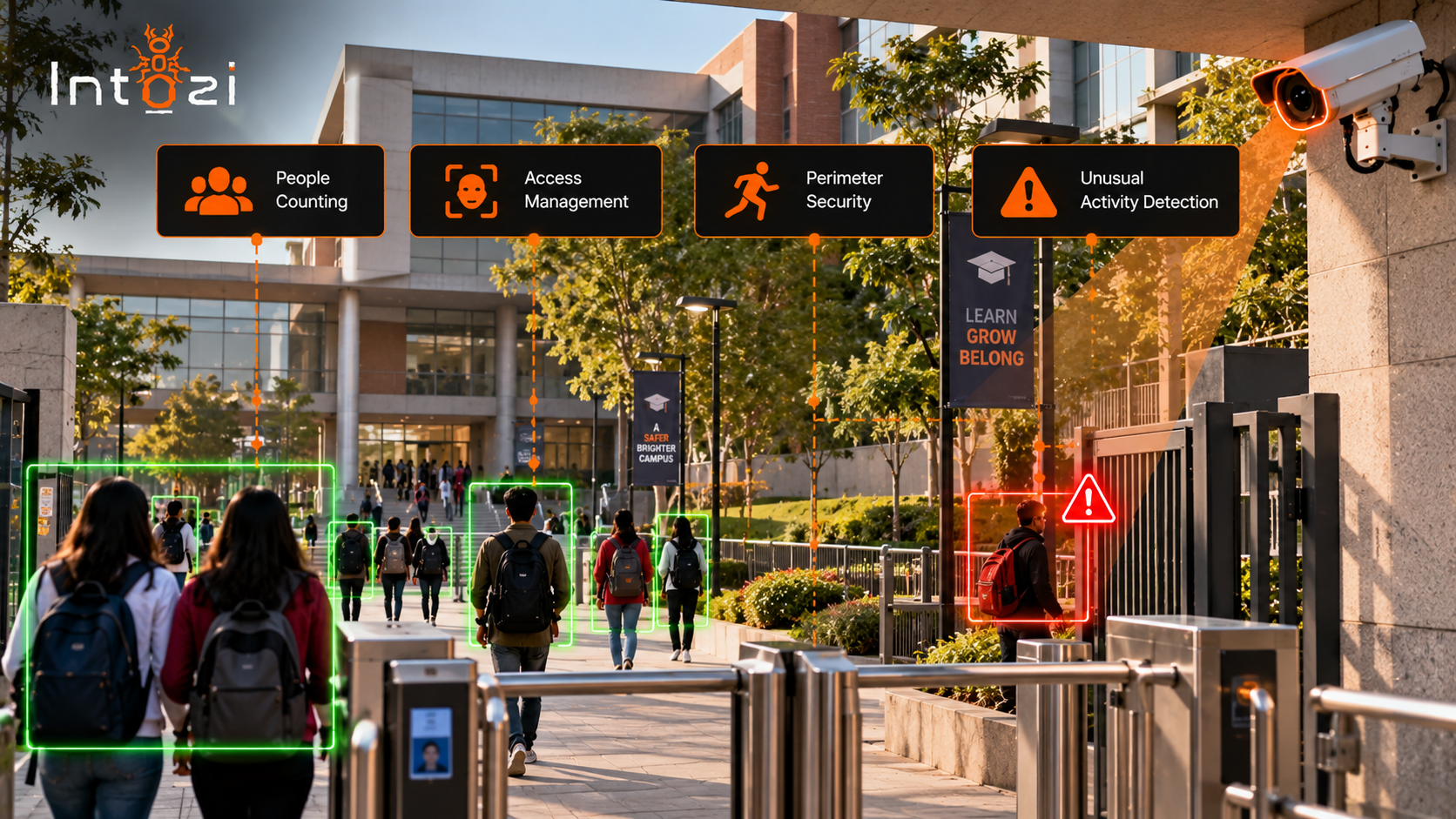
Schools, colleges, and universities manage busy environments where student safety, campus access, visitor movement, and daily operations require careful coordination. Traditional CCTV systems help security teams observe and record activities, but manually monitoring multiple camera feeds across large campuses can be challenging. AI video analytics for education institutions can add an intelligent monitoring layer by identifying predefined events and helping authorised personnel focus on situations that require attention.
An effective system is not simply about installing AI software. It requires suitable camera coverage, relevant detection capabilities, reliable alert workflows, responsible data handling, and integration with existing campus infrastructure. When these elements work together, educational institutions can make better use of video monitoring to support campus security and operational visibility.
What Security Challenges Do Educational Institutions Face on Campus?
Educational campuses include classrooms, laboratories, libraries, hostels, parking areas, playgrounds, and administrative buildings. Each location has different access requirements and monitoring needs.
Common challenges include:
- Identifying unauthorised entry into restricted buildings or campus zones.
- Monitoring gates, entrances, and visitor access points.
- Maintaining visibility across corridors and common areas.
- Monitoring movement around parking areas and campus boundaries.
- Reviewing incidents across multiple camera feeds.
- Coordinating security teams across large or multi-building campuses.
A well-designed campus surveillance system helps institutions organise these monitoring requirements. Adding AI capabilities can support event detection and alert generation, reducing dependence on continuous manual observation.
How Can AI Video Analytics Improve Campus Security?
An effective AI-powered campus security system should be configured around the institution’s actual security priorities. Rather than treating every camera identically, the system can use appropriate detection models and rules for different campus locations.
With AI for education security, possible applications include:
- Detecting people entering restricted areas outside permitted conditions.
- Identifying movement across configured virtual boundaries.
- Monitoring access points and designated perimeter zones.
- Flagging unusual activity for review by authorised personnel.
- Supporting incident investigation with relevant video footage and timestamps.
These capabilities can strengthen intelligent campus surveillance by directing attention towards defined events. Detection performance depends on camera positioning, lighting, network conditions, and the AI models selected. Alerts should be reviewed by trained staff before decisions are made.
What Features Should a Smart Campus Security System Include?
A reliable smart campus security approach combines suitable technology with clearly defined operating procedures. Institutions should evaluate whether a solution supports the locations, events, and response workflows relevant to their campus.
Important features include:
- Real-time event alerts: Notifications for supported security events in monitored areas.
- Restricted-area monitoring: Configurable detection zones for laboratories, server rooms, hostels, and administrative buildings.
- Perimeter monitoring: Visibility around gates, boundary walls, and designated access routes.
- Centralised monitoring: A coordinated view of relevant video streams and alerts across campus.
- Incident review: Access to recorded footage for investigating reported events.
- Flexible integration: Compatibility with supported cameras, video management systems, and existing security workflows.
A smart campus management strategy may also connect security monitoring with other operational systems. However, AI video analytics should be selected for the specific tasks it can reliably perform rather than assumed to manage every aspect of campus administration.
How Can Computer Vision Support Student and Campus Safety?
Computer vision for education safety focuses on analysing visual information to identify selected activities or conditions that may require attention. Depending on the deployed models, this can include monitoring restricted areas, identifying falls, or detecting movement into designated hazardous zones.
For example, AI-powered campus safety applications may help institutions:
- Monitor access to laboratories and other controlled environments.
- Identify people entering areas restricted during certain operating periods.
- Flag potential falls or unusual activity in supported scenarios.
- Improve visibility around parking areas and vehicle routes.
- Review incidents occurring in monitored corridors and common areas.
These capabilities can support campus safety teams, but they cannot reliably interpret every student interaction or determine intent from video alone. Policies should define appropriate use, human review, and escalation procedures, particularly where children and young people are involved.
Is Face Recognition Attendance Suitable for Universities?
A face recognition attendance system for universities is a specialised application that identifies individuals by analysing facial features. It differs from general-purpose video analytics and requires additional consideration of accuracy, consent or other applicable legal grounds, security, and data protection.
Before deploying facial recognition, universities should assess whether it is necessary and proportionate for the intended purpose. They should also evaluate applicable privacy requirements, alternative attendance methods, access controls, data retention, and procedures for handling incorrect matches.
Facial recognition should not be treated as a mandatory feature of every campus security system. In many cases, institutions can improve security through access monitoring, perimeter detection, and event-based video analytics without identifying every person on campus.
How Can AI Improve Campus Perimeter Security?
Campus boundaries may include multiple gates, vehicle entrances, pedestrian routes, and less frequently used access points. Monitoring these areas consistently can be difficult when security personnel must also manage visitors and respond to incidents elsewhere.
Campus perimeter security AI can help identify people crossing configured virtual boundaries or entering monitored zones where access is restricted. Depending on camera coverage and the selected models, it may also flag movement near designated boundary areas for verification.
An effective implementation should consider:
- Camera coverage and blind spots.
- Lighting conditions during the day and night.
- The location of gates, walls, and pedestrian routes.
- Alert routing to the responsible security team.
- Integration with existing access-control procedures.
These measures can help institutions strengthen monitoring while keeping physical security controls and human supervision in place.
What Should Schools Consider When Selecting AI Surveillance Software?
When evaluating AI surveillance for schools, institutions should consider more than the number of cameras supported. The system should address practical security requirements while respecting students’ and staff members’ privacy.
Key considerations include:
- Use-case suitability: Confirm which events the AI models can detect and which require separate technologies.
- Camera compatibility: Check whether existing cameras provide sufficient image quality and coverage.
- Detection performance: Test the system under actual campus conditions, including crowded areas and changing lighting.
- Privacy safeguards: Define who can access footage, how long recordings are retained, and how data is protected.
- Human oversight: Establish procedures for verifying alerts and responding proportionately.
- Integration: Check compatibility with existing video management systems and security workflows.
- Scalability: Determine whether the system can support additional buildings or campuses as requirements evolve.
These factors help institutions evaluate computer vision in education based on practical needs rather than relying on technology claims alone.
How Can Institutions Align Campus Monitoring with Safety Guidelines?
Educational institutions in India should review applicable regulatory requirements and official guidance when planning security systems. UGC campus safety guidelines compliance should be treated as a governance and implementation consideration, not as a feature that an AI platform automatically guarantees.
Universities should verify current University Grants Commission (UGC) requirements and other applicable rules relevant to their institution, including campus security arrangements, grievance procedures, privacy, and the safeguarding of students. AI video analytics may support selected monitoring activities, but compliance depends on the institution’s overall policies, infrastructure, implementation, and operating procedures.
A responsible approach includes documenting the purpose of monitoring, restricting access to recordings, training personnel, and establishing clear processes for responding to incidents.
How Intozi and Ikshana Support Intelligent Campus Monitoring
Intozi develops AI video analytics software that helps organisations turn video feeds into actionable insights. Its Ikshana platform supports real-time video analytics applications across different operational environments, including use cases related to security, safety, and situational awareness.
For educational institutions considering AI video analytics for education institutions, the appropriate solution depends on campus layout, existing CCTV infrastructure, monitoring priorities, and data governance requirements. Combining suitable AI models with responsible policies and trained security personnel can help institutions build a more coordinated approach to campus monitoring without relying solely on manual observation.
Frequently Asked Questions (FAQs)
What is AI video analytics for educational institutions?
AI video analytics analyses compatible camera footage to identify predefined events, such as entry into restricted areas or movement across configured boundaries. It can help campus security teams prioritise events for review.
Can AI video analytics work with existing school and university CCTV cameras?
Yes, some platforms can use compatible existing cameras. Suitability depends on video quality, camera positioning, network connectivity, and the detection tasks required.
How does AI improve campus surveillance?
AI can identify selected events in video streams and generate alerts for authorised personnel. This can reduce the need to rely entirely on continuous manual observation.
Is facial recognition necessary for campus security?
No. Institutions can use event-based video analytics for applications such as perimeter monitoring, restricted-area detection, and incident review without identifying every person through facial recognition.
Can AI video analytics guarantee student safety?
No system can guarantee complete safety. AI video analytics can support monitoring and incident response, but it should complement physical security measures, trained personnel, safeguarding policies, and appropriate emergency procedures.
What should universities check before implementing AI campus security?
Universities should assess detection capabilities, camera compatibility, privacy safeguards, access controls, alert workflows, integration requirements, and applicable regulations before deployment.
About The Author



