


Every founder who ships their first mobile app hits the same uncomfortable surprise at their first payout: the number that lands in their account is noticeably smaller than the price they set. Somewhere between the sale and the deposit, a platform commission quietly took a real cut, and if you built your financial model around the sticker price your customer paid, that model was wrong from day one. Understanding exactly what Apple and Google actually take, and how to legally reduce it, is exactly the kind of groundwork worth doing with a mobile app development company in New York founders trust before you set your pricing, not after your first payout surprises you.
The Entry Fee: Cheap Either Way, But Structured Differently
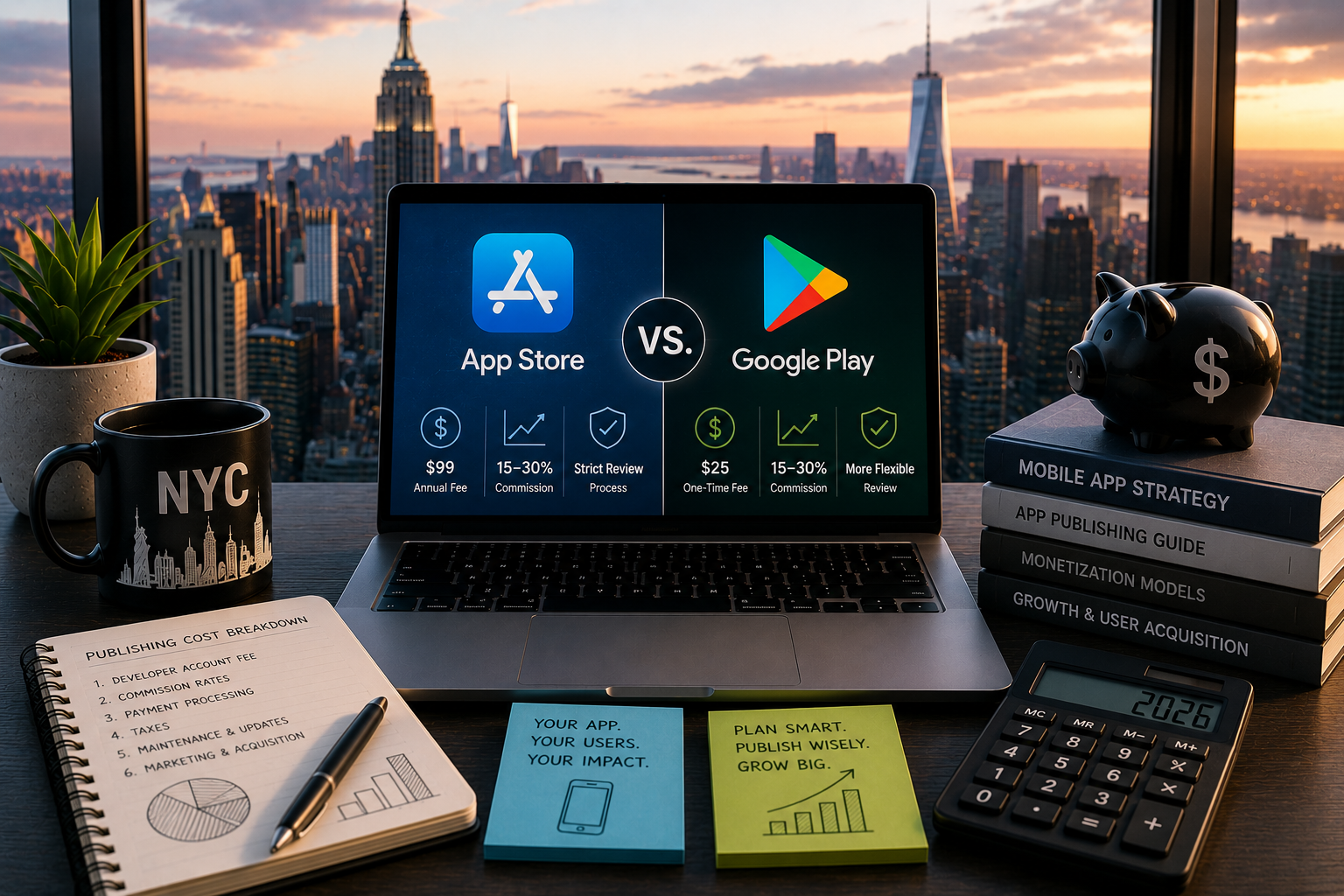
Google Play charges a one-time $25 registration fee with no recurring renewal; pay it once, and your developer account stays active indefinitely. Apple charges $99 annually through its Developer Program, a recurring cost that never goes away regardless of how many apps you publish or how much revenue they generate. Over a five-year horizon, that’s $25 total for Google versus roughly $495 for Apple, a real but genuinely modest difference in the context of an actual app development budget, worth knowing but not a decision-driver on its own.
The Commission Structure Both Platforms Actually Use
Here’s where the real money moves. Both platforms run a similar headline structure: a standard 30% commission on paid apps, in-app purchases, and subscriptions, with a reduced 15% rate available to smaller developers.
Apple’s App Store Small Business Program drops your commission from 30% to 15% if you earned $1 million or less in App Store proceeds during the prior calendar year, which covers the overwhelming majority of indie developers, early-stage startups, and any brand-new app by definition. The catch, and it’s a genuinely important one: you have to actively enroll. This isn’t automatic, and a surprising number of eligible developers never sign up, quietly paying double the commission rate they’re entitled to avoid.
Google Play’s structure is similarly tiered but slightly more generous by default in most regions: your first $1 million in annual Play revenue is automatically charged at 15%, with only revenue above that threshold moving to 30%, no enrollment step required. For subscriptions specifically, Google charges 15% from day one regardless of revenue tier, while Apple only drops subscription commission to 15% after a subscriber completes a full year of paid service. For a subscription-based app specifically, this timing difference is worth building directly into your financial projections rather than assuming both platforms treat recurring revenue identically.
A Genuinely New Wrinkle as of Mid-2026
Starting June 30, 2026, Google began rolling out a materially different fee model in the US, UK, and European Economic Area, unbundling its previous single commission into a separate service fee plus a distinct billing fee for developers using Google Play’s own billing system, with reduced rates available if you route payments through your own processor or link out to the web for checkout instead. This is a genuinely new development worth confirming directly against current documentation if you’re building financial projections right now, since it means Google’s fee structure in these specific regions no longer simply mirrors Apple’s the way it used to.
What a Realistic First-Year Budget Actually Looks Like
Beyond the commission structure, a realistic budget for actually getting an app published, developer accounts, certificates, basic store assets, and minimum compliance work, typically runs somewhere between $2,500 and $8,000 for a small startup, before counting the cost of building the app itself. For the leanest possible case, a free app with no monetization, published to both stores, you’re realistically looking at $124 in combined first-year store fees ($99 Apple, $25 Google) plus your own time.
The Regional Wrinkles Worth Knowing
Fee structures aren’t uniform globally, and this matters if your app has any international ambition. India’s competition regulator ordered Google to allow third-party billing on Play at a reduced 26% commission, a mandate that remains in force in 2026. South Korea runs a comparable structure at a similar rate. The EU’s Digital Markets Act has opened genuine alternative distribution paths in Europe specifically; Apple now allows EU developers to distribute directly from their own website with proper notarization, entirely bypassing App Store commission, though you give up the store’s built-in discovery and take on the full marketing burden yourself.
When Skipping the Stores Entirely Actually Makes Sense
Direct distribution, a web app plus sideloading, avoiding app store commission entirely, genuinely works for a specific category of app: vertical-specific tools where users arrive through channels outside the store to begin with, like enterprise software or niche B2B productivity tools where discovery was never going to happen through app store search anyway. For a typical consumer-facing B2C app depending on organic store discovery, this tradeoff usually isn’t worth it; you’d be giving up real, valuable discovery infrastructure to save a commission percentage that a properly enrolled small business program membership already cuts in half.
A Practical Starting Point
- Enroll in Apple’s App Store Small Business Program immediately if you qualify; this is genuinely the single highest-value, lowest-effort action available, cutting your Apple commission in half for essentially every early-stage app.
- Model your pricing around your actual net payout, not your listed price; build the realistic 15-30% commission directly into your unit economics from the start, rather than discovering the gap at your first payout.
- If you’re building a subscription app, account for the timing difference between platforms: Google’s 15% subscription rate applies immediately, while Apple’s applies only after a subscriber’s first full year.
- Confirm current fee structures directly before finalizing financial projections, particularly if you’re targeting the US, UK, or EU specifically, given Google’s mid-2026 fee restructuring in those regions.
FAQs
Is Google Play actually cheaper than Apple’s App Store overall?
In pure entry-fee terms, yes, a one-time $25 versus Apple’s recurring $99 annually. On commission, the two are close once Apple’s Small Business Program is properly enrolled, though Google’s subscription rate is more consistently favorable from day one rather than only after a subscriber’s first year.
Do I automatically get the reduced 15% commission rate, or do I need to do something?
This differs by platform: Google’s reduced rate on your first $1 million in annual revenue applies automatically with no action needed, while Apple’s equivalent reduction requires actively enrolling in the App Store Small Business Program, a step many eligible developers skip without realizing it.
Should I consider distributing my app outside the official stores to avoid commission entirely?
Generally, only if your app doesn’t depend on store-based discovery to begin with; for most consumer apps, giving up the stores’ organic discovery to save a commission percentage that’s already halved through proper small business program enrollment isn’t a favorable trade.
How much should I actually budget to publish an app for the first time?
Beyond the app’s development cost itself, plan for roughly $2,500 to $8,000 covering developer accounts, certificates, store assets, and basic compliance work for a small startup, with the ongoing store fees themselves being a comparatively minor part of that first-year budget.
Does the commission rate affect how I should price my app or in-app purchases?
Directly, yes, pricing based on the amount your customer pays rather than the amount you’ll actually receive after commission is one of the most common financial modeling mistakes founders make, and it’s worth correcting before your pricing strategy is finalized, not after your first payout.
Bottom Line
The gap between what a customer pays and what actually reaches your account is real, well-documented, and larger than most first-time founders expect, but it’s also genuinely manageable once you understand the mechanics, particularly Apple’s often-skipped Small Business Program enrollment. This is exactly the kind of financial groundwork worth getting right from the start with a mobile app development company in New York that founders trust to help you price and plan around your real net revenue, not the number your customer sees at checkout.
About The Author