



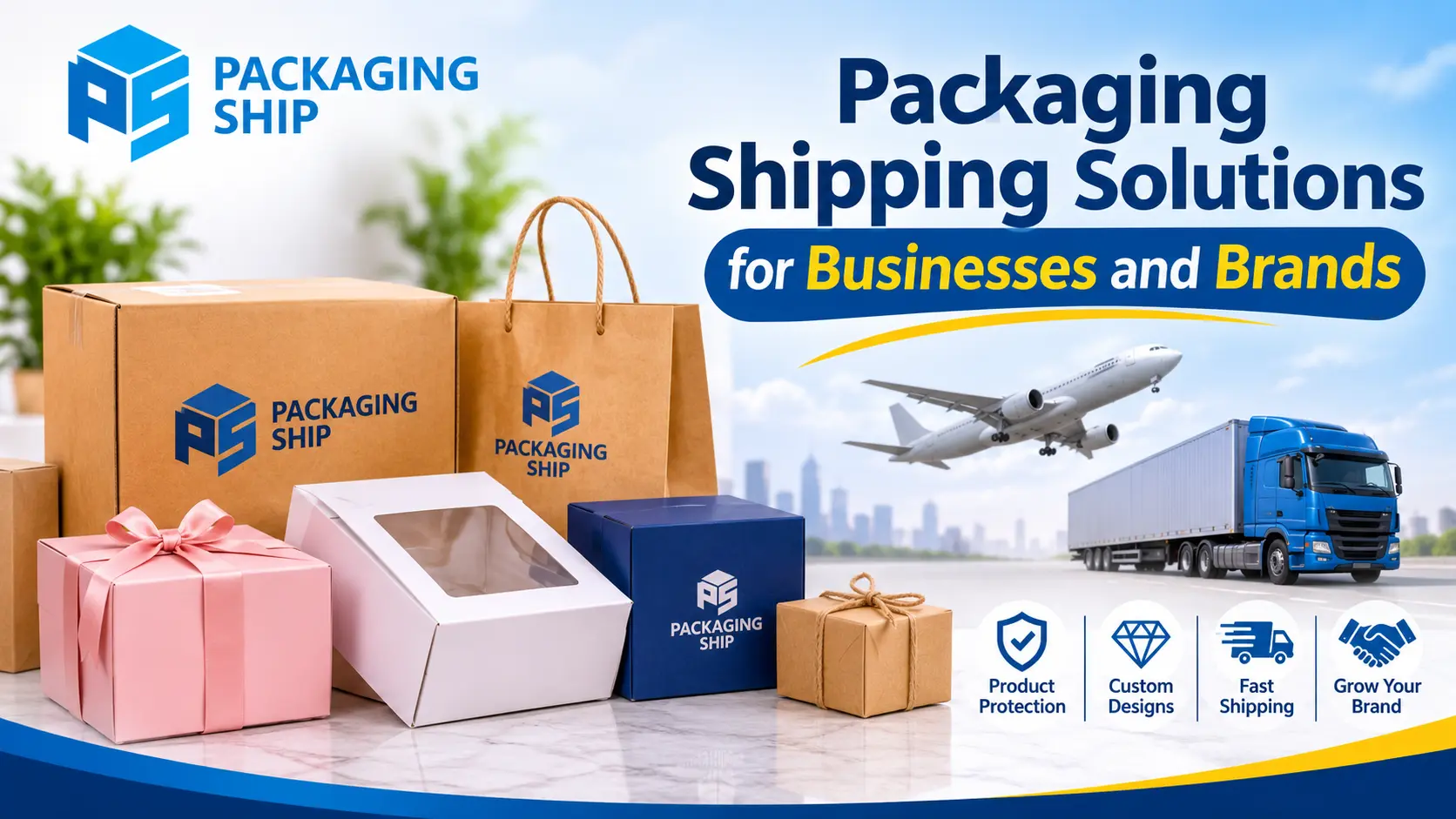
Custom packaging shipping solutions help a growing business cut damage, control freight costs, and deliver a better unboxing experience at the same time. The right setup pairs a box sized to the product with the right material, an insert where needed, and a supplier who can scale with your orders. Packaging Ship makes custom boxes for US businesses, and this guide explains how to plan your shipping packaging as order volume grows.
What Are Custom Packaging Shipping Solutions?
Custom packaging shipping solutions are boxes, inserts, and protective materials built around your product’s size and shipping method. Instead of using a generic carton and filling the gaps with paper, you get packaging that fits, protects, and carries your branding.
A typical setup includes:
- A custom mailer box or shipping box sized to the product
- Inserts, dividers, or padding that hold the item still
- Printed branding on the outside, the inside, or both
- A closure that stays shut through sorting and handling
- Optional extras like tissue, thank-you cards, or tamper-evident seals
For an e-commerce brand, this is the packaging a customer sees first, so it works as both protection and marketing.
Why Do Growing Businesses Outgrow Stock Boxes?
Stock boxes work fine when you ship a handful of orders a week. Once volume climbs, wasted space, damaged items, and inconsistent branding start to cost real money. A box built for your product trims material, lowers shipping charges, and makes packing faster for your team or fulfillment center.
How Does Box Size Affect Shipping Costs?
Box size affects shipping costs because most carriers charge by dimensional weight, which is based on package volume as well as actual weight. A large box holding a light product can cost more to ship than a small, dense one.
That makes size one of the easiest places to save:
- Measure your product in inches, then add only the room needed for padding
- Compare your box dimensions against your carrier’s rate rules
- Remember that a few inches on each side can bump you into a higher rate tier
- Check size limits for USPS, UPS, and FedEx before you finalize a design
Carriers update their rates and rules often, so check current pricing before you commit to a box size for a long production run.
What Is Dimensional Weight in Plain Terms?
Dimensional weight is a pricing method that turns a package’s size into a billable weight. The carrier compares that number with the real weight and charges the higher one. If your box has a lot of empty space, you may pay for air.
Which Box Type Works Best for Shipping?
Mailer boxes suit most e-commerce orders, shipping boxes handle heavier or bulkier items, and rigid boxes suit premium products that need a stronger look. The right choice depends on weight, fragility, and how the item reaches the customer.
| Box Type | Best For | Strength | Notes |
|---|---|---|---|
| Custom mailer box | Apparel, accessories, beauty, subscription items | Moderate | Ships flat, prints inside and out |
| Corrugated shipping box | Heavier or bulkier items | High | Tape-sealed, strong stacking |
| Rigid box | Jewelry, electronics, gift sets | High (structural) | Premium feel, usually placed in an outer carton |
| Folding carton | Retail products, small items | Low to moderate | Best inside a stronger shipper |
| Mylar bag | Coffee, supplements, dry goods | Barrier protection | Light, good for moisture control |
Do You Need a Box Inside a Box?
For fragile or premium items, often yes. A rigid or retail box handles presentation, while an outer shipping carton handles the trip. This two-layer approach protects the product and keeps the inner box looking new when the customer opens it.
How Do You Protect Products During Shipping?
You protect products by limiting movement, absorbing shock, and choosing material strong enough for the weight. Most damage happens when an item shifts inside the box and hits the walls or another item.
Common protection methods:
- Die-cut inserts hold the product in a fixed position
- Cardboard dividers separate multiple items in one box
- Molded pulp trays cushion bottles and jars with a recyclable material
- Paper void fill takes up leftover space without adding much weight
- Double-wall corrugated adds crush resistance for heavy loads
A simple test helps: pack the box, close it, and shake it. If anything moves or rattles, the box needs a better fit or more support. For high-volume or high-value products, many brands run drop and vibration tests, sometimes following industry procedures such as those from ISTA, before settling on a design.
What Should You Consider for Different Product Types?
Each product type has its own shipping risks, so packaging should follow the product. Food, cosmetics, and apparel all need different things from a box.
- Food products. Use food-safe materials, and ask your supplier to confirm they meet FDA food-contact requirements where the packaging touches the food.
- Cosmetics and skincare. Use tuck boxes or cosmetic boxes with inserts so bottles and jars stay upright and don’t leak or crack.
- Apparel. Use mailer boxes or poly-lined mailers, with tissue to prevent creasing.
- Coffee, tea, and supplements. Use mylar bags for a moisture and air barrier, then ship in a sturdy outer box.
- Jewelry and gifts. Use rigid boxes with a snug insert, then place them in a protective shipper.
- Subscription kits. Use a mailer with dividers so each item stays organized.
How Do You Keep Shipping Packaging Affordable as You Grow?
Keep costs in check by right-sizing boxes, ordering in sensible quantities, and standardizing your box styles. A smaller set of well-designed boxes is easier to stock, cheaper to produce, and faster to pack.
Practical ways to save:
- Use one or two box sizes that cover most products
- Order enough to benefit from volume pricing, without overbuying
- Choose simple one- or two-color printing for plain shippers
- Save premium finishes like foil or embossing for gift or retail lines
- Pick flat-shipping styles to save warehouse space
- Ask for the delivered price, since freight on bulk boxes adds up
How Much Does Custom Shipping Packaging Cost?
Custom shipping boxes commonly cost between $0.50 and $5.00 each, depending on material, size, printing, and quantity. Simple mailers with one-color printing sit near the low end, while rigid boxes with finishes cost more.
| Cost Factor | Effect on Price |
|---|---|
| Order quantity | Larger runs lower the price per box |
| Material and board thickness | Double-wall and rigid cost more |
| Print colors and finishes | Each extra step raises the price |
| Inserts and dividers | Small added cost per box |
| Shipping on the box order | Free shipping lowers your total |
How Do You Plan Packaging for Peak Shipping Season?
Plan early, order extra, and confirm lead times before the rush starts. Carriers get busy from Black Friday through the end of December, and packaging suppliers fill their schedules too.
A simple peak-season plan:
- Forecast your holiday order volume using last year’s sales and current growth
- Order boxes weeks before you need them, since production usually takes two to four weeks
- Keep a buffer of 10 to 20 percent more than your forecast
- Check carrier cutoff dates and shipping deadlines
- Test one packed order end to end before the rush
If you’re reading this now, in late November, a new custom order may not land before the peak, so consider a plan for next season and use ready-made options in the meantime.
What Should You Look for in a Packaging Supplier?
Look for a supplier who offers clear pricing, a proof before production, honest lead times, and the ability to grow with your business. Reliability matters as much as unit price, since a late box order can stop your fulfillment line.
Questions worth asking:
- What is the minimum order quantity?
- Will you see a proof or sample before full production?
- Is design help included?
- Is shipping included in the quote?
- How long does production take, and how does that change in peak season?
- Can they produce different box types as your product line grows?
Packaging Ship is a US-based custom packaging company in Valley Stream, New York, producing mailer boxes, rigid boxes, tuck boxes, food packaging, cosmetic boxes, and mylar bags to order. They offer free design support, free shipping, and wholesale pricing without needlessly high minimums, which suits a business that’s scaling from a few orders a week to a few hundred.
Frequently Asked Questions
What are custom packaging shipping solutions?
They’re boxes, inserts, and protective materials designed around your product and your carrier. The goal is to cut damage, lower shipping costs, and keep your branding consistent.
How much does custom shipping packaging cost?
Most custom boxes cost between $0.50 and $5.00 each, depending on material, size, printing, and quantity. Larger orders and simple designs lower the price.
What is the minimum order quantity for custom shipping boxes?
It varies by supplier, and many start between 50 and 100 units. Confirm the exact number before you finalize your design.
How long does it take to get custom shipping packaging?
Production and shipping usually take two to four weeks, and peak season can add time. Rush options may be available for an extra fee.
What type of box is best for e-commerce shipping?
Custom mailer boxes work well for most online orders, since they ship flat and print on both sides. Heavier or more fragile items may need a corrugated shipping box or an insert.
Where can I order custom packaging for shipping in the USA?
US-based suppliers such as Packaging Ship produce custom boxes with free design support and free shipping. Ask for a proof or sample before placing a large order.
How can I lower shipping costs with better packaging?
Use a box sized close to your product, avoid extra void space, and compare your dimensions against carrier rate rules. Lighter, smaller packages often cost less to ship.
Ready to Upgrade Your Shipping Packaging?
Good shipping packaging fits the product, survives the trip, and scales with your orders. When you’re ready to compare box styles and get pricing, request a quote from Packaging Ship with your product size, quantity, and shipping method.
About The Author