


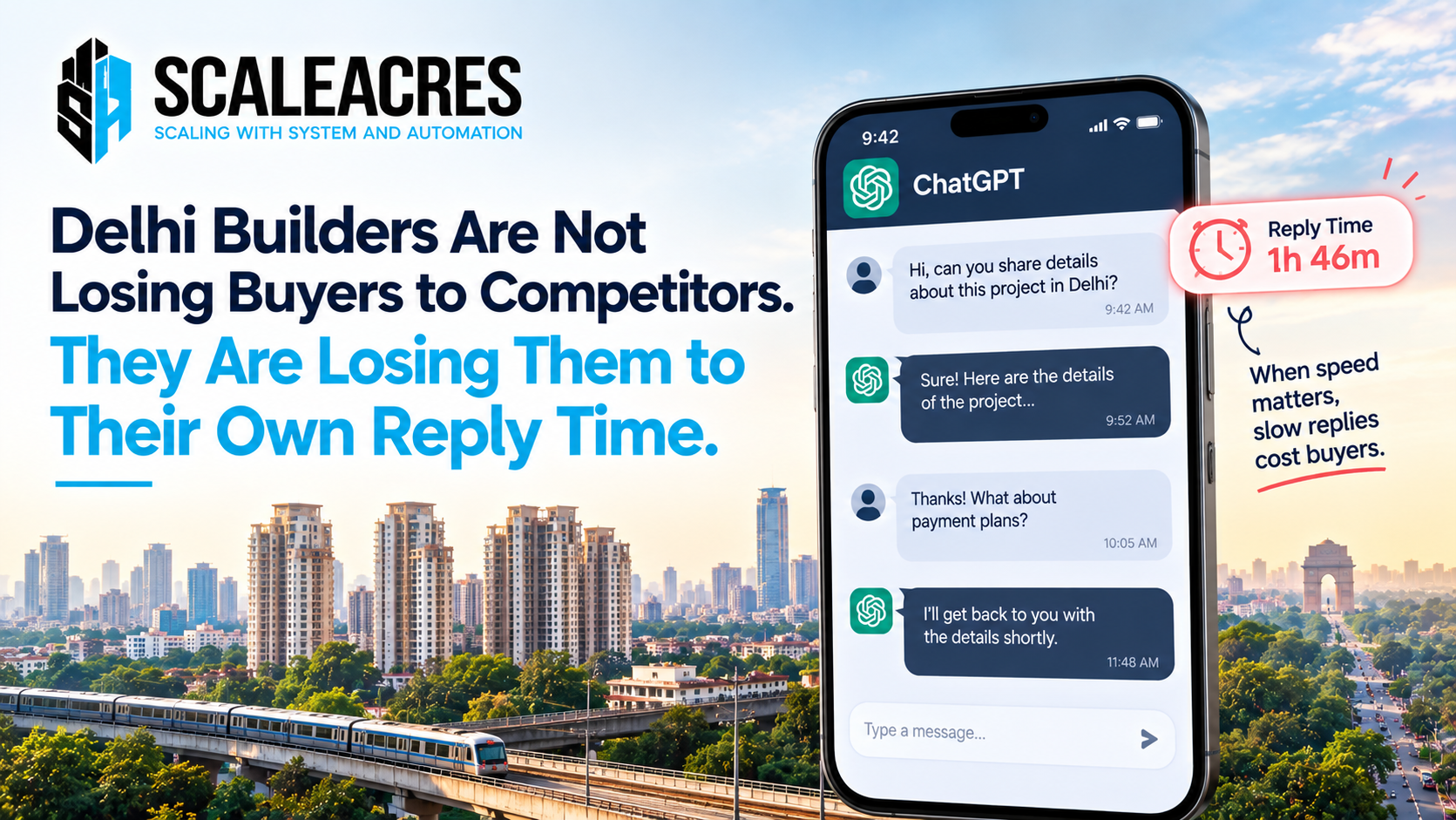
Most Delhi developers can name the competitors they worry about: the project down the road, the bigger brand, the one with the larger ad budget. But if you follow what happens to a typical enquiry, a different pattern often shows up. The buyer did not choose someone else because the other project was clearly better. They chose whoever replied first, and replied usefully. Strong digital marketing services for real estate in Delhi are not only about bringing enquiries in. They are also about making sure those enquiries are answered while the buyer’s interest is still alive.
Quick answer: Competitors matter, but in many cases the larger and more fixable loss happens after the enquiry: a slow first reply, a generic message, an unanswered price question, or silence after the brochure. A buyer comparing several projects tends to move forward with the one that responds quickly and clearly. This is a view based on common patterns in property follow-up, not a statistic, so check it against your own CRM data.
Why reply time carries so much weight
A buyer who fills in a form is at the peak of their interest. A few things are true at that moment:
- They have probably enquired with more than one developer. Delhi NCR buyers often look at projects across several locations and price points at the same time.
- They remember the project right now. A day or two later, the details have blurred.
- They are forming an impression. The first reply tells them how organised, honest and helpful the team is likely to be after booking as well.
- They are busy. Working buyers often browse in the evening or on weekends, so a reply during a slot that suits them counts for more.
None of this means the project, price and location don’t matter. They do. It means a good project can still lose a buyer in the first few hours if the reply is slow or empty.
What “reply time” really includes
Teams often measure only one number: how fast the first call was made. In practice, three different delays matter:
| Delay | What it means | Why buyers feel it |
|---|---|---|
| Time to first response | How long until the buyer hears anything | Silence feels like indifference |
| Time to first useful answer | How long until the buyer gets price, details or a real answer | A fast “we’ll call you” without information doesn’t help |
| Time between follow-ups | How long the buyer waits when they ask a second or third question | Gaps let the buyer move on |
A team can look fast on the first measure and still be slow on the other two.
Where Delhi teams usually lose time
- Leads sit in a shared inbox or spreadsheet, with no clear owner and no alert.
- Leads arrive from many places (Meta, Google, portals, website, WhatsApp) and are collected in different systems.
- Manual assignment waits for a manager to distribute leads.
- One person handles everything, with no backup during calls, site visits or time off.
- Evening and weekend enquiries wait until the next working day, even though buyers are often most active then.
- Replies need approval for price or brochure details, which slows everything down.
- The first reply is generic, so a second reply is needed before the buyer gets anything useful.
- Follow-up depends on memory, not on reminders or a defined plan.
What the buyer experiences
From the buyer’s side, a slow reply looks like this:
- No acknowledgement after submitting the form
- A call many hours later, at an inconvenient time
- A brochure with no price range
- A second person calling with the same questions
- A price question answered with “please visit”
- Silence for a few days, then a call asking “are you still interested?”
Meanwhile another developer sent a short message with price range, location and a walkthrough within minutes. The buyer did not decide that the second project was better. They decided it was easier.
A simple response system any team can set up
Tier 1: Instant (seconds)
An automatic WhatsApp or SMS confirmation that names the project and includes the brochure link, price range and location pin.
Tier 2: Fast and personal (within minutes during working hours)
A personal message or call that mentions the exact configuration the buyer asked about and offers a clear next step.
Tier 3: Steady follow-up (days and weeks)
Short, useful messages at planned intervals, such as a floor plan, commute information or a construction update, so the buyer stays informed without feeling chased.
Outside working hours: send the instant reply, assign the lead to a named person, and follow up first thing the next morning.
Sample first messages
Instant auto-reply:
“Hello [Name], thank you for your enquiry about [Project Name] in [Location]. We have received your details and our team will contact you shortly. Meanwhile, here is the brochure and location: [link].”
Personal follow-up:
“Hi [Name], this is [Your Name] from [Developer]. You asked about [configuration] at [Project Name]. I can share the pricing and availability here, or call if that’s easier. What time works for you?”
Keep messages short, specific and easy to read on a phone.
How to set it up in practice
- Bring all leads into one CRM, so nothing is scattered.
- Turn on instant alerts to the sales team’s phones.
- Assign leads automatically, with a backup person if the first doesn’t respond.
- Prepare ready-to-send templates for common first replies, and personalise them.
- Keep a shareable information pack with price range, floor plans, location pin and approvals.
- Use WhatsApp automation for acknowledgements and reminders, while keeping the conversation itself personal.
- Set a response target and review it weekly, not once a year.
Mistakes that make it worse
- Replying fast with nothing useful in the message
- Calling many times in a row and overwhelming the buyer
- Having several people contact the same lead
- Ignoring leads that arrive at night or on weekends
- Treating leads from portals differently from leads from ads without a reason
- Not recording response times, so no one knows the real numbers
How to find out if this is happening in your team
You don’t need to guess. Check your own data:
- Average time to first response, and the spread (the slowest 20% matters more than the average)
- Time to first useful answer, such as the first message that included price or details
- Share of leads contacted within your target time
- Lead-to-visit rate for fast replies compared with slow replies
- Number of different people who contacted each lead
- Number of leads never contacted at all
- Response time by source, by time of day and by team member
If fast-reply leads visit more often than slow-reply leads, you have found something worth fixing before you spend more on ads.
Frequently asked questions
How quickly should a builder reply to a property enquiry?
Send an automatic confirmation instantly, and follow up personally as soon as your team can, ideally within minutes during working hours. Use your own data to set the exact target.
Is reply time really more important than price?
Price matters a lot, but a buyer who never gets a useful reply never reaches the price conversation. Speed and clarity decide whether you stay in the shortlist.
What if the team is too small to reply instantly?
Use automation for the first acknowledgement and share useful information in it. Then assign a named person and a clear time for the personal follow-up.
Does a faster reply mean a pushier sales process?
No. Speed is about being available and useful. Respect the buyer’s preferred channel and timing, and avoid repeated calls.
What should I fix first?
Start with the basics: one CRM, instant alerts, a clear owner for each lead and an information pack that answers the first questions buyers ask.
The bottom line
It is tempting to blame competitors when enquiries don’t turn into visits. Sometimes that is fair. But very often the loss happens earlier and closer to home, in the hours after the form was submitted. Reply time is one of the few parts of the sales process that a developer can improve quickly, without changing the project, the price or the ad budget.
If you want help building a faster, more useful follow-up system around your campaigns, you can explore ScaleAcres and its digital marketing services for real estate in Delhi, including lead generation, WhatsApp and CRM automation, retargeting and local SEO for developers and brokers.
About The Author