



Direct-to-consumer brands are outgrowing their platforms faster than ever. What worked for a five-SKU launch on a monolithic e-commerce platform often buckles under the weight of omnichannel selling, personalisation demands, and Google’s ever-shifting Core Web Vitals thresholds. According to Salesforce’s State of Commerce, 73% of customers expect a consistent experience across multiple channels, making flexible commerce architectures increasingly important for growing D2C brands. This has pushed “headless commerce” from a buzzword into a genuine architecture decision, but it isn’t the right call for every brand.
This is a decision more brands are being forced to confront earlier in their growth curve. The shift usually isn’t triggered by a single event, but by a build-up of friction: slowing page speeds, marketing teams waiting on developers for basic page changes, and backend systems that can’t keep pace with new sales channels. For companies like Focalworks, a custom software development company that builds scalable eCommerce and headless commerce solutions for D2C and retail brands, these challenges have become increasingly common.
What Separates Headless Commerce From Traditional Platforms
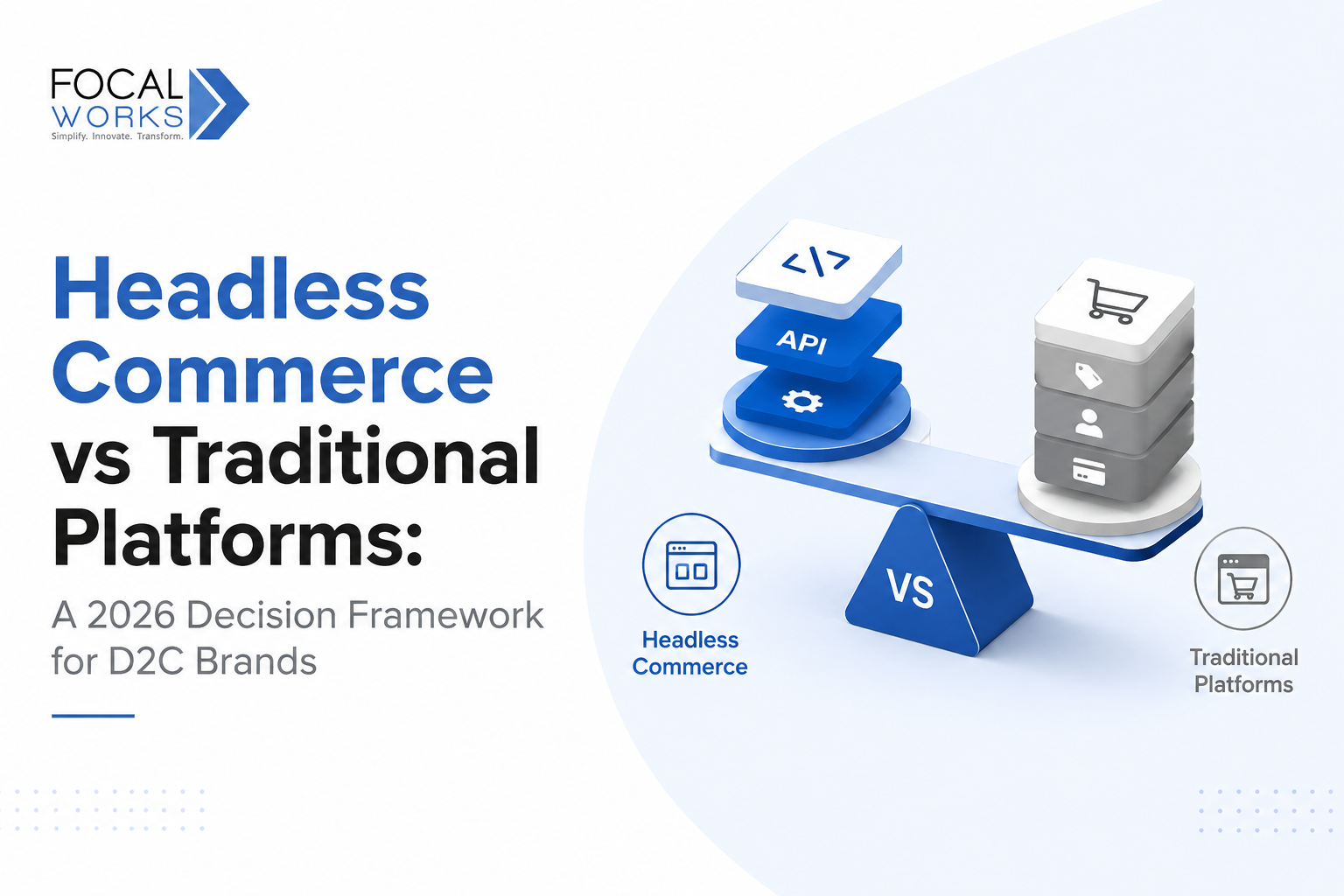
A traditional e-commerce platform bundles the frontend (what shoppers see) and the backend (inventory, checkout, payments) into one tightly coupled system. Templates are fast to launch but slow to customize once you outgrow them.
Headless commerce decouples these layers. The backend continues to handle commerce logic, while the frontend is built independently and connects via APIs. This means:
- Content and commerce can be delivered to any channel, including web, app, kiosk, voice, or IoT, from a single backend
- Frontend teams can ship UI changes without touching backend infrastructure
- Brands aren’t locked into a platform’s native design constraints
Why D2C Brands Are Reconsidering Their Stack in 2026
Three forces are driving this shift for direct-to-consumer companies specifically:
- Page speed is now a conversion lever, not just an SEO metric. Headless frontends, often built on React or Next.js, consistently outperform template-heavy monolithic sites on load times, which directly affects mobile conversion rates.
- Omnichannel expectations have normalised. Shoppers move between app, web, and social commerce fluidly, and brands need one commerce engine powering all of it consistently.
- Personalisation and AI-driven merchandising require flexibility. Recommendation engines, dynamic pricing, and AI search increasingly need direct API access to commerce data, something monolithic platforms often restrict or slow down.
Research from Google shows that as page load time increases from 1 to 3 seconds, the probability of a bounce rises by 32%, reinforcing why frontend performance has become a direct revenue driver for ecommerce brands.
When Traditional Platforms Still Make Sense
Headless isn’t automatically the better choice. For a large share of D2C brands, a traditional platform remains the more sensible option:
- Early-stage or bootstrapped brands need to validate product-market fit quickly, and headless adds engineering overhead you may not need yet
- Small catalogues with simple funnels rarely see meaningful ROI from architectural flexibility
- Limited in-house or agency development resources make headless maintenance costly, since you lose the “batteries included” simplicity of a monolithic platform
- Marketing teams that rely on drag-and-drop page builders may find headless frontends slower to update without dedicated developer support
The honest trade-off is that headless buys you flexibility and performance at the cost of implementation complexity and higher upfront development investment.
A Simple Decision Framework
Rather than treating this as an all-or-nothing choice, D2C brands should evaluate four factors:
- Growth Trajectory: Are you scaling into multiple markets, channels, or storefronts within 12 to 18 months?
- Content-Commerce Complexity: Do you need rich editorial, brand storytelling, or frequent landing page experimentation alongside product listings?
- Technical Capacity: Do you have, or can you resource, a frontend development team to maintain a decoupled architecture?
- Performance Sensitivity: Is your customer acquisition cost heavily tied to page speed and Core Web Vitals performance?
If you answered yes to two or more of these, headless commerce is worth serious evaluation. If your funnel is simple and your team is lean, a modern traditional platform with partial headless capabilities may deliver better ROI with less risk. As your business scales, headless commerce services can help you build a more flexible, high-performance ecommerce experience that is ready for future growth.
How Focalworks Approaches Headless Commerce for D2C Brands
Making the shift to headless is as much an implementation challenge as it is an architectural one, which is where an experienced development partner matters. Focalworks works with growing D2C and retail brands to evaluate whether headless is the right fit before committing to a rebuild, rather than defaulting to it as a trend.
Their process generally covers:
- A technical and business audit of catalogue complexity, traffic patterns, team capacity, and growth plans before recommending an architecture
- Frontend development on modern frameworks such as React and Next.js, built to integrate with API-first commerce backends
- Phased migration paths that decouple high-traffic pages first, avoiding disruption to live storefronts during the transition
- Post-launch support to fine-tune performance, integrations, and scaling as the brand’s channels and catalogue grow
For brands exploring headless commerce, Focalworks offers services across architecture planning, implementation, and deployment. Businesses that are not ready for a complete rebuild can also consider its broader e-commerce website development capabilities, including composable and hybrid approaches that support gradual modernization of high-impact storefront experiences.
Choosing the Right Commerce Architecture for Your Brand
There’s no universally better architecture, only the better fit for a brand’s stage, team, and growth ambitions. Brands under real scaling pressure, with the technical resources to support it, will likely see the strongest returns from headless commerce. Brands still proving out their model are often better served staying lean on a traditional platform until the complexity is actually justified by growth.
Choose Focalworks as your technology partner. From architecture assessment and API-first development to phased migration and long-term optimization, Focalworks helps D2C brands adopt headless commerce with a practical, scalable approach. Whether you need a complete rebuild or a hybrid commerce strategy, their headless commerce services are designed to support sustainable growth without disrupting your business.
Email us: connect@focalworks.com
About The Author