



Hospitals, clinics, laboratories, and other authorized providers across the UAE generate patient data every day, yet that data often stays locked inside the system that created it. When records are fragmented, clinicians wait longer for relevant information, patients repeat their histories, and care teams work with an incomplete picture.
Health information exchange (HIE) platforms address this by supporting authorized, secure sharing of clinical information across participating organizations. This guide covers the features, architecture, integration requirements, and development process behind a UAE-ready HIE platform, including NABIDH, Malaffi, and Riayati considerations.
What Is Health Information Exchange (HIE) Software?
Health information exchange software enables the electronic sharing of patient health information between independent healthcare organizations, under defined authorization and governance rules. Rather than storing everything in one place, it connects the systems that already hold the data and makes the right information available to the right authorized user.
It helps to separate three similar-sounding concepts:
- Electronic health record (EHR/EMR): a provider’s own clinical record of its patients.
- Hospital information system (HIS): the operational backbone of a facility, covering registration, billing, scheduling, and clinical workflows.
- HIE platform: the exchange layer that connects many such systems so data can flow between organizations.
Commonly exchanged data includes patient demographics, encounters, diagnoses, laboratory results, and medication information. Standards make this possible: HL7 v2 remains widely used for event-based messaging, while FHIR provides API-based access to discrete resources such as Patient, Observation, and MedicationRequest. Both are typically needed in real-world exchange environments.
Why the UAE Needs Secure Healthcare Data Exchange
Connected records support better care coordination across participating providers. A physician who can see recent laboratory results or medication history avoids repeated tests and repeated data entry, and can make decisions with more context.
The UAE’s healthcare data exchange landscape is not a single network. It includes distinct ecosystems with their own governance, onboarding, and technical requirements. Access and exchange always depend on authorization, applicable regulations, and each ecosystem’s specifications, so platform design must start from those constraints rather than from generic interoperability assumptions.
Essential Features of an HIE Platform
A capable platform should include:
- Patient identity matching and record reconciliation: links records belonging to the same person and reduces duplicates and mismatches.
- Secure clinical data exchange and API connectivity: controlled interfaces for sending and retrieving data.
- HL7 and FHIR interoperability: support for the message types, resources, and versions partners require.
- Clinical document and laboratory result exchange: reliable delivery of results and summaries.
- Role-based access control and audit trails: ensures users see only what they are authorized to see, with traceable activity.
- Data validation, error handling, and message monitoring: catches malformed or failed messages before they affect care.
- Terminology mapping and data transformation: translates local codes, units, and formats into consistent values.
- Reporting, operational dashboards, and system monitoring: gives technology teams visibility into volumes, errors, and performance.
For healthcare groups managing many facilities and vendors, these capabilities reduce manual reconciliation and make complex integrations easier to govern.
HIE Platform Architecture and Core Components
A scalable HIE solution is usually built from a set of cooperating components:
- Integration engine and interface adapters that connect to source systems.
- FHIR API layer and HL7 message processing for standards-based exchange.
- Data normalization and terminology mapping to harmonize content.
- Patient identity and record-matching services to maintain accurate associations.
- Secure exchange gateway and access controls to enforce authorization.
- Audit logging, monitoring, and error recovery for traceability and resilience.
Architecture choices should follow data volume, the number and type of participating systems, exchange workflows, and interoperability requirements. A single-facility pilot and a multi-facility network need different designs. Connections to a hospital information system dubai providers already use are often the first interfaces built, because registration, orders, and results originate there.
Integrating with NABIDH, Malaffi, and Riayati
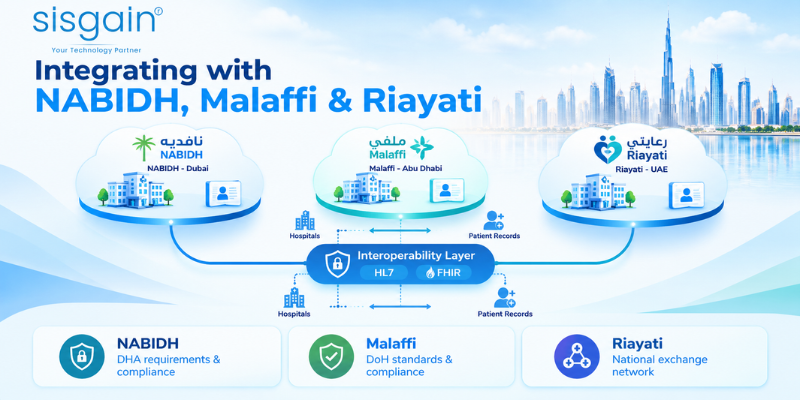
Each ecosystem has its own onboarding and conformance requirements. Integration should never be treated as generic plug-and-play, and connecting to one does not automatically provide access to the others.
NABIDH Integration in Dubai
Begin by reviewing the applicable Dubai Health Authority requirements, including supported interfaces, data standards, validation rules, and onboarding specifications. Build and test against these rather than against general HL7 or FHIR assumptions.
Malaffi Integration in Abu Dhabi
Follow the applicable Department of Health Abu Dhabi and Malaffi technical, security, and data-exchange requirements. Facilities must align message content, security controls, and testing with those specifications before going live.
Riayati Integration Across the UAE
Assess the applicable national exchange requirements, supported workflows, and specifications for participating systems. Confirm early which of your facilities and use cases fall within scope.
Because these ecosystems rely on HL7 and FHIR, a reusable interface layer saves effort. For a deeper look at that foundation, see our guide to Custom HL7 & FHIR Integration Software for UAE.
Step-by-Step Process to Develop an HIE Platform
- Gather requirements: Identify participating organizations, clinical workflows, data sources, and user roles.
- Define the architecture: Select suitable integration patterns, APIs, and exchange components.
- Map healthcare data: Establish consistent identifiers, terminology, formats, and validation rules.
- Develop interfaces: Implement required HL7 messages, FHIR resources, and partner-specific connections, following the approach outlined in our guide to Custom HL7 & FHIR Integration Software for UAE.
- Implement security: Configure authentication, access controls, encryption, and audit trails.
- Test interoperability: Validate data quality, message handling, error recovery, and end-to-end workflows.
- Deploy and maintain: Conduct a controlled rollout, monitor system performance, and manage changes to interface specifications.
Security, Privacy, and Interoperability Considerations
Security is a design requirement, not a final checklist item. Key practices include:
- Follow applicable UAE health data and privacy requirements.
- Apply least-privilege access and secure data transmission.
- Maintain traceable audit records and incident-response procedures.
- Validate message formats, data mappings, and partner-specific implementation guides.
- Establish governance for data quality, retention, and system updates.
Choosing the Right HIE Development Partner
Evaluate partners on technical expertise, healthcare integration experience, security practices, interoperability testing, documentation, and ongoing support. For custom HIE development, a healthcare software development company dubai organizations trust should be able to show prior exchange projects and explain how it handles ecosystem-specific onboarding. When your landscape spans many applications, experienced healthcare system integrators in dubai add value through multi-system connectivity and integration expertise.

Conclusion: Building a Connected Healthcare Ecosystem
Successful HIE development depends on secure architecture, standards-based exchange, strong data governance, and careful, ecosystem-specific integration planning. Treat NABIDH, Malaffi, and Riayati as separate requirements, not a single checkbox.
Healthcare groups and health-tech startups should assess their interoperability requirements, current systems, and target ecosystems before development begins. A clear assessment now prevents costly rework later.
Frequently Asked Questions
1. What is health information exchange software? It is software that securely shares patient health information between independent healthcare organizations, based on authorization and governance rules.
2. How does an HIE platform work in the UAE? It connects participating systems through interfaces, normalizes data, matches patients, and delivers authorized information, following the technical rules of the relevant ecosystem.
3. What is the difference between NABIDH, Malaffi, and Riayati? They are separate exchange ecosystems, each with its own governing authority, onboarding process, and technical requirements. Connecting to one does not automatically connect you to the others.
4. How does HL7 and FHIR support HIE interoperability? HL7 v2 handles event-based messaging between systems, while FHIR provides API-based access to structured resources. Together they enable consistent data exchange.
5. What features should an HIE platform include? Patient identity matching, secure APIs, HL7 and FHIR support, terminology mapping, access control with audit trails, error handling, and monitoring dashboards.
6. What should healthcare organizations consider before developing an HIE platform? Participating systems, workflows, applicable regulations, ecosystem onboarding requirements, security needs, data governance, and the expertise of the development partner.
About The Author