




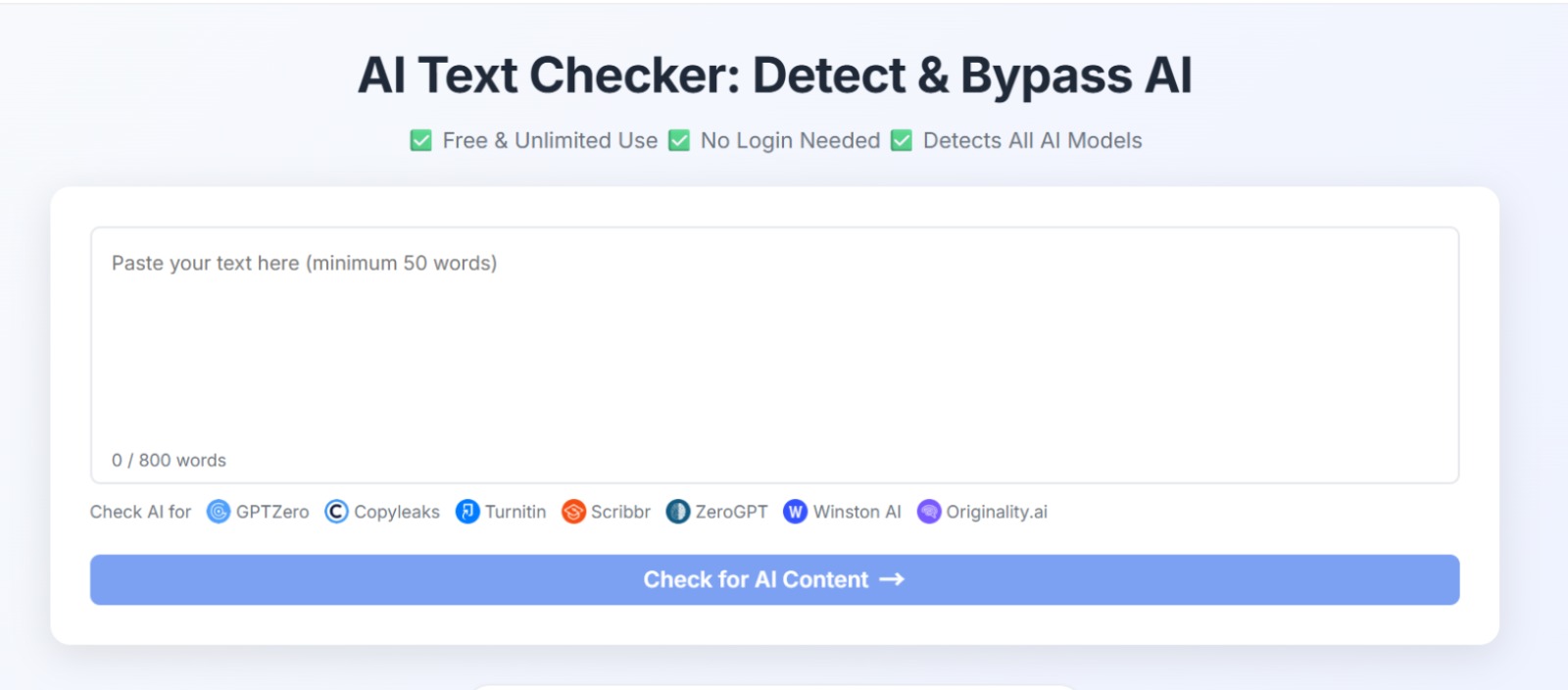
A teacher flags an essay as “likely machine-written.” A freelancer’s honest draft gets a 70% AI score. A marketer wonders whether a polished paragraph will pass a review. These situations are now common, and they all raise the same question: how much should anyone trust a percentage on a screen?
This guide explains what these tools measure, where they go wrong, and how to read their results sensibly.
What an AI Text Checker Actually Measures
A checker cannot see who wrote a text or how it was produced. It looks for statistical patterns and estimates how closely the writing resembles what language models usually generate.
Two ideas sit behind most tools:
- Predictability. Language models tend to choose the most probable next word. Text made of highly expected word choices scores as more “machine-like.”
- Rhythm and variation. People mix long, winding sentences with short ones, and they drift off-topic or repeat themselves. Generated text is often more even and polished.
Many modern tools also train classifiers on large collections of human and generated writing. The result is a probability, not a verdict. A score of 85% does not mean 85% of the text was written by a machine. It means the tool is 85% confident in its guess, and that is a very different statement.
Why Results Can Be Wrong
Understanding the failure points matters more than the score itself.
False positives happen to real writers. Formal, technical, or heavily edited text is naturally predictable. Non-native English speakers often write in simpler, more standardized patterns, which can look “machine-like” to a classifier. Legal summaries, product descriptions, and academic abstracts are frequent victims.
Mixed authorship confuses detectors. Most real workflows are not purely human or purely generated. Someone might outline with an assistant, rewrite by hand, then polish with a grammar tool. A single score cannot describe that history, and sentence-level highlighting is usually more informative than the overall number.
Short texts are unreliable. With only a few sentences, there is too little signal. Results on texts under roughly 200 words should be treated as weak hints at best.
Language matters. Many tools were built mainly around English. Accuracy can drop for German, Spanish, or other languages, especially for idiomatic or regional writing. A reader checking multilingual content should test with known human samples first.
Paraphrasing tools shift scores. Running generated text through a rewriter can lower a score without changing who wrote it. That is one reason detection works better as a signal than as proof.
How to Read a Result Like a Careful Reviewer
Instead of asking “pass or fail?”, try a short routine:
- Check the length. If the sample is brief, don’t draw conclusions.
- Look at the highlighted passages. Are the flagged sentences generic, or are they the parts with personal detail and specific knowledge?
- Run more than one tool. If two checkers strongly disagree, that disagreement is itself information.
- Test your own baseline. Paste in something you wrote years ago, before these tools existed. If it scores as generated, you’ve learned how much noise the tool produces.
- Look for human evidence outside the score. Drafts, version history, notes, and the writer’s ability to explain their choices are far stronger than any percentage.
Reading the Text Itself
You can also develop your own sense for generic writing. Common signs include vague claims with no concrete example, repetitive paragraph shapes, unnaturally balanced “on one hand, on the other” phrasing, and confident statements that have no source behind them. None of these proves anything, since tired humans write this way too, but they tell you where to ask questions.
Using These Tools Responsibly
Publishers, teachers, and hiring managers carry the most responsibility here. A flagged result should open a conversation, not close one. Penalizing someone based on a score alone risks hurting honest writers, particularly students and international professionals.
Privacy deserves a moment of thought as well. Before pasting confidential drafts, contracts, or unpublished research into any online checker, read how the service stores and uses submitted text. Some retain inputs; others state they don’t.
Writers can protect themselves too. Keep drafts and revision history, add specific details only you would know, and cite sources. These habits make your work stronger and easier to defend if it is ever questioned.
For a quick, practical way to test how different passages score, a free KI detector such as isgen.ai can serve as one data point in your review, alongside the checks above.
The Bottom Line
A detector ia can be useful, but only as one clue among several. These tools estimate patterns; they cannot establish authorship. They work best on longer English text, struggle with mixed or edited writing, and produce false alarms for perfectly human prose.
Treat any score as a prompt for closer reading rather than a final judgment. Context, drafts, and a simple conversation with the writer will tell you far more than a percentage ever could.
About The Author