




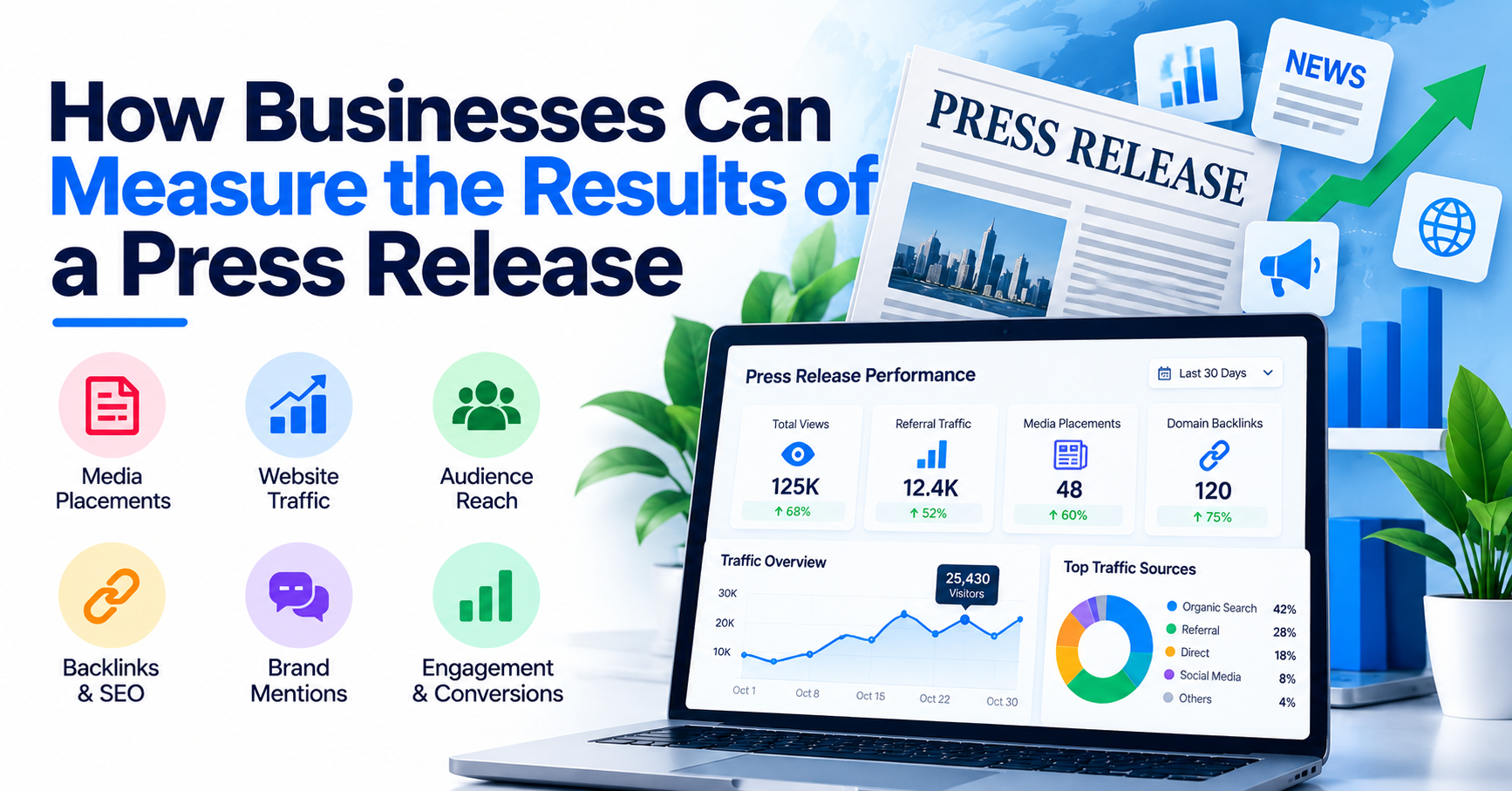
Sending a press release is the easy part. Knowing whether it worked is harder. Many businesses publish an announcement, see a few links appear online, and move on without ever asking what the release actually achieved. That makes it difficult to justify the spend or to improve the next one.
Measurement does not need to be complicated. It does need to be planned before the release goes out, not after. This guide explains what to track, where to find the data, and how to interpret results realistically, so you can judge a release on evidence rather than guesswork.
Start With the Goal, Not the Metrics
Every useful measurement starts with a clear goal. A release can serve several purposes, and each one points to different numbers.
- Awareness: getting the news in front of more people
- Media interest: earning coverage or follow-up questions from journalists
- Website traffic: sending readers to a page about the announcement
- Credibility: creating a public, dated record of company news
- Leads or inquiries: prompting people to contact the business
Trying to track everything at once usually leads to confusion. Choose one or two primary goals, then pick the metrics that match them. A local bakery announcing a new location and a software company announcing a partnership will not measure success the same way, and that is perfectly fine.
Know What You Paid For
Results only make sense next to the investment. Before reviewing any numbers, write down what the release actually cost, including writing, editing, and distribution.
Businesses often ask how much it costs to do a press release, and the answer depends on what is included. In the United States, the overall press release distribution cost for most small and mid-sized businesses tends to fall between $150 and $1,000, although it can be lower or run well above $1,000 for national or international campaigns. As a rough guide, packages under $150 usually cover basic writing or a very limited network, while the $300 to $800 range often adds a wider network and better reporting. Releases at $800 and above generally involve national reach, industry targeting, and detailed analytics.
These are general ranges, not fixed rates, but they illustrate why the cost of a press release should be compared with the scope of what was delivered. A release that cost $200 and reached a small set of news sites should not be judged by the same standard as one that cost $1,200 and was targeted at industry editors. Keeping the budget in view also gives you a way to calculate a simple cost per result later on.
The Main Metrics Worth Tracking
1. Distribution Reach and Placements
The first thing to check is where the release was actually published. A good distribution report typically lists the sites that carried it, with links to the live pages. Review the list and ask:
- Did the release appear on the kinds of sites you expected?
- Are the outlets relevant to your industry or region?
- Are the pages indexed and publicly accessible?
Keep in mind that not every placement is equal. Some are news sites with real readership, while others are automated feeds that exist mainly as a public record. Both have a place, but they should be counted differently. Ten placements on relevant sites are usually worth more than fifty that no one visits.
2. Views, Impressions, and Engagement
Many distribution services provide basic statistics, such as how many times the release was viewed or clicked. These figures are useful for spotting trends, but they should be read carefully. “Impressions” show how often the release was displayed, not how many people read it. Treat them as a rough indicator of exposure rather than proof of interest.
Engagement signals, such as clicks on links inside the release, are more meaningful because they show that someone took an extra step.
3. Website Traffic From the Release
If the release includes a link to your website, you can measure what happens when people follow it. The most reliable method is to add UTM parameters to the link, which tag the visit with a source and campaign name. In Google Analytics, you can then filter traffic by that tag and see:
- How many visitors came from the release
- Which pages they viewed
- How long they stayed
- Whether they took a desired action, such as filling out a form
Without tagging, the traffic from a release often gets mixed in with other sources, which makes it nearly impossible to separate.
4. Media Pickups and Journalist Responses
For many businesses, the real prize is earned coverage. Track any articles, mentions, or interview requests that follow the release. Useful sources include:
- Google Alerts for your company name and announcement keywords
- Manual searches of the headline in quotation marks
- Media monitoring tools, if your budget allows
- The inbox listed as the media contact
Be careful to separate coverage that came from the release from coverage that would have happened anyway. If a reporter mentions the announcement and quotes your spokesperson, that is a clear sign the release worked. If an article appears weeks later with no connection to the release, it is harder to attribute.
5. Backlinks and Search Visibility
Releases can create links to your site, but it is important to keep expectations realistic. Google’s spam policies treat keyword-heavy anchor text in press releases distributed at scale as a potential link scheme, and many distribution services use nofollow attributes for that reason. A release should not be treated as a ranking shortcut.
What you can reasonably track is whether the announcement helps people find your brand. Look for changes in branded search volume in Google Search Console, such as more searches for your company name around the announcement date. Also check whether any editorial sites linked to your page naturally after seeing the news.
6. Social Shares and Mentions
Shares, comments, and tags on social platforms show whether the news resonated with people. They are a softer metric, but a useful one, especially for consumer-facing announcements. Record the numbers shortly after publication, since attention usually fades within days.
7. Leads, Inquiries, and Sales Signals
If the goal was to prompt action, check for any increase in contact form submissions, phone calls, or emails that mention the announcement. A simple method is to ask new contacts how they heard about you. It is not perfect, but it provides context that analytics alone cannot.
Build a Simple Measurement Routine
You do not need advanced tools to measure a release properly. A basic routine looks like this:
- Before sending: set one or two goals, add UTM tags to your links, and note the total cost.
- Day of release: save the distribution report and screenshots of key placements.
- Within one week: check traffic, social activity, and any media responses.
- Within 30 days: review branded search trends, inquiries, and late-arriving coverage.
- Afterward: record everything in one place, such as a spreadsheet, and compare it with the cost.
Keeping this record over time is what turns a single release into useful knowledge. After a few announcements, patterns appear. You may notice that product launches earn more coverage than staff announcements, or that releases sent on certain days perform better.
Calculating a Realistic Return
Return on investment for a press release is rarely a single number. Some benefits, like credibility or a public record, are difficult to price. Still, a few simple calculations can help:
- Cost per placement: total cost divided by relevant placements
- Cost per visit: total cost divided by tracked visits from the release
- Cost per inquiry: total cost divided by contacts or leads linked to the announcement
If a release with a press release price of $500 led to 250 tracked visits and four inquiries, you can see what each result cost and compare it with other channels. These figures are not perfect, but they provide a consistent way to evaluate releases against each other.
When reviewing results, it also helps to ask whether the price matched the scope. A higher-priced package is not automatically better. If it delivered a broader network and clearer reporting that supported your goal, it may justify the cost. If it did not, a simpler option may serve you just as well next time.
Common Measurement Mistakes
- Judging results too early. Some coverage and search effects appear days or weeks later.
- Counting every placement equally. Relevance matters more than volume.
- Ignoring attribution. Without tagged links, traffic is hard to connect to the release.
- Expecting guaranteed outcomes. No release can promise coverage, rankings, or sales.
- Not recording anything. Without records, there is nothing to learn from.
Choosing Support for Distribution and Reporting
Reporting quality varies between distribution providers, so it is worth checking what data you will receive before you commit. Agencies such as SP Tech Solutions offer press release writing and distribution, and businesses comparing options can review the scope and reporting details of each package to see how closely it fits their measurement goals. Whichever provider you choose, ask whether you will receive links to live placements, basic performance data, and a clear summary after the release goes out.
Frequently Asked Questions
1. How do you measure the success of a press release?
Start by setting one or two goals, such as media coverage, website traffic, or inquiries. Then track the matching numbers: where the release was published, clicks and views, tagged website visits, media pickups, branded search changes, and any leads that mention the announcement.
2. What is the most important metric for a press release?
It depends on your goal. For awareness, look at relevant placements and views. For traffic, track visits from tagged links. For credibility or media interest, count quality coverage and journalist responses.
3. How much does it cost to do a press release?
For most small and mid-sized U.S. businesses, the total usually falls between $150 and $1,000, though it can be lower or go well beyond $1,000 for national or international reach. The final number depends on writing, distribution size, targeting, and reporting.
4. How do I know if the cost of a press release was worth it?
Compare the results with what you spent. Simple calculations, such as cost per placement, cost per tracked visit, and cost per inquiry, give you a consistent way to judge one release against another.
5. Can I track website traffic from a press release?
Yes. Add UTM parameters to the links in your release, then filter that campaign in Google Analytics. This separates release traffic from other sources and shows which pages visitors viewed and what actions they took.
Final Thoughts
A press release is easier to value when you decide in advance what success looks like. Set a clear goal, understand what you paid for, tag your links, and review reach, traffic, coverage, and inquiries within a reasonable window. Be honest about what the data can and cannot tell you.
Measurement will not make every release a success, but it will make each one more useful than the last. Over time, the numbers show which announcements deserve more effort, which distribution options fit your goals, and how much a release is really worth to your business. Businesses that want support with writing and distribution can include providers such as SP Tech Solutions in their comparison, as long as they first check what reporting and performance data each package provides.
About The Author