

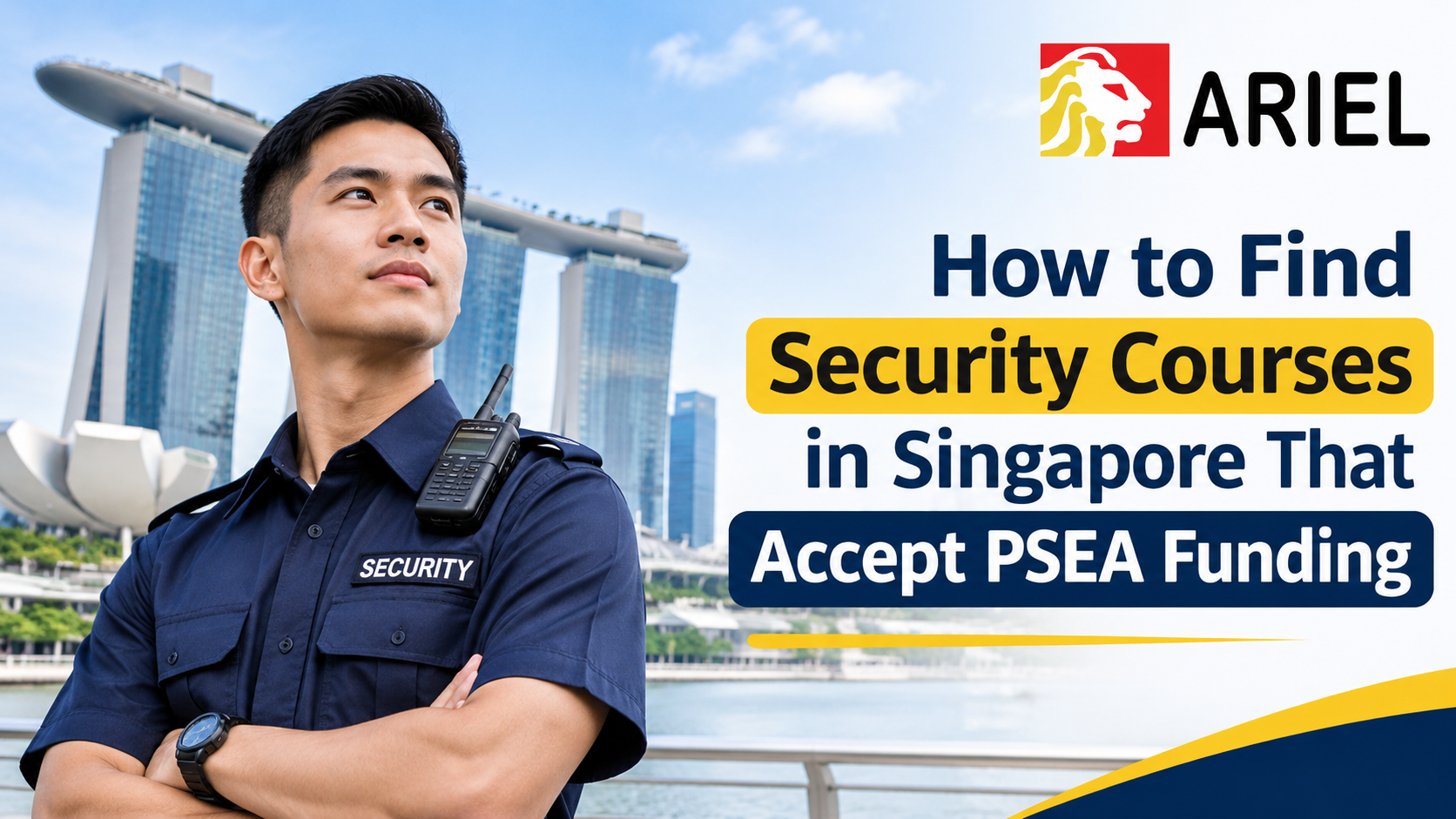
Finding security courses in Singapore with PSEA funding starts with understanding which training programmes qualify, whether the training provider can process PSEA payments, and whether you meet the account’s eligibility requirements. Before enrolling, confirm the funding status of the specific course rather than assuming every security training programme accepts PSEA.
For anyone planning to begin a security career or complete relevant training in Singapore, checking these details early can help avoid unexpected course fees and registration delays.
Ariel Security Academy offers security training in Singapore, including its Basic Security Officers Course. If you are considering enrolling, it is worth asking the academy directly whether your chosen course currently qualifies for PSEA funding and what payment arrangements apply.
This guide explains how to check eligibility, compare courses, understand the application process, and choose a suitable training option without relying on unverified funding claims.
What Is PSEA Funding, and How Does It Work?
The Post-Secondary Education Account (PSEA) is an account administered by Singapore’s Ministry of Education (MOE). Eligible Singaporeans can use the funds for approved education and training expenses under the applicable rules.
PSEA is not a general training voucher that can automatically be used for any course. The course, training provider and intended use of the funds must satisfy the relevant eligibility requirements.
Depending on the approved programme and applicable conditions, PSEA may be used for eligible courses offered by recognised institutions and approved training providers. The availability of funding depends on the specific course and the relevant approval arrangements.
For people considering security training, this means checking three things before making a payment:
- Whether the course is eligible for PSEA funding.
- Whether the training provider is authorised to facilitate the relevant PSEA withdrawal.
- Whether you can use your available PSEA funds for that course.
You should also ask whether PSEA can cover the full payable fee or only part of it. An eligible course does not necessarily mean every expense associated with enrolment, assessment or certification will be covered.
How to Find Security Courses in Singapore With PSEA
The safest approach is to verify eligibility before registering. Use the following steps to narrow down your options and avoid making decisions based only on a course advertisement.
1. Search for Eligible Courses Through Official Channels
Start by checking the MySkillsFuture course directory and its available PSEA eligibility information. The directory can help you identify programmes that may be funded through your account.
Search using relevant terms such as security officer training, security operations, or the name of a specific course. Compare the course title, training provider and programme details carefully.
If a course does not appear in your initial search, do not immediately assume it is ineligible. Ask the provider whether the programme falls under an approved PSEA arrangement and how you can verify this.
2. Check the Exact Course, Not Just the Academy
A training provider may offer several programmes with different funding arrangements. Eligibility for one course does not automatically establish eligibility for every course offered by the same academy.
For example, a provider may offer basic security training, incident-handling modules and additional training for existing officers. Each programme should be checked separately.
When reviewing PSEA-eligible security courses in Singapore, record the following details:
- Full course name and module code, where available.
- Training provider’s name.
- Course dates and duration.
- Total course fee and assessment charges.
- PSEA eligibility and payment instructions.
This information will help you compare programmes accurately and ask the right questions before committing.
3. Contact the Training Provider Directly
After identifying a suitable course, contact the academy to confirm the current funding arrangements.
Ask clear questions rather than simply asking whether the academy accepts PSEA. For example:
- Is this exact course currently eligible for PSEA funding?
- Can your academy process the required PSEA withdrawal?
- What documents or forms must I submit?
- Is there a remaining amount that I must pay myself?
- Are assessment fees covered separately?
A written confirmation is useful because it gives you a record of the information provided before enrolment.
4. Confirm Your Own Eligibility and Available Balance
Even when a course is eligible, your personal circumstances and available funds can affect how you pay for it.
Check your PSEA balance and confirm that the intended withdrawal is permitted for the selected course. If you are unsure whether your account can be used, contact MOE or consult the relevant official guidance.
Do not assume that a relative’s account can be used automatically. Any permitted use or transfer involving a sibling’s PSEA must follow the applicable rules.
5. Understand the Payment Process Before Registering
The approved institution should explain which PSEA withdrawal process applies. Depending on the arrangement, this may involve a one-time withdrawal for a specific purpose or a standing order for eligible future withdrawals through that institution.
Ask when the payment will be processed and whether you need to pay any amount upfront. Keep copies of your enrolment confirmation, fee breakdown and funding instructions.
Avoid paying a non-refundable amount until you understand the course’s funding conditions and withdrawal policy.
Which Security Training Courses Should You Compare?
Choosing a course involves more than finding one that may accept PSEA. You should also consider the training content, assessment requirements, career objectives and total amount payable.
Basic Security Officer Course
A basic security officer course may suit someone who wants to start working in the security sector and needs to develop foundational skills.
Ariel Security Academy lists a Basic Security Officers Course covering areas such as guard and patrol services, security incident handling and threat observation. These are relevant areas to review when comparing introductory security training.
Before enrolling, check which modules are included in the specific intake, how assessments are organised and what certification or statement of attainment applies upon successful completion.
Most importantly, confirm PSEA eligibility for the exact course or module you intend to take.
Security Incident and Response Training
Incident-handling training focuses on how security personnel respond to situations that may arise during their duties. Depending on the module, this can include reporting incidents, responding to emergencies and following workplace procedures.
If you are comparing security training in Singapore with PSEA funding, check whether incident-response training is offered as a separate module or as part of a broader programme.
Do not assume that funding eligibility transfers from a basic course to an additional module.
Advanced or Additional Security Modules
People who already work in security may want to improve their capabilities through further training. The right option depends on their current qualifications, job responsibilities and the training required for their intended role.
Before choosing an advanced module, ask whether you meet its prerequisites and whether it is relevant to your career plans. Then verify the funding arrangement independently.
The most suitable programme is one that matches your training needs, not simply the one advertised with the lowest initial fee.
How Much Can PSEA Cover for a Security Course?
The amount you can pay through PSEA depends on the course’s eligibility, the permitted expenses, your available balance and the applicable funding conditions.
It is better to request a written fee breakdown than to rely on a general statement that a course accepts PSEA.
Use this comparison when contacting different training providers:
| Cost item | What to confirm |
| Course fee | The total published fee before any funding |
| PSEA payment | The amount that can be paid using eligible funds |
| Assessment fee | Whether assessment charges are included or separate |
| Additional charges | Any other compulsory expenses |
| Remaining balance | The amount you must pay personally |
| Refund conditions | What happens if you withdraw or cannot attend |
Example: Comparing Two Course Quotes
Suppose two training providers quote different prices for similar introductory security programmes. One offers a lower advertised course fee, while the other includes certain assessment charges in its quotation.
Comparing only the advertised price could lead you to choose the more expensive option overall.
Instead, compare the final payable amount after confirming any applicable funding. Ask whether the same modules, assessment arrangements and certification outcomes are included.
This is especially important if you have a limited PSEA balance. A course that meets your training needs and fits your available funds may be more practical than one with a lower headline price but additional expenses.
Remember that PSEA eligibility and the amount payable are separate questions. Confirm both before making a decision.
Who Can Use PSEA for Security Training?
PSEA is available to eligible Singaporeans under the relevant account rules. However, having an account does not mean every course or training expense qualifies.
Before enrolling, consider these questions:
- Are you eligible to use PSEA? Check the applicable MOE rules for your account.
- Is the programme approved? Confirm the exact course and provider.
- Are the expenses permitted? Ask whether course and assessment fees are covered.
- Is your balance sufficient? Check the amount available for the intended payment.
- Are there specific application steps? Obtain the correct forms and instructions from the approved institution.
If you are unsure about any requirement, seek confirmation before submitting your registration.
Can You Use PSEA If You Are New to the Security Industry?
You can explore eligible introductory training even if you have not worked as a security officer before. However, your ability to use PSEA depends on the account rules and the selected course’s funding status, not simply your experience level.
If you are new to the industry, first identify the training required for your intended role. Then check the course prerequisites, assessment arrangements and funding eligibility.
This approach helps you avoid paying for a programme that does not match your needs.
What to Check Before Choosing a Security Training Provider
Funding matters, but it should not be the only factor in your decision. The quality and suitability of the training can affect how well prepared you are for the work.
Course Content and Learning Objectives
Review the syllabus to understand what you will learn. For basic security training, this may include guard and patrol duties, incident handling, reporting and threat observation.
Check that the programme covers the skills you need and that the stated learning outcomes match your expectations.
Duration and Class Schedule
Training schedules can affect your ability to attend consistently, especially if you are working or managing other commitments.
Confirm the number of training days, assessment dates, attendance requirements and available class timings before registering. Ask whether rescheduling is possible and whether additional charges apply.
Assessment and Certification
When choosing a security training school in Singapore, beginners should consider the provider’s training experience and assessment performance. Check how long the school has been offering training and whether it shares clear information about learner assessment outcomes. These factors can help you compare providers and make a more informed decision. Ariel Security Academy reports a 95.6% assessment pass rate, giving prospective learners an additional point of reference when evaluating security training options. Contact the academy to understand how this figure is calculated and which courses or assessment periods it covers.
Ask how the assessment works, what you must complete to pass and which certificate or statement of attainment is issued upon successful completion.
If you intend to work as a licensed security officer, confirm the current training and licensing requirements that apply to your circumstances. Completing a course should not be assumed to guarantee employment or automatic eligibility for a licence.
Support and Communication
A provider should be able to explain its registration process, course requirements and payment arrangements clearly.
Pay attention to how it answers questions about PSEA eligibility. If the funding status is unclear, request clarification before paying any deposit or accepting a place.
Location and Travel
Consider whether you can reach the training venue reliably for the full duration of the course. Ariel Security Academy lists its training address at A’Posh Biz Hub, Yishun Industrial Street 1, Singapore.
If you are comparing providers across Singapore, include transport time and travel costs in your overall decision. A course that fits your schedule may be more manageable than one requiring a lengthy journey.
How Ariel Security Academy Fits Into Your Course Search
When researching security courses in Singapore, Ariel Security Academy is one provider you can consider for introductory security training.
Its listed Basic Security Officers Course covers foundational security duties, including guard and patrol services, handling security incidents and recognising terrorist threats. Prospective students should review the current syllabus, course schedule and assessment requirements before enrolling.
For anyone specifically searching for security courses Singapore with PSEA, the next step is to contact the academy and confirm whether the intended course or individual module currently qualifies for PSEA funding. Its published course information alone should not be treated as confirmation that PSEA can be used for every programme.
Before registration, ask the academy to clarify:
- The exact course and modules available for your preferred intake.
- Whether PSEA funding applies to your selected programme.
- The total payable fee, including any separate assessment charges.
- The documents and payment steps required.
- The refund and rescheduling conditions.
This gives you a clearer picture of both the training and the financial commitment before making a decision.
Common Mistakes to Avoid When Using PSEA for Security Training
A few simple checks can help you avoid delays and unexpected costs.
Assuming all courses at one academy are eligible. Funding arrangements may differ by programme. Confirm the exact course rather than relying on the provider’s general description.
Confusing PSEA with SkillsFuture Credit. These are separate funding mechanisms with different eligibility rules. Do not assume that eligibility under one scheme guarantees eligibility under the other. Ask the provider how each applicable payment option works.
Ignoring assessment fees. The advertised course fee may not represent the complete amount payable. Request a breakdown of compulsory charges.
Registering before checking the withdrawal process. Find out which forms are required, who submits them and when payment is processed.
Choosing a course based only on funding. A funded course is not automatically the best option for your career goals. Check the syllabus, prerequisites, assessments and relevance to the role you want.
Relying on outdated information. Course schedules, fees and funding arrangements can change. Confirm current details directly with the provider before enrolling.
Frequently Asked Questions
1. How can I find security courses in Singapore that accept PSEA funding?
Start with the MySkillsFuture course directory and its PSEA eligibility information. Then contact the training provider to confirm that the exact security course is eligible and that the provider can process the required withdrawal.
2. Can I use PSEA for a Basic Security Officer Course in Singapore?
It depends on the eligibility of the specific course and the applicable funding arrangements. If you are considering Ariel Security Academy’s Basic Security Officers Course, ask the academy to confirm its current PSEA status before registering.
3. Who is eligible to use PSEA for security training?
PSEA is available to eligible Singaporeans under MOE’s rules. Having an account does not automatically make every security course or expense eligible, so check both your eligibility and the programme’s funding status.
4. Does PSEA cover the full cost of a security course?
Not necessarily. The amount payable through PSEA depends on the eligible expenses, available balance and applicable conditions. You may need to pay certain fees yourself. Request a complete fee breakdown before enrolment.
5. Can I use PSEA for individual security training modules?
Some approved modular courses may qualify, but eligibility must be confirmed for the particular module. Ask whether the individual unit is approved rather than assuming it inherits the funding status of a larger programme.
6. What is the difference between PSEA and SkillsFuture Credit?
PSEA is an education account administered by MOE for eligible Singaporeans, while SkillsFuture Credit is a separate scheme with its own rules. An eligible learner may have different payment options depending on the course. Confirm the applicable arrangements with the provider before combining funding sources.
7. What documents do I need to apply for PSEA course payment?
The requirements depend on the institution and payment arrangement. You may need to complete the relevant PSEA withdrawal form and provide enrolment or course details. Ask the approved institution which documents are required for your specific application.
8. Can I use a sibling’s PSEA to pay for my security course?
Do not assume that you can use a sibling’s account automatically. PSEA transfers and permitted uses are subject to MOE rules and eligibility conditions. Check the official requirements before relying on another person’s funds.
9. Should I enrol before confirming PSEA eligibility?
It is safer to confirm eligibility, the withdrawal procedure and the final payable amount first. This reduces the risk of unexpected expenses or misunderstandings about how your course will be funded.
Conclusion
Finding the right security courses Singapore with PSEA funding requires more than searching for a course that advertises financial support. You need to verify the programme’s eligibility, understand the withdrawal process, compare the full course fees and ensure the training suits your career goals.
Start with official course information, confirm the details directly with your chosen provider and keep a written record of the funding arrangements. These steps can help you make a more informed decision before committing to training.
If you are exploring introductory security training, contact Ariel Security Academy to discuss its Basic Security Officers Course, current schedules and assessment requirements. Ask specifically whether your intended course qualifies for PSEA funding so you can assess your options before registering.
About The Author