



A battery connection can look fine on the day it is installed and still become a problem later.
Moisture, humidity, salt and repeated temperature changes can gradually affect exposed copper. This is where Tinned Battery Lugs can be useful. A tin coating helps protect the copper from corrosion while the copper core provides the conductive path needed for the connection.
Here’s how to get the installation right.
Why Use Tinned Battery Lugs?
Copper is widely used for battery terminals because it offers excellent electrical conductivity. The downside is that bare copper can oxidise when exposed to moisture and other environmental conditions.
That matters more in places where keeping a connection completely dry isn’t realistic.
Tinned copper provides an added layer of protection around the copper. This is one reason tinned lugs are commonly used in marine and other demanding electrical applications.
They aren’t necessarily required for every installation. A battery inside a dry, protected electrical cabinet may have very different requirements from one installed in a boat.
The environment should be part of the decision.
Check the Cable and Stud Size First
Before installing a lug, check two things: the cable size and the mounting hole.
The lug barrel needs to match the cable gauge. The hole in the lug needs to match the battery stud, bolt or busbar connection.
These measurements aren’t interchangeable.
Check both before ordering or starting the installation. Selterm’s tinned copper battery lugs are available in different cable and stud sizes for a range of battery and power applications.
Getting the size right at this stage makes the rest of the job much easier.
Prepare the Cable Carefully
Start with a clean section of cable. If you’re replacing an old lug, inspect the conductor once the damaged terminal has been removed. Copper that has already developed significant corrosion may need to be cut back before fitting a new lug.
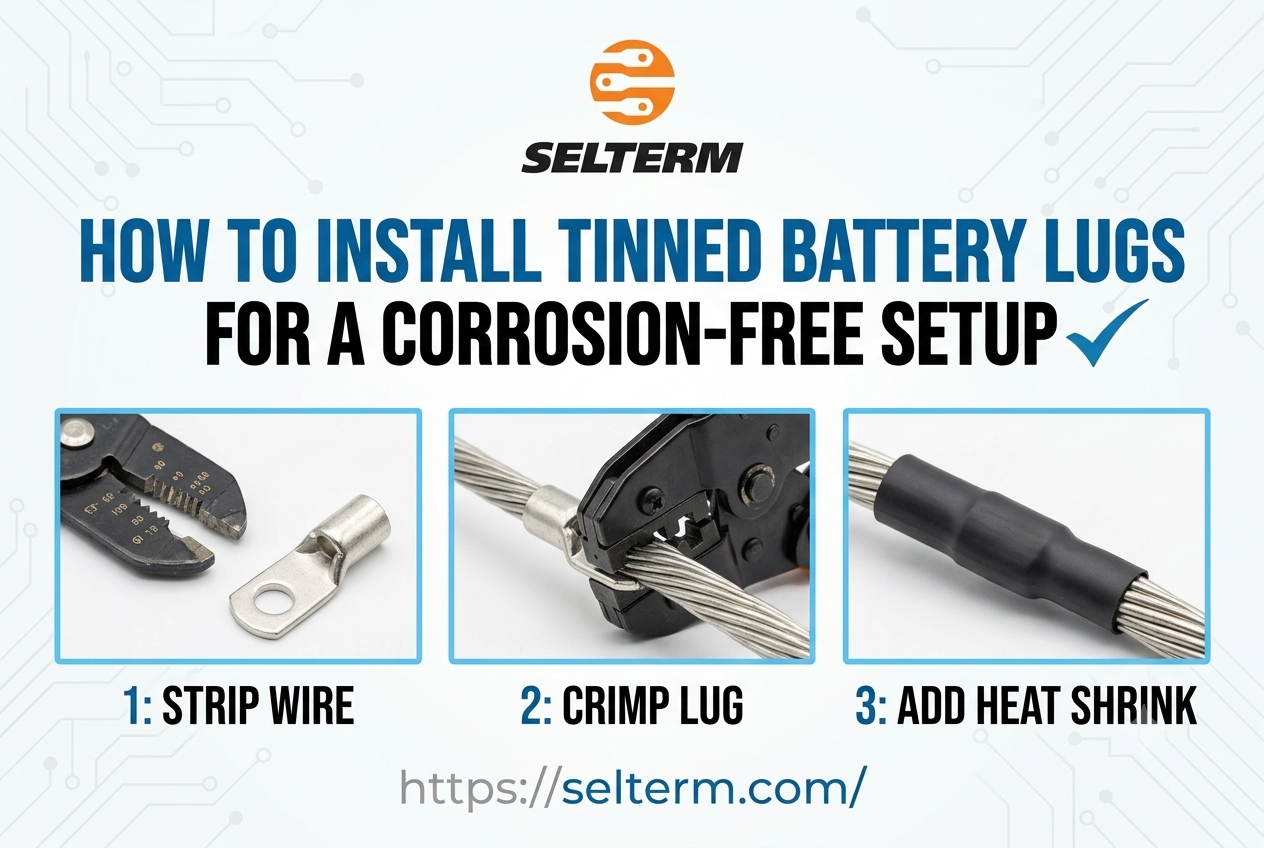
Strip only enough insulation to allow the conductor to sit correctly inside the lug barrel. Avoid cutting into the copper strands while removing the insulation.
The stripped conductor should be clean and intact. It shouldn’t be excessively long, with copper sticking out beyond the barrel, and it shouldn’t be so short that it fails to reach properly inside the lug.
Put the Heat Shrink on Before Crimping
If you’re using adhesive-lined heat shrink to seal the connection, slide it onto the cable before installing and crimping the lug. Once the lug is attached, the heat shrink won’t be going over the barrel unless you’ve planned for it.
The tubing should be long enough to cover the transition between the cable insulation and the lug.
For installations exposed to moisture, adhesive-lined heat shrink can provide an additional barrier around this area and help limit moisture getting into the connection.
It’s a small addition, but particularly useful for marine, RV and outdoor applications.
Insert the Cable Into the Lug
Push the stripped conductor fully into the lug barrel.
If the lug has an inspection window, check that the conductor has reached the correct position. The cable should sit securely inside the barrel without excessive movement.
The insulation should come close to the end of the barrel while staying outside the actual crimping area.
Before reaching for the crimper, check the basics one more time.
lass=”yoast-text-mark” />>Is this the correct lug for the cable?
lass=”yoast-text-mark” />>Is the mounting hole right?
>Is the conductor fully inserted?
This is the easiest point in the process to correct a mistake.
Make a Proper Crimp
The crimp creates the mechanical and electrical connection between the cable and lug, so this isn’t the place for shortcuts.
Use a crimping tool designed for the lug and cable size. Smaller terminals may be suitable for an appropriate hand crimper, while larger battery cables generally require heavier mechanical or hydraulic crimping equipment.
Position the lug correctly in the crimping die and follow the tooling manufacturer’s instructions.
Avoid using a hammer or pliers to flatten the lug. It may appear tight afterwards, but an improvised crimp doesn’t provide the controlled compression needed for a reliable connection.
Once the crimp is complete, give the cable a firm hand pull. The conductor shouldn’t move inside the lug.
The finished connection should feel solid, with the cable and lug effectively behaving as one piece.
Seal the Cable-to-Lug Joint
With the crimp finished, move the adhesive-lined heat shrink into position over the cable and lug barrel.
Apply heat evenly and avoid concentrating it on one spot for too long. As the tubing contracts, the adhesive should form a seal around the joint.
Allow the connection to cool before putting unnecessary strain on the cable.
Take a quick look once the heat shrink has settled. There shouldn’t be obvious gaps or damage around the sealed area.
Install the Lug on the Battery
The finished lug can now be connected to the battery terminal, stud, busbar or other equipment connection.
Make sure the contact surfaces are clean and that the lug sits flat. It shouldn’t be forced into position or held at an angle because the cable is too short.
Use the correct hardware and follow the battery or equipment manufacturer’s torque specification. For vehicle, RV and marine installations, also consider cable movement and vibration. A well-made connection can still suffer if the cable is constantly pulling against the lug.
Secure the cable so that the terminal isn’t carrying unnecessary mechanical strain.
Where Copper Battery Lugs Fit In
Battery Lugs Copper construction remains popular because copper provides the conductivity needed for high-current electrical connections.
The choice between bare and tinned copper usually comes down to the installation environment.
Bare copper can work well in a dry, protected location. Tinned copper becomes more attractive where the terminal will regularly encounter moisture, humidity, salt or condensation.
That’s why tinned copper lugs are commonly found in marine battery systems and other outdoor power applications.
The goal isn’t to use the most heavily protected component in every situation. It’s to choose a terminal that makes sense for the conditions it will have to handle.
Inspect the Finished Connection
Before powering up the system, take a moment to inspect the complete connection.
Check that the cable gauge and lug size match, the crimp is secure, the heat shrink is properly sealed and the lug sits flat against the mounting surface.
Also check the cable route. Keep it away from sharp edges, excessive heat and moving parts. If the cable can rub against something while the vehicle or equipment is operating, secure it before putting the system back into service.
A tinned lug provides better corrosion protection, but it still benefits from sensible installation and routine checks.
FAQ
Are tinned battery lugs better than bare copper lugs?
For marine, outdoor, RV and other moisture-prone applications, tinned copper lugs offer additional corrosion protection. Bare copper can be suitable for dry, protected installations.
Do tinned battery lugs conduct electricity as well as copper lugs?
The tin coating is thin, while the main body of the lug remains copper. The copper provides the primary conductive path while the tin coating helps protect the surface from corrosion.
Can tinned battery lugs be used on RV batteries?
Yes. Tinned copper lugs are suitable for many RV battery and power connections, provided the lug is correctly matched to the cable and mounting hardware.
Do I need heat shrink with a tinned battery lug?
Heat shrink isn’t a substitute for a properly made crimp, but adhesive-lined heat shrink can provide additional protection around the cable-to-lug joint, particularly in damp or outdoor environments.
How do I choose the right tinned battery lug?
Start by checking the cable gauge and the size of the battery stud or mounting bolt. Then consider the current requirements and the environment where the connection will be installed.
Where can I find tinned copper battery lugs?
Selterm offers a range of tinned copper battery cable lugs in different cable gauges and stud sizes for battery, marine, RV, solar and other electrical applications.
About The Author