




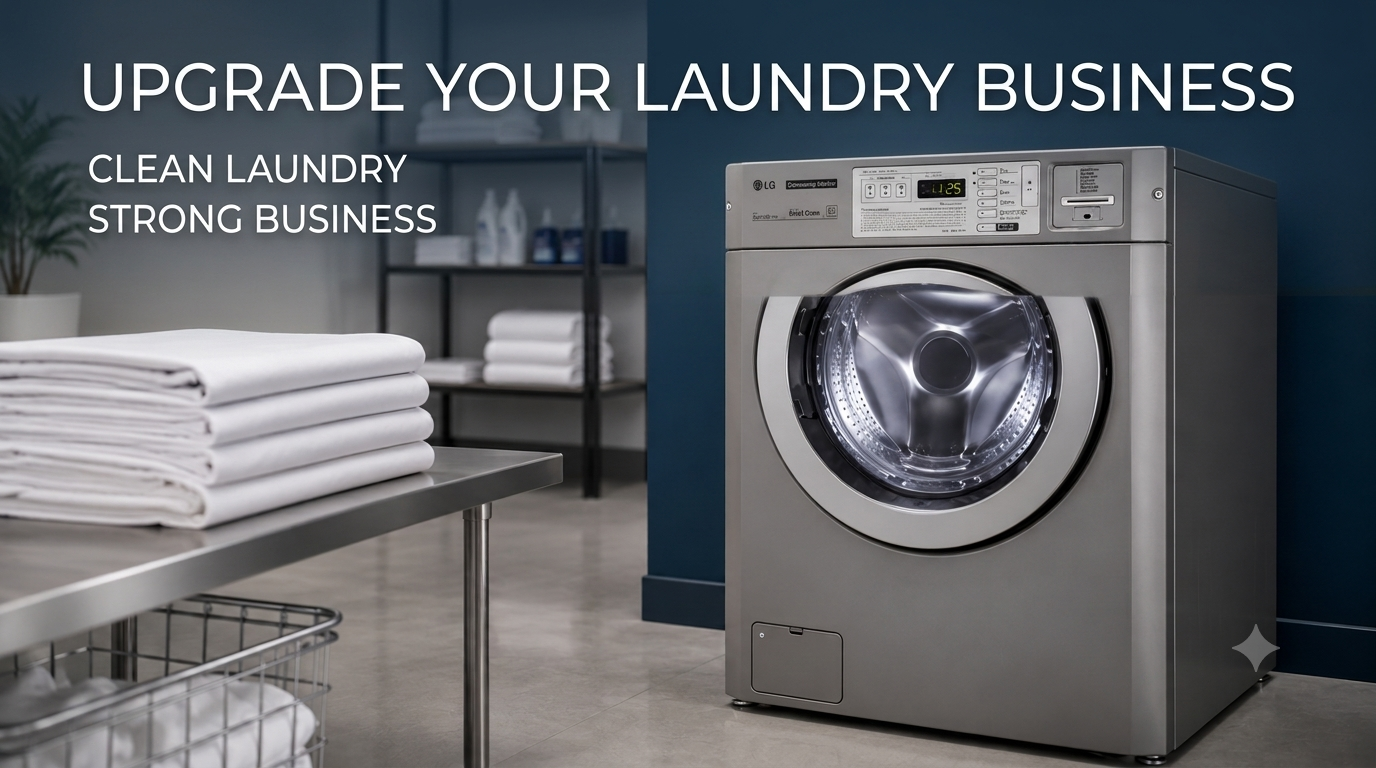
For hotels, hospitals, restaurants, hostels, laundromats and other businesses, laundry is a recurring operational expense. Outsourcing the work to a commercial laundry service can be convenient, especially when laundry volumes are low or unpredictable. But as your daily laundry requirements increase, paying a third party for every kilogram can become a significant cost.
At that point, investing in a commercial washing machine can make financial and operational sense. The right equipment can give your business greater control over washing quality, turnaround time and long-term laundry costs.
But how do you know when it is time to stop outsourcing and bring laundry operations in-house?
When Does Outsourcing Laundry Stop Making Financial Sense?
The first step is to calculate how much your business actually spends on outsourced laundry every month. Consider the amount of linen or clothing washed, the rate charged per kilogram, transportation costs, minimum order charges, and any additional fees for urgent services.
For example, a business processing several hundred kilograms of laundry every week may find that outsourcing costs continue to rise as its operations grow. Delays can also become a problem when clean linen is required quickly.
Owning laundry equipment becomes more attractive when:
- Your laundry volume is consistent
- You require washing every day
- Outsourcing costs are increasing
- You need faster turnaround
- Laundry quality needs to be controlled internally
- You expect your laundry volume to grow
Calculate Your Monthly Outsourcing Cost
A simple calculation can help you compare the two options:
Monthly outsourcing cost = Total laundry volume × Outsourcing cost per kg
You can then compare this with the expected cost of operating your own equipment, including electricity, water, heating, chemicals, labor, maintenance, and installation.
This gives you a clearer picture of whether purchasing equipment could reduce your long-term laundry expense.
What Is a Commercial Washer and Who Needs One?
A commercial washer is designed for professional laundry operations where machines may need to handle significantly more loads than a domestic washing machine.
Unlike household machines, professional equipment is built for frequent operation, higher capacities and demanding working environments. Depending on the model, businesses can select different capacities, wash programs and extraction speeds according to their requirements.
A commercial machine can be suitable for hotels, hospitals, restaurants, laundromats, hostels, institutions and businesses that regularly process uniforms, towels, bedding or other textiles.
Commercial Washer vs Domestic Washing Machine
A domestic washing machine is designed primarily for household use. Running one through multiple heavy cycles every day can increase wear and may not provide the productivity required by a business.
A professional washer offers greater capacity, durability and operational flexibility, making it more suitable when laundry is part of your daily business activity.
Is a Commercial Laundry Machine Worth the Investment?
The answer depends mainly on laundry volume and machine utilization.
Buying a commercial laundry machine requires an initial investment, but the calculation should not stop at the purchase price. You should also consider installation, utilities, labour, detergents and chemicals, maintenance, and the expected working life of the equipment.
If your business has a predictable laundry requirement, regular machine utilization can help spread the equipment cost across a large number of loads.
For example, if bringing laundry in-house saves a consistent amount every month, you can estimate the payback period by comparing your total equipment investment with those monthly savings.
Estimated payback period = Equipment investment ÷ Monthly operating savings
The actual result will vary according to laundry volume, utility rates, machine capacity and operating practices.
When Should You Buy an Industrial Washing Machine Instead?
Not every business requires an industrial machine. The right choice depends on the amount and type of laundry you process.
An industrial washing machine is generally more appropriate for larger laundry operations where machines are expected to handle substantial workloads throughout the day. Commercial laundries, large hotels, hospitals, institutional laundries and industrial facilities may require higher-capacity equipment or multiple machines.
If your laundry demand is moderate, a commercial washer may be sufficient. If your operation processes large volumes continuously, an industrial setup can provide the capacity and productivity required.
Why a Commercial Washer Extractor Can Be Better for Business
For businesses where drying time is also a concern, a commercial washer extractor can offer an important advantage.
A washer extractor combines washing with high-speed water extraction. After the wash cycle, the machine removes a substantial amount of moisture from the textiles before they reach the dryer.
This can help:
- Reduce residual moisture
- Shorten drying times
- Improve laundry throughput
- Reduce the workload on tumble dryers
- Improve overall workflow
For a business processing large quantities of towels, linen or uniforms, reducing moisture before drying can make the entire laundry process more efficient.
Which Businesses Can Benefit From a Laundry Machine for Business?
A laundry machine for business can support many different operations beyond a traditional laundry shop.
Hotels and Resorts
Hotels regularly process bed linen, towels, uniforms and other textiles. In-house equipment can help improve turnaround time and provide greater control over laundry quality.
Hospitals and Healthcare Facilities
Healthcare facilities have continuous requirements for patient linen, bedding, uniforms and towels. Dedicated laundry equipment can support consistent washing processes and help manage high daily volumes.
Laundromats and Commercial Laundries
Laundromats and professional laundry businesses depend on reliable equipment because washing is the core revenue-generating activity. Capacity, cycle time and machine durability directly affect productivity.
Hostels, PGs and Institutions
Large residential facilities can generate substantial quantities of bedding, towels and other washable textiles. Bringing laundry operations in-house can reduce dependency on external service providers.
Restaurants and Food-Service Businesses
Restaurants may need to process kitchen linen, uniforms, napkins and other washable items regularly.
What Commercial Laundry Equipment Do You Need?
A washing machine is only one part of a professional laundry setup. Depending on your operation, you may also require:
- Washer extractors
- Tumble dryers
- Ironing and finishing equipment
- Laundry chemicals
- Automatic chemical dosing systems
- Garment handling equipment
The right combination depends on your laundry volume, fabric types, available space, utility connections and turnaround requirements.
For smaller operations, a washer and dryer may be enough. Larger facilities may require multiple washing machines, dryers and finishing equipment to maintain a continuous workflow.
How Much Does Commercial Laundry Equipment Cost?
There is no single price for commercial laundry equipment because the investment depends on several factors.
Capacity, machine type, extraction speed, heating method, automation, brand, installation requirements, and utility configuration can all influence the total cost.
Instead of choosing a machine based only on its purchase price, businesses should evaluate its expected workload, operating costs, service availability, and productivity.
A cheaper machine may not necessarily be the most economical choice if it cannot handle your daily laundry requirements.
Owning a Commercial Laundry Machine vs Outsourcing Laundry
Outsourcing requires less initial investment and eliminates the need to manage machines, maintenance and utilities. It can be a practical choice for businesses with low or unpredictable laundry volumes.
Owning equipment requires a larger upfront investment but gives you greater control over the process.
| Factor | Outsourcing | In-House Laundry |
| Initial investment | Lower | Higher |
| Control over washing | Limited | High |
| Turnaround time | Depends on supplier | Under your control |
| Cost at high volume | Can increase | Can become more economical |
| Maintenance | Outsourced | Your responsibility |
| Scalability | Depends on provider | Equipment can be expanded |
The key is utilization. If your business generates regular laundry every day, owning equipment can become more attractive than continuously paying an external provider.
Can a B2B Laundry Business Be Built Around Your Own Equipment?
Your equipment does not necessarily have to serve only your own business.
A B2B laundry business can provide washing and finishing services to hotels, restaurants, salons, spas, hostels, hospitals, and other organizations that need regular laundry support.
This creates an opportunity to turn laundry equipment from a cost-saving investment into a revenue-generating asset.
Businesses can start by handling their own laundry and gradually take on external clients as available capacity increases.
How to Choose the Right Commercial Washing Machine
Before purchasing equipment, evaluate:
- Daily and peak laundry volume
- Types of fabrics being washed
- Required machine capacity
- Available floor space
- Water and drainage requirements
- Electrical, gas or steam availability
- Required extraction speed
- Expected operating hours
- Dryer requirements
- Service and maintenance support
The machine should be selected according to actual workload rather than simply choosing the largest available capacity.
How Can Orgaearth Help?
Orgaearth supplies commercial and industrial laundry equipment for businesses looking to build or upgrade their laundry operations.
The range includes washer extractors, tumble dryers, ironing and finishing equipment, laundry chemicals and automatic dosing solutions. Orgaearth can also support businesses with laundry setup requirements, installation coordination, after-sales service, and AMC/CMC support.
Whether you are looking to bring laundry operations in-house, upgrade an existing facility or develop a commercial laundry setup, the equipment should be selected according to your capacity, workflow and business requirements.
Conclusion
Outsourcing laundry can be convenient, but it is not always the most economical option as your laundry volume grows. If your business processes laundry consistently every day, investing in professional equipment can provide greater control, faster turnaround and potentially lower long-term costs.
The right decision depends on your laundry volume, operating costs, available space and future requirements. Start by calculating your current outsourcing expense and comparing it with the expected cost of running your own laundry operation.
For businesses with predictable and growing laundry requirements, owning the right commercial equipment can be more than a cost-saving decision—it can become an important part of the business operation and, in some cases, the foundation for a new B2B laundry service.
FAQs
- Is a commercial washing machine worth buying for a small business?
It can be worthwhile when the business generates regular laundry and the cost of outsourcing is significant. Compare your monthly outsourcing expense with equipment, utility, labour and maintenance costs before making a decision.
- What is the difference between a commercial washer and an industrial washing machine?
A commercial washer is generally suited to professional businesses with moderate to high laundry requirements, while an industrial washing machine is intended for larger-scale operations with heavier and more continuous workloads.
- What is a commercial washer extractor?
A commercial washer extractor washes textiles and then uses high-speed extraction to remove excess water. This reduces the moisture entering the dryer and can improve overall laundry productivity.
- How much does a commercial laundry machine cost?
The price varies according to capacity, machine configuration, extraction speed, heating method, automation, brand, and installation requirements. The total investment should also include utility and installation costs.
- What businesses need commercial laundry equipment?
Hotels, hospitals, laundromats, restaurants, hostels, institutions, commercial laundries and industrial facilities can all require professional laundry equipment depending on their laundry volume.
- Can I use a commercial washing machine for a laundry business?
Yes. Commercial machines are designed for professional laundry applications and can be used by laundromats, wash-and-fold businesses, and other commercial laundry operators.
- Is it cheaper to own a commercial washing machine or outsource laundry?
It depends on laundry volume and operating costs. Outsourcing may be economical at lower volumes, while owning equipment can become more attractive when laundry is frequent and predictable.
- Can a commercial washing machine be used for a B2B laundry business?
Yes. Businesses can use professional laundry equipment to provide washing services to hotels, restaurants, hostels, salons, hospitals, and other organizations.
- What equipment is needed along with a commercial washing machine?
Depending on the operation, you may also need a tumble dryer, ironing or finishing equipment, laundry chemicals, automatic dosing systems, and garment handling equipment.
Suggested Tags
- Commercial Laundry Equipment
- Commercial Washing Machines
- Industrial Laundry Equipment
- Laundry Business
- Laundry Solutions
About The Author