




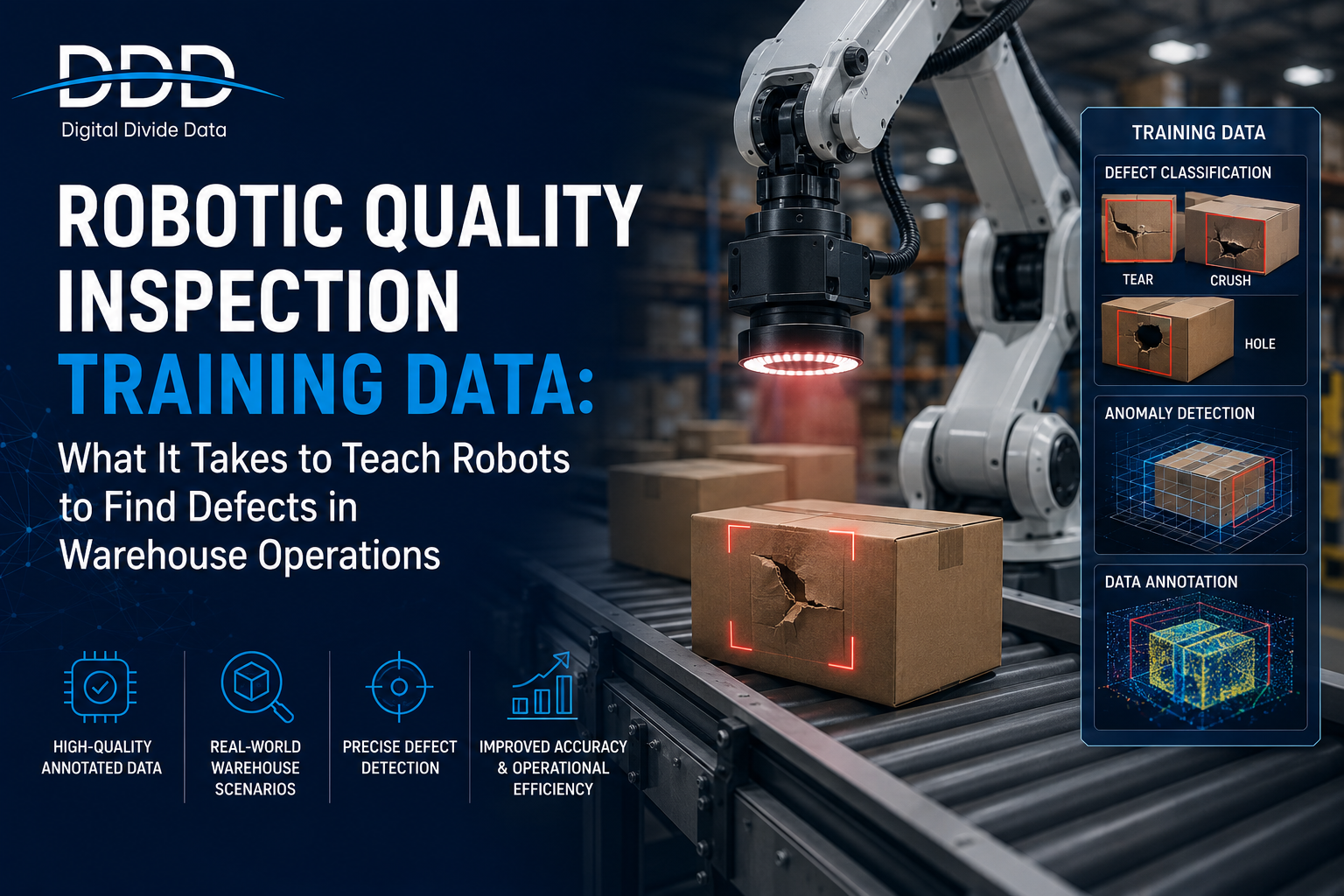
Warehouse quality inspection has historically been a human task. A worker checks received goods for damage, verifies that outbound packages are correctly labeled and sealed, confirms that picked items match the order specification, and flags non conforming products for returns processing. At high volume, this inspection task is both labor intensive and inconsistently executed; human inspectors get tired, make judgment calls inconsistently, and produce quality outcomes that vary by inspector, by shift, and by time of day.
Computer vision based robotic quality inspection replaces or supplements human inspection with camera equipped systems that apply consistent detection criteria across every item inspected. Building these systems requires training data that covers the full range of defect types, the full range of product and packaging appearances, and the challenging visual conditions under which real warehouse inspection occurs.
The Inspection Tasks That Warehouse Robotics Addresses
Inbound Goods Inspection
Goods received at a warehouse robotics training data distribution center need to be checked for damage that occurred during transport: crushed packaging, broken seals, wet or contaminated items, and in some categories, physically damaged products visible through transparent packaging. Robotic inbound inspection systems examine items as they move on conveyor systems and flag items that show evidence of transport damage.
Training data for inbound inspection covers:
Damage appearance taxonomy: The visual signatures of different damage types for each product category: crushed corners on cardboard boxes, torn outer packaging, water staining patterns, seal separation on vacuum packaging, visible dents or deformation on rigid packaging. Each damage type needs annotated examples across the range of severity levels minor cosmetic damage versus structural damage requiring return with the classification boundary defined by the inspection policy.
Undamaged reference data: A comparable volume of annotated undamaged items in the same product categories, photographed under the same inspection conditions. The inspection model needs to learn both what defects look like and what the normal range of undamaged item appearances includes which varies across the natural variation in packaging, labeling, and surface finish that undamaged items exhibit.
Lighting and orientation variation: Items arrive at the inspection camera in any orientation and under the facility’s fixed inspection lighting. Training data that covers the full range of item orientations on the conveyor upright, tilted, sideways, upside down, and the lighting variation across the inspection station’s operating conditions (overhead fluorescents at different intensities, ambient light from nearby loading doors) produces models that inspect reliably regardless of how items arrive.
Outbound Package Verification
Before outbound orders leave the facility, they need to be verified: the correct label is affixed, the label is readable and correctly positioned, the package is appropriately sealed, and the package dimensions are consistent with the contents. Robotic verification systems check these properties at conveyor speed.
Training data for outbound verification covers:
Label presence and position: Labeled examples of correct label placement, crooked labels (not detected by the packaging machine but not within the acceptance criteria), missing labels (packaging failure), and labels applied to the wrong package face. The position acceptability boundary, how far from the ideal position is still acceptable, needs to be defined by the inspection policy and reflected in the annotation.
Label readability: Examples of readable barcodes and human readable text at the range of print quality levels that the packaging system produces, from clean, high contrast prints to faded or streaked prints that approach the border of readability. For barcode readability specifically, the test is whether the barcode scanner can successfully decode the label; training data that includes scanner readability labels alongside the visual data enables models that predict scanner success rather than only visual quality.
Seal integrity: For sealed packaging types (heat sealed bags, tamper evident seals, pressure sensitive labels), visual examples of intact seals and compromised seals open seams, partial seals, seal contamination, tamper evidence activation.
Pick Verification
In pick and pack operations, the verification that the item picked matches the order specification is a quality step that prevents the wrong items from reaching customers. Visual pick verification systems check the picked item against the order’s expected item before it is packed.
Training data for pick verification covers:
Product identification across appearance variation: The same SKU photographed across the variation in product appearance that occurs in real inventory, different production date batches with slight label design changes, color variation within acceptable product specifications, different levels of shelf wear on packaging that has been handled multiple times. The model needs to correctly identify the product despite these within SKU appearance variations.
Similar product discrimination: Products from the same category with packaging designs that are similar but distinguishable, the same brand’s different product variants, different size options of the same product. These near neighbor products are the highest false match risk in pick verification. Training data with annotated examples of each product and its closest near neighbors, with explicit labeling of the visual features that distinguish them, teaches the model to make the discriminations that matter.
Defect Annotation: The Domain Expertise Challenge
Defect annotation for quality inspection training data is subject to the same domain expertise requirement as medical annotation: the annotator needs to know what a defect looks like in the specific product category and what the acceptance criteria are to annotate correctly.
A general annotator examining a box with a minor crease in one corner may not know whether that crease constitutes damage under the inspection policy or falls within the acceptable range of packaging variation. An annotator with product quality control training in the relevant category knows both the visual signatures of the defect types and the policy thresholds that determine whether each defect warrants rejection.
Without domain expertise in the annotation workforce, defect annotation produces inconsistent labels; the same cosmetic defect is annotated as “reject” in some images and “accept” in others, depending on the annotator’s individual judgment. Models trained on this inconsistency develop classification boundaries that don’t align with the actual inspection policy.
The solution is not just detailed annotation guidelines it is domain expert involvement in annotation program design, annotator training, and quality review. For product categories where the defect taxonomy is complex or the acceptance criteria are nuanced, domain experts need to:
- Define the defect taxonomy with the product quality engineering team, not independently
- Provide calibration examples for each defect type at multiple severity levels
- Review sampled annotations throughout the program to catch systematic interpretation errors
- Adjudicate the borderline cases that consistently produce annotator disagreement
The Rare Defect Coverage Problem in Inspection Training Data
Quality inspection training data has a structural imbalance problem: in well managed operations, most items pass inspection. A dataset that accurately reflects operational reality might be 98% passing items and 2% defective items, a class imbalance severe enough that a classifier that labels everything as “pass” achieves 98% accuracy while being completely useless for inspection.
Addressing this requires deliberate defect example collection strategies:
Mining historical defect records: Quality control systems typically record rejected items. Mining these historical records for defect examples, photographing archived rejected items or pulling inspection camera footage of detected defects accumulates real defect examples without requiring additional defect induction.
Controlled defect induction: Creating defective examples in controlled conditions applying known damage to sample items, generating specific seal failures, producing specific label defects that produce annotated defect examples across the full defect taxonomy at controlled severity levels.
Transfer from similar products: In product categories where defect appearance is similar across product variants, transfer learning from a rich defect dataset for one variant to the sparse defect data for another can address the rarity problem while maintaining the category specific visual characteristics that the model needs to learn.
Augmentation: Image augmentation techniques that simulate specific defect types texture overlay for surface contamination, geometric deformation for physical damage, color adjustment for staining applied to undamaged item images to generate synthetic defect examples. Synthetic augmentation extends defect coverage but needs to be validated against real defect examples to confirm that the simulated defects are visually representative of the real defect type.
Final Thought
Warehouse robotic quality inspection training data is the discipline that determines whether automated inspection achieves consistent, policy aligned quality outcomes or whether it introduces new inconsistencies that require manual review to catch. The defect taxonomy completeness, the domain expert annotation involvement, the class imbalance strategies for rare defect types, and the appearance variation coverage together determine whether the trained inspection model applies the facility’s quality standard consistently at automated inspection speeds.
Programs that build this training data with domain expertise and deliberate defect coverage produce inspection models that match or exceed human inspection consistency. Programs that treat inspection annotation as general object detection produce models whose defect classification boundaries drift from the policy the facility actually intends to enforce.
About The Author