




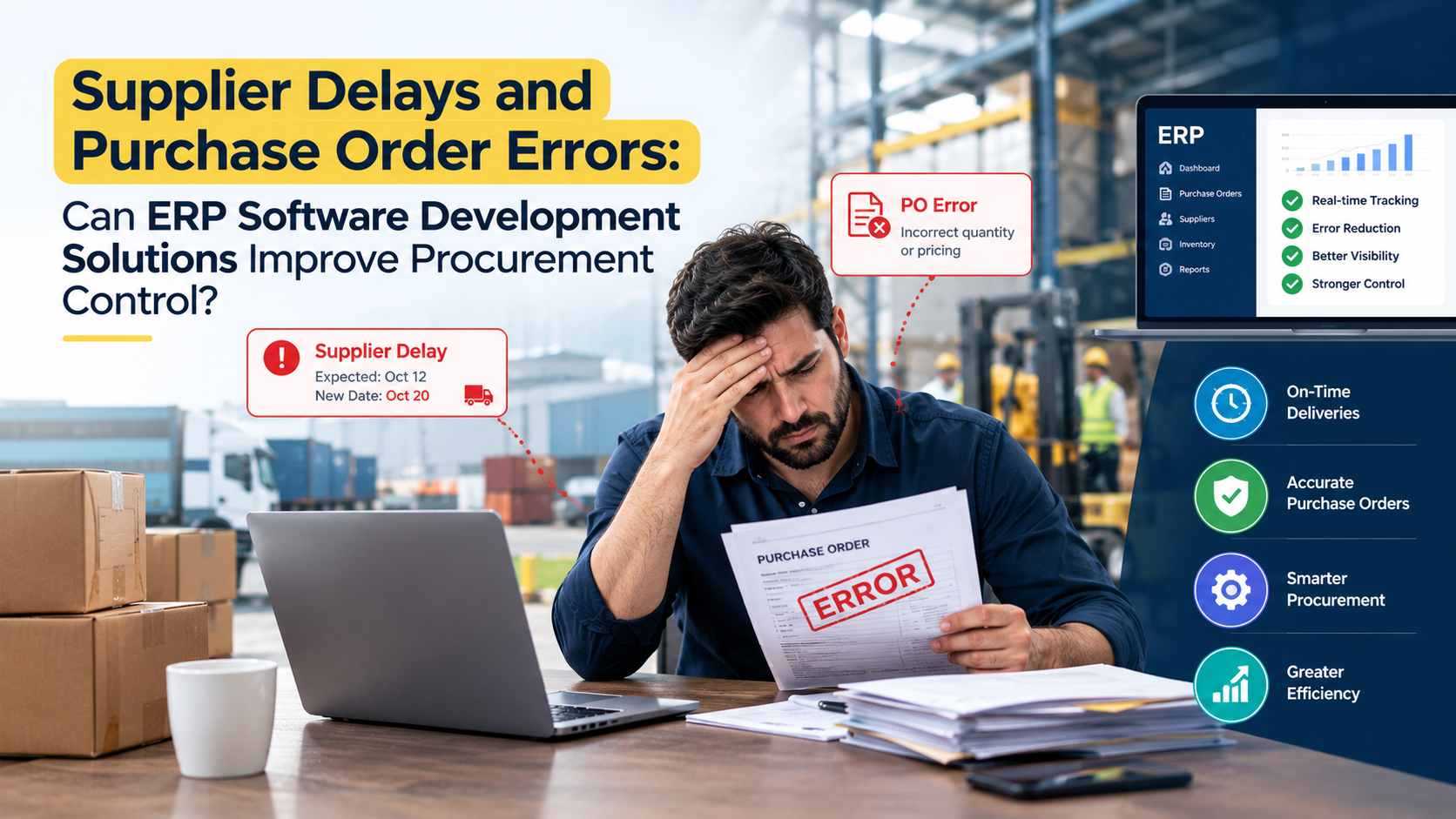
Ask any procurement manager how often a “confirmed” delivery date actually holds, and most will laugh before answering. A PO goes out, the supplier signs off on a date, and three weeks later the line is sitting idle waiting on parts that were supposedly “on the way.”
Arobit has sat across the table from enough manufacturers to know this isn’t an unusual story. It’s the default one. Nobody’s being lazy here. The real issue is that the information teams need lives in five different places at once, and by the time someone spots the gap, it’s already costing money.
Why procurement keeps breaking down
Most supplier delays don’t come out of nowhere. Trace them back and the same root cause usually shows up: data scattered across tools that don’t talk to each other.
- Lead times sit in someone’s personal spreadsheet, updated whenever they remember
- Supplier history lives buried in old email threads
- Inventory counts come from a separate system on its own update schedule
None of this syncs. So when something shifts, nobody notices until it’s too late to do anything about it.
Purchase order mistakes happen for similar, almost boring reasons. A decimal lands in the wrong spot and 50 units becomes 500. Someone approves an order for a part that was discontinued months back, because the catalog they checked hadn’t been updated. Nobody’s being careless. Teams are just stuck manually checking things that should already line up on their own.
Timing is the part that really stings. Teams usually learn about a delay only after it’s already hit the schedule. A vendor misses an internal cutoff and says nothing. The first real sign of trouble is an empty loading dock. By then the options are all bad ones. Rush shipping. Reshuffling the production line. A phone call to a client explaining why their order is late.
Where the cost actually lands
It’s tempting to file procurement slip-ups under “back-office annoyance.” They don’t stay there long.
A late shipment of raw material pushes back a production run. That pushes back fulfillment. Soon a customer is emailing to ask what happened to their order. Finance gets pulled in too, stuck matching invoices against POs that don’t reflect what actually arrived.
One mid-sized electronics manufacturer, working through issues like these, found that close to a fifth of its monthly purchase orders needed manual correction. Wrong quantities here. Mismatched pricing there. A duplicate entry nobody caught until the invoice showed up twice. Multiply that across hundreds of orders a month, and the hours lost to cleanup start rivaling the hours that should go toward actual sourcing strategy.
How ERP actually changes this
ERP gets tossed around as a buzzword a lot. For procurement specifically though, it fixes something real. It pulls procurement, inventory, finance, and supplier records into one place, so nobody’s hopping between five tools to answer a simple question. One dashboard shows supplier history, current stock, and open orders together.
The bigger payoff sits in what runs underneath that visibility. Best ERP software development solutions catch problems before they become expensive ones.
An order quantity that looks off compared to past patterns gets flagged before it’s approved, not after
A supplier who’s missed three delivery windows this quarter shows up clearly, instead of staying buried in an inbox nobody checks
Automation picks up a lot of the routine load too. Approvals, reorder triggers, status checks. Nobody needs to remember to log in every morning and manually review a dashboard. The system handles that part on its own. That frees procurement staff to spend their time on supplier negotiations and the exceptions that actually need a person thinking it through.
Integration ties it together. Connect ERP directly to a supplier’s portal or EDI system, and shipping updates show up almost the moment they happen. A delay gets caught the day it occurs. Not three weeks later, once the delivery date has already quietly slipped past.
A scenario worth picturing
Picture a company sourcing from three regional suppliers. Each one sends updates differently. One by email. One through a clunky portal nobody likes logging into. One through a phone call to whoever picks up.
Someone on the team had the job of manually updating a master tracking sheet every time something changed. That sheet was almost always a day or two behind reality.
After this company moved to an integrated ERP setup, those supplier updates started feeding straight into the procurement module automatically. Lead times adjusted on their own based on real delivery history, not the original contract terms that rarely held up anyway. The moment a ship date moved, downstream production schedules recalculated right away. Planners went from a few hours of warning to several days.
That’s not a pitch. It’s just what happens once procurement data stops sitting in silos and starts behaving like one connected system.
Picking the right kind of ERP
Not every ERP rollout delivers this, and it’s worth saying plainly. Off-the-shelf platforms sometimes force a company to bend its workflow around the software’s assumptions instead of the other way around. For businesses with unusual supplier arrangements, regulatory requirements, or multiple sites, that mismatch creates new headaches instead of solving old ones.
Custom‑built ERP software development services are usually the ones that pull ahead of options. A system built around a company’s way of sourcing, approving and tracking orders fits how people already work. Custom‑built ERP software development services mean nobody has to relearn their job just to use it.
It’s not about adding complexity for its own sake. It’s about precision. The logic inside should match real supplier contracts, real approval chains, and real stock thresholds. Not a generic template built for nobody in particular.
Where this is headed
Procurement software is moving past simple record-keeping. Newer platforms are beginning to find problems before they appear. Predictive tools inside enterprise resource planning systems now warn about delays by looking at supplier history, seasonal trends and also issues with shipping routes. That is a change from dealing with problems once they occur to getting ready, for them ahead of time.
Companies that treat ERP as a one‑time purchase tend to fall behind. The ones that keep refining ERP as their supplier base and order volume grow usually stay a step when things go sideways.
Closing thoughts
Supplier delays and PO mistakes aren’t going away completely. Supply chains carry built-in uncertainty that no software erases. What changes with a solid ERP setup is how fast a business catches the problem, and how much room it has left to react before the damage spreads.
Arobit’s team has worked with manufacturers dealing with exactly these headaches more times than most would guess. What stands out, again and again, is how much difference it makes once scattered data turns into something people can actually act on, often before a small delay turns into a real crisis.
FAQs
- How soon will a business see results after rolling out ERP for procurement?
Most companies see mistakes when entering orders after a few months. The part that predicts problems, like finding suppliers that might cause delays takes time because it has to use past information to get better.
- Does ERP only make sense for large manufacturers?
Not really. Smaller companies often see the advantage more because they don’t have much extra money to handle the cost of mistakes made by hand. A chosen ERP system grows along, with the company instead of requiring a complete change later.
- What actually separates off-the-shelf ERP from a custom build?
Off-the-shelf tools help you get started quickly.. They often make you change your workflow to fit the software. Custom or configured ERP software development takes longer at the beginning.. It fits the way your company really works. It matches approval chains and supplier terms exactly. That makes everything run smoother in the term.
About The Author