


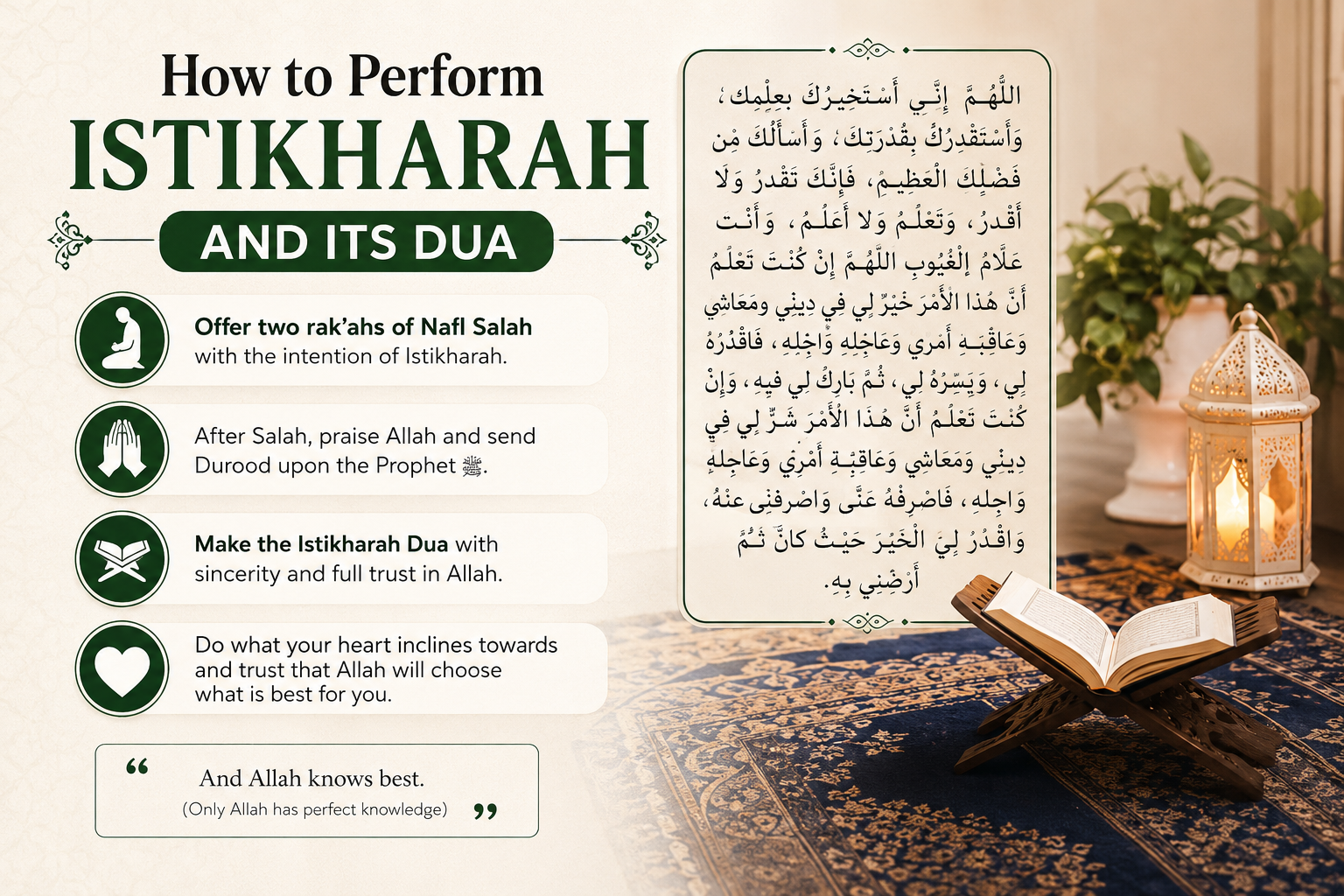
Translation:
O Allah! I seek goodness from You through Your knowledge, and I seek strength through Your power, and I ask You from Your immense bounty. Indeed, You have power, and I have no power. You know, and I do not know. You are the Knower of all that is unseen.
O Allah! If, in Your knowledge, this matter is good for me, for my religion, my worldly life, and my Hereafter, and for my present and future, then decree it for me, make it easy for me, and bless it for me.
But if, in Your knowledge, this matter is bad for me, for my religion, my worldly life, my Hereafter, and for my present and future, then turn it away from me and turn me away from it. And decree for me whatever is good, wherever it may be, and then make me content with it.
It is narrated in a Hadith of Sahih al-Bukhari:
عن جابر رضي اللہ عنه قال: كان النبي صلی اللہ علیہ و سلم يعلمنا الاستخارة في الأمور كلها، كالسورة من القرآن: إذا هم بالأمر فليركع ركعتين، ثم يقول: اَللّٰهُمَّ اِنِّیْ اَسْتَخِيْرُكَ بِعِلْمِكَ، وَ اَسْتَقْدِرُكَ بِقُدْرَتِكَ، وَ اَسْئَلُكَ مِنْ فَضْلِكَ الْعَظِيْمِ، فَاِنَّكَ تَقْدِرُ وَ لَا اَقْدِرُ، وَ تَعْلَمُ وَ لَا اَعْلَمُ، وَ اَنْتَ عَلَّامُ الْغُيُوْبِ، اَللّٰهُمَّ اِنْ كُنْتَ تَعْلَمُ اَنَّ هٰذَا الْاَمْرَ خَيْرٌ لِیْ فِیْ دِينِیْ وَ مَعَاشِیْ وَ عَاقِبَةِ اَمْرِیْ، اَوْ قَالَ عَاجِلِ اَمْرِیْ وَ آجِلِهٖ، فَاقْدُرْهُ لِیْ، وَ اِنْ كُنْتَ تَعْلَمُ اَنَّ هٰذَا الْاَمْرَ شَرٌّ لِیْ فِیْ دِينِیْ وَ مَعَاشِیْ وَ عَاقِبَةِ اَمْرِیْ، اَوْ قَالَ عَاجِلِ اَمْرِیْ وَ آجِلِهٖ، فَاصْرِفْهُ عَنِّیْ وَ اصْرِفْنِیْ عَنْهُ، وَ اقْدُرْ لِی الْخَيْرَ حَيْثُ كَانَ ثُمَّ رَضِّنِیْ بِهٖ
Translation:
It is narrated from Hazrat Jabir (RA) that he said:
The Holy Prophet ﷺ used to teach us Istikharah (seeking goodness from Allah) in all matters with the same care and attention as he taught us a Surah of the Holy Qur’an. He ﷺ said:
“When any one of you intends to undertake a matter, he should perform two Rak’ahs of (voluntary) prayer and then recite this supplication (mentioned above).”
(Sahih al-Bukhari, Vol. 5, p. 2345, Hadith No. 6019, Published by Dar Ibn Kathir, Damascus)
Explanation of the Hadith:
In the supplication mentioned in the Hadith, at one place,
(اَنَّ هٰذَا الْاَمْرَ) is mentioned. At this point, one should mention his or her specific need.
Then it continues:
فِیْ عَاقِبَةِ اَمْرِی“ اَوْ قَالَ ’’عَاجِلِ اَمْرِیْ وَ آجِلِهٖ۔
At this point, one of the narrators became uncertain as to whether the Holy Prophet ﷺ said:
فِیْ عَاقِبَةِ اَمْرِیْ
or whether he ﷺ said this instead:
(عَاجِلِ اَمْرِيْ وَ آجِلِهٖ). It is better to recite both.
فِیْ عَاقِبَةِ اَمْرِیْ وَ عَاجِلِ اَمْرِیْ وَ آجِلِهٖ۔
(Nuzhat al-Qari, Commentary on Sahih al-Bukhari, Vol. 2, p. 696, Published by Farid Book Stall, Lahore)
Note: Istikharah may only be performed regarding matters in which every Muslim has been given the freedom to choose. For example: whether to choose business or employment, which day or means of travel would be more suitable, whether buying a house or a shop would be beneficial, which area would be suitable for residence, where to get married, and similar matters.
As for matters regarding which Shariah has already given clear rulings, Istikharah is not performed. For example, the five daily obligatory prayers, paying Zakah when one possesses the required wealth, fasting during the month of Ramadan, and similar obligations. One should not perform Istikharah to decide whether or not to offer Salah, whether or not to pay Zakah, and so on.
Likewise, regarding matters that Shariah has prohibited, such as telling lies, violating the rights of others, and similar acts, one should not perform Istikharah to decide whether to do them or not. Rather, in all such matters, it is necessary to act according to the guidance of Shariah.
Among the etiquettes of Istikharah is that it should be performed regarding a matter about which the heart is not already inclined toward one side. If a person has already developed a strong preference for one option, then it becomes very difficult for the true situation to become clearly apparent through Istikharah.
About The Author