




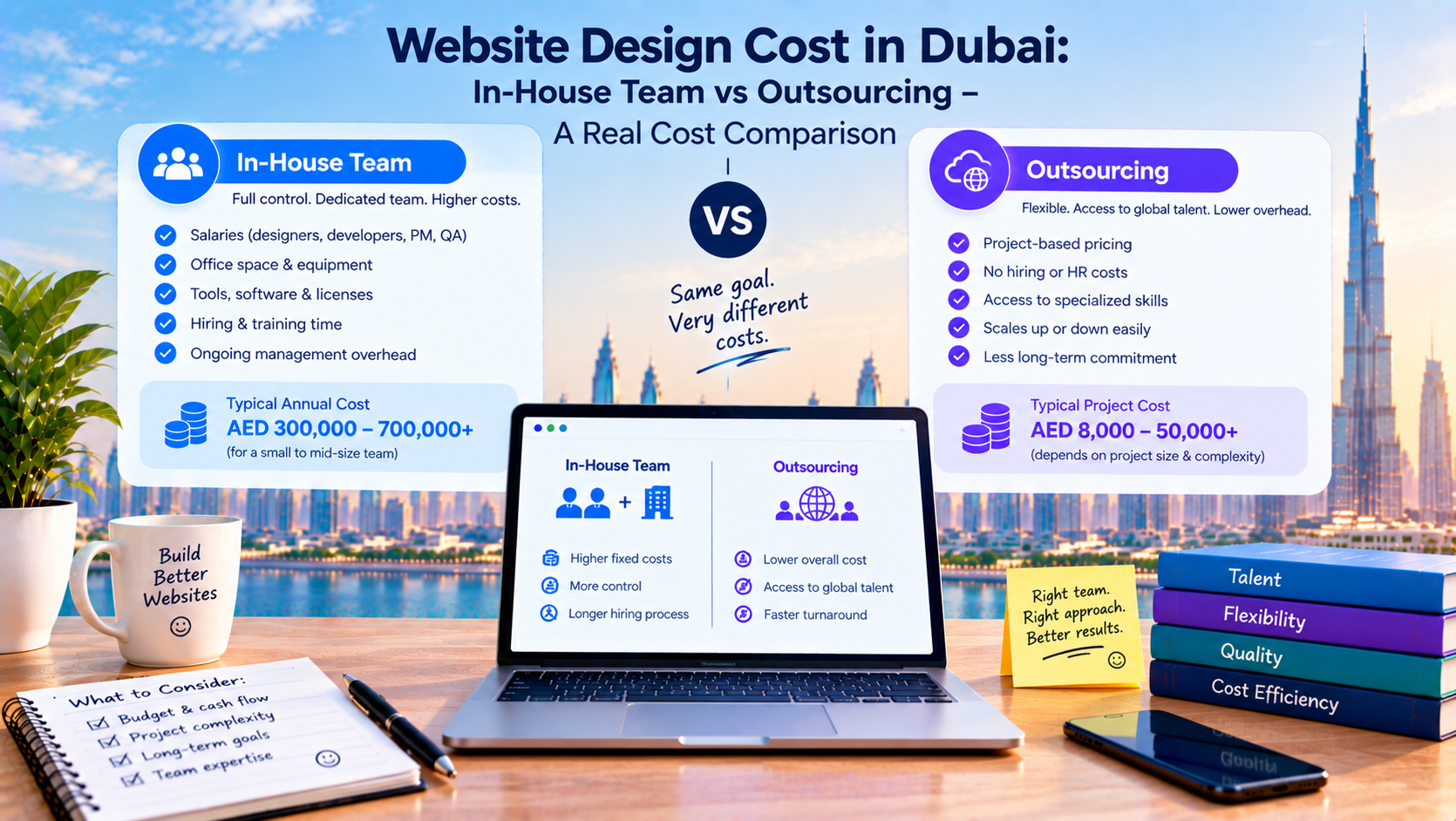
A growing Dubai business reaches a point where website requests keep piling up, a new landing page here, a product update there, a campaign microsite next month, and someone eventually asks whether it’s time to just hire a developer rather than paying an agency project by project. It’s a reasonable question, and the honest answer almost always comes down to one number most businesses never actually calculate: the fully loaded cost of an employee versus the all-in cost of outsourced output for the same volume of work.
Here’s how that comparison genuinely plays out, and what it means for website design cost in Dubai, whichever direction you lean.
Why Salary Alone Is the Wrong Number to Compare
The single most common mistake in this decision is comparing a developer’s advertised salary directly against an agency’s project quote, as if they’re the same unit. They’re not. A full-time hire’s real annual cost includes far more than the salary figure on the offer letter, UAE employment costs typically add visa sponsorship and processing, mandatory health insurance, annual leave and gratuity accrual, equipment and software licenses, and genuine management overhead for someone to actually direct and review the work. Across the wider industry, this fully-loaded multiplier commonly runs 1.3 to 1.6 times base salary once everything is properly accounted for, even before factoring in recruitment time and the inevitable ramp-up period before a new hire is genuinely productive.
Dubai web developer salaries vary considerably by experience and reporting source, but a reasonable working range for a solid mid-level hire sits somewhere between AED 70,000 and AED 150,000 annually in base salary, with senior or highly specialized developers commanding meaningfully more. Apply the fully-loaded multiplier, and the real annual cost of a single in-house developer in Dubai often lands in the AED 100,000-220,000 range, a number worth holding against the alternative before deciding.
What Outsourcing Actually Costs for Comparable Output
Outsourced web development, whether through a local Dubai agency, a freelancer, or an offshore team, is typically 30-60% cheaper than the fully loaded cost of an equivalent in-house hire, according to broad industry benchmarking. This gap is largest with offshore teams and smaller with locally based contractors, where the real advantage shifts from pure cost toward flexibility and faster onboarding rather than savings alone.
For a Dubai business specifically, a standard multi-page business website project through an agency typically runs AED 8,000-55,000 depending on complexity, a cost that covers the entire build, not an ongoing annual commitment. Even a business needing regular, ongoing updates can often secure a monthly retainer arrangement with an agency or freelancer for a fraction of a full-time salary’s annual cost, provided the actual volume of work doesn’t genuinely require someone dedicated full-time.
When In-House Genuinely Starts to Make Financial Sense
This isn’t an argument that outsourcing always wins, it depends entirely on your actual volume and nature of ongoing need. In-house hiring becomes more cost-effective specifically when your business has continuous, substantial web development needs that would otherwise require multiple concurrent agency engagements or retainers stacking up to a comparable or higher total cost. A useful industry rule of thumb: in-house tends to become the more economical choice once you consistently need the equivalent of several people working on web development year-round, rather than periodic projects or occasional updates.
There’s also a genuine strategic dimension beyond raw cost. If your website or digital product is genuinely your core business, not just your marketing presence, but the actual product customers interact with, deep, accumulated product knowledge and the ability to iterate immediately without external coordination often justifies the premium of in-house ownership, even when the raw hourly math favors outsourcing.
The Hybrid Model Most Growing Dubai Businesses Actually Land On
In practice, the cleanest answer for many mid-growth businesses isn’t a strict either-or. A common, sensible structure pairs a single in-house hire, handling daily updates, routine content changes, and ongoing site health, with an agency or specialist freelancer engaged for larger, periodic projects: a full redesign, a new platform migration, or specialized functionality the in-house hire isn’t equipped to build alone. This hybrid approach captures the responsiveness of having someone immediately available for day-to-day needs while avoiding the cost of building an entire in-house team capable of every specialized skill a growing website eventually needs.
What Gets Missed When Businesses Compare Purely on Numbers
A few genuinely important factors sit outside a pure cost spreadsheet. An in-house hire provides continuity and institutional knowledge that’s harder to replicate through rotating agency staff or freelancers, which matters more for businesses where the website is deeply tied to ongoing, evolving internal processes. Conversely, an agency brings a full team’s breadth immediately, designers, developers, QA, project management, without the recruitment risk of a single hire turning out to be a poor fit, or becoming unavailable at a critical moment with no backup in place.
Recruitment itself carries real, often underestimated cost and time. Sourcing, interviewing, and properly onboarding a quality developer in the UAE market can take a meaningful number of weeks even before productive output begins, a delay that simply doesn’t exist when engaging an established agency ready to start immediately.
A Practical Way to Make This Decision
Calculate your actual ongoing web development need honestly, in hours per month, over the coming year, not the volume during your busiest launch period, but a realistic average. Compare that honest estimate against the fully-loaded cost of a hire versus an equivalent volume of agency or freelance engagement. If the comparison is close, the hybrid model- one in-house hire for routine work, an agency for larger periodic projects- often captures the best of both without over-committing to either extreme.
Bootesnull has worked alongside UAE businesses on both sides of this decision, supporting clients who ultimately built a small in-house team once their ongoing needs genuinely justified it, and serving as the external partner for businesses whose actual volume didn’t come close to justifying a full-time hire despite initially assuming it would. In nearly every case, running the honest fully-loaded cost comparison, rather than comparing salary to invoice directly, was what actually clarified the right path.
Final Thoughts
Website design cost in Dubai looks very different depending on whether you’re comparing a single project quote against a full year of employment costs, or genuinely comparable ongoing volumes against each other. Outsourcing wins on flexibility and lower commitment for most businesses without continuous, substantial development needs; in-house hiring earns its higher fully-loaded cost once your actual volume and strategic need for the website genuinely justify a dedicated, full-time resource.
Frequently Asked Questions
1. Is it always cheaper to outsource web development than hire in-house in Dubai?
Generally yes for most small-to-mid-sized businesses, since outsourcing avoids visa, insurance, and overhead costs that significantly increase a hire’s real annual cost beyond their base salary. In-house becomes more economical only once ongoing volume genuinely justifies a full-time resource.
2. What’s the real annual cost of hiring a web developer in Dubai, including all overhead?
Factoring in visa, insurance, and management overhead on top of base salary, the fully-loaded cost of a single in-house developer in Dubai commonly lands somewhere in the AED 100,000-220,000 range annually, depending on experience level.
3. When does it make sense to hire a developer in-house instead of outsourcing?
When your business has continuous, substantial web development needs, the equivalent of multiple people working on it year-round, or when deep, accumulated product knowledge genuinely matters more than the cost savings outsourcing offers.
4. Can I combine in-house and outsourced resources for my website?
Yes, this hybrid approach is common and often effective, a single in-house hire handling routine updates, paired with an agency or specialist freelancer for larger periodic projects like redesigns or new feature builds.
5. How long does it typically take to hire and onboard an in-house web developer in Dubai?
Sourcing, interviewing, and properly onboarding a quality hire often takes several weeks before they’re genuinely productive, a delay that doesn’t apply when engaging an established agency or freelancer ready to start immediately.
About The Author