





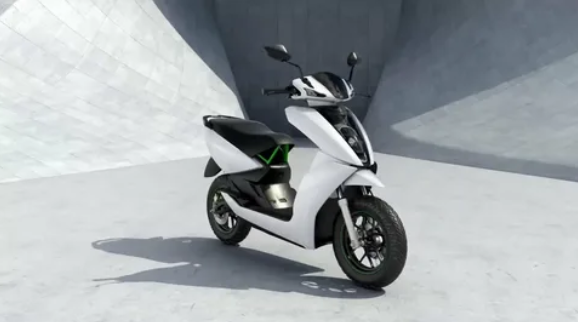
An Ather electric scooter appeals to riders who want more than low running cost. The current line-up combines connected dashboards, navigation, battery management and strong charging infrastructure with two distinct product philosophies: the family-oriented Rizta and the performance-focused 450 range.
That makes Ather Electric Scooter relevant whenever buyers compare top electric scooters in India. The important question is not whether electric propulsion is modern. It is whether range, charging access, warranty and everyday ergonomics fit the rider’s routine.
The Rizta Is Designed Around Family Practicality
The current Rizta offers S and Z variants with 123 km or 161 km IDC range choices. Peak motor power is 4.3 kW and top speed is 80 km/h.
Its large seat and storage-focused design make it more suitable to shared household use than a compact performance scooter.
The 450 Range Targets More Enthusiastic Riders
The Ather 450S, 450X and 450 Apex place greater emphasis on acceleration, handling and connected technology. Current models offer IDC ranges up to roughly 161–165 km depending on variant.
The Apex can reach 100 km/h and accelerates from 0–40 km/h in about 2.9 seconds.
Range Choices Help Buyers Avoid Overspending
Not every commuter needs the largest battery. A rider covering 20 km per day may be perfectly comfortable with a lower-range version, while someone travelling 70–80 km should leave a larger buffer.
Choosing range according to real usage is one of the best ways to control purchase cost.
Home Charging Is the Foundation of Easy Ownership
Electric scooters are most convenient when they can be charged overnight at home. A dedicated parking point with safe electrical access removes dependence on public charging for routine use.
Apartment residents should confirm installation permissions before buying.
Ather’s Public Charging Network Adds Flexibility
Ather currently states that its public fast-charging ecosystem has more than 6,100 points across 370-plus cities.
Public charging is useful for unexpected longer trips, although home charging remains the easier daily solution.
Battery Warranty Is a Key Ownership Factor
Rizta configurations include standard battery warranty coverage, with longer options available through AtherStack-related packages. Buyers should read the retained-capacity terms and kilometre limits carefully.
The battery is the most expensive component, so warranty conditions matter more than decorative features.
Connected Dashboards Add Genuine Utility
Higher Ather variants include TFT displays, navigation and software-driven features. On the 450X and higher configurations, Google Maps integration and regenerative functions increase everyday convenience.
These features are most useful when they reduce phone dependence rather than simply adding information overload.
Running Energy Cost Can Be Much Lower Than Petrol
Charging at home can reduce per-kilometre energy cost substantially compared with petrol, depending on local electricity tariffs. The more kilometres a rider covers each month, the more relevant the saving becomes.
Tyres, brakes and suspension still require maintenance, so electric does not mean maintenance-free.
Rizta Versus 450: Choose by Use Case
The Rizta is better for family comfort, storage and predictable urban use. The 450 is better for riders who value sharper acceleration and a more engaging chassis.
Both are legitimate smart choices, but for different types of ownership.
Real-World Range Will Be Lower Than Certified Range
IDC figures are standardised comparison numbers. Speed, load, temperature, gradients and riding mode affect actual distance.
Buyers should leave a practical range buffer rather than planning each day around the full certified figure.
Service Access Still Matters with an EV
Software and batteries reduce some conventional maintenance, but repairs still require trained support. Before purchase, riders should check the nearest Ather Experience Centre and service process.
Convenient local support can be more important than a small difference in claimed range.
Could an Ather Electric Scooter Be Your Next Ride?
Yes, especially if home charging is available and daily travel is predictable. The current range covers both family and performance needs, while the charging and software ecosystems add meaningful ownership value.
Among top electric scooters, Ather stands out most strongly for riders who want the vehicle, charging system and connected interface to work as one integrated product rather than as separate features.
Software Support Is Part of the Product
An electric scooter increasingly depends on software for navigation, charging information, ride modes and diagnostics. Buyers should therefore consider the manufacturer’s history of software updates and app support alongside mechanical service.
A well-integrated interface can improve daily convenience, while unreliable connectivity can quickly become frustrating even when the scooter rides well.
What to Verify Before Finalising This Motorcycle
Before paying a booking amount, confirm the exact variant, current ex-showroom price, insurance, registration charges and standard equipment in your city. Manufacturers can revise prices or variant equipment, so a current dealer quotation is more useful than an old online listing.
Also test the motorcycle on realistic roads and check pillion comfort if relevant. A good purchase should remain comfortable, affordable and easy to service long after the initial excitement has faded.
Rizta and 450 Serve Different Ownership Priorities
The Rizta is easier to recommend to households because it prioritises seat space, storage and predictable performance. The 450 range is more compact and performance-led, with quicker acceleration and a sharper riding feel. Buyers should decide which philosophy matters before comparing battery capacity.
A family buyer may gain more value from a comfortable seat and storage than from a higher top speed. A solo commuter who enjoys spirited riding may reach the opposite conclusion.
Check Charging Time as Carefully as Range
Range determines how far the scooter can travel, but charging time determines how easily it fits into the rider’s routine. Someone who can charge overnight may not care about a few extra hours, while a rider with irregular parking access may need faster or more flexible charging. The best electric scooter is the one whose charging pattern matches the home and work environment.
That integrated approach is especially valuable for riders who expect navigation, charging data and vehicle information to work together consistently every day.
About The Author