





Key takeaways
- Stay competitive: content alone no longer sets a streaming platform apart. The ecosystem around it does.
- Enhance user experience: AI personalization, one wallet and one login make Arabic and English viewing feel effortless.
- Improve efficiency: evolve your existing OTT stack in five phases instead of rebuilding it.
- Grow revenue per user: tickets, merchandise, microtransactions and ads sit beside subscriptions.
- Reduce build effort: a cross-platform codebase serves iOS, Android and, where suitable, web and TV.
- Protect the business: DRM, payment security and UAE data-protection rules belong in the first design.
Dubai’s OTT Market Is Entering Its Next Phase
Dubai’s streaming market has stopped being a race for the biggest catalogue. In January 2026, Dubai Media Incorporated launched Dubai+, a free, ad-supported service with more than 20 exclusive series and 12 live sports championships, into a market that already includes Netflix, Shahid and Starzplay. Analysys Mason expects UAE spending on pay TV and streaming video to grow from AED 4.6 billion in 2025 to AED 5.7 billion by 2030, with most of that growth coming from streaming. More money is arriving, but so is more competition for every dirham.
That pressure turns OTT apps vs super apps from a technical curiosity into a boardroom question. Viewers expect live sport, payments, tickets, shopping and social features around the content, in Arabic and English, on a phone, a TV and a laptop. Understanding how OTT apps are evolving is the first step toward deciding what your own platform should become.
This guide answers what is an entertainment super app, sets out the difference between OTT app and super app, and shows how a media company can get there in phases without discarding what it has already built. The core argument is simple: the next generation of Dubai platforms will pair OTT capabilities with super-app functionality such as AI personalization, wallets, commerce and community.
Why Dubai Media Companies Are Rethinking the Traditional OTT Model
From Standalone Streaming to Connected Entertainment
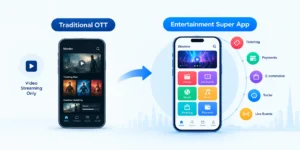
The traditional OTT model is easy to describe: build a content catalogue, sell a subscription, stream the video. It worked while streaming was the novelty; now it’s the baseline. Global and regional services chase the same households, and viewers rotate between subscriptions across apps that don’t talk to each other.
Video alone no longer sets a platform apart, and that is the clearest sign of how OTT apps are evolving: from a delivery channel for films and series into the front door of a wider digital relationship. Gulf News has described TikTok, Instagram Reels and YouTube Shorts as feeders for longer-form streaming in the UAE, so the app itself has to turn a casual clip-watcher into a paying, returning customer. An experienced OTT app development company can help you decide which layers to add first.
The Growing Demand for Integrated Digital Experiences
How OTT apps are evolving shows up in everyday habits: viewers already live inside apps that combine services. When they watch a match or a concert stream, the next step should be one tap away:
- Streaming + payments: buy a pay-per-view fight or a season pass without leaving the player.
- Streaming + ticketing: book seats for the live event.
- Streaming + e-commerce: order the kit or products featured on screen.
- Streaming + social interaction: react, comment and share with friends in real time.
- Streaming + live events: move from the broadcast to the venue and back.
Each integration gives viewers a reason to open the app on days with nothing to watch, which lifts session frequency and makes cancelling feel like a real loss.
Where the Traditional OTT Model Falls Short
Subscription-only OTT has structural limits:
- Subscription-only monetization: revenue rests on one fee that competitors can undercut.
- Limited engagement outside viewing: the app sits idle between episodes.
- Fragmented user journeys: tickets, shopping and payments happen elsewhere.
- Weak microtransaction paths: without a wallet, small purchases carry too much friction.
- Few ecosystem effects: nothing improves as more partners and users join.
- Piracy and account sharing: a login alone is hard to defend.
Any honest comparison of OTT apps vs super apps starts with these gaps, because each gap marks part of the difference between OTT app and super app.
What Is an Entertainment Super App?
What Is an Entertainment Super App in Business Terms?
So, what is an entertainment super app? In plain business terms, it is one application where a viewer can watch, pay, book, shop and socialise under a single login, a single wallet and a single recommendation engine. WeChat and Grab made the super-app model familiar in Asia. An entertainment super app applies the same logic to media and live experiences.
So what is an entertainment super app, technically? Four building blocks make it work. A unified identity recognises the customer everywhere. A wallet handles subscriptions, tickets and small purchases. A recommendation engine learns from behaviour across every service, not only viewing history. A service layer lets partners such as ticketing providers, retailers and food vendors plug in without rebuilding the core. Working examples already exist: OTTplay in India bundles content from ZEE5, SonyLIV and Lionsgate Play into one access point, and Amazon Prime Video opened a Channels marketplace in India in 2021 to host other subscription services.
Difference Between OTT App and Super App
A direct look at OTT apps vs super apps shows the difference between OTT app and super app across eight areas.
| Area | Traditional OTT app | Entertainment super app |
|---|---|---|
| Core purpose | Video streaming | Connected entertainment ecosystem |
| Content | Movies, shows, live content | Content plus experiences |
| Payments | Subscription via payment gateway | Integrated wallet and transactions |
| Commerce | Usually limited | Merchandise, food, tickets, products |
| Social | Limited | Social and community features |
| Personalization | Content recommendations | Personalized ecosystem |
| Engagement | Primarily viewing | Viewing, purchasing and interacting |
| Monetization | Subscription or advertising | Multiple revenue streams |
From a business perspective, the difference between OTT app and super app is a shift from selling access to content toward earning from the whole customer journey. From a technology perspective, a standard streaming app is built around a video pipeline, while a super app is built around identity, payments and APIs, with video as one service among many. For Dubai, where audiences are mobile-first, bilingual and comfortable paying digitally, that second architecture matches how people already live.
OTT Apps vs Super Apps — What Is Driving the Shift in Dubai?
Consumers Want More Than Content
The OTT apps vs super apps shift starts with viewer behaviour. People in Dubai move between entertainment, payments, events and shopping on the same phone, often within minutes, and they expect those moments to connect. Mobile-first habits and multi-screen viewing mean the experience has to follow the person from phone to smart TV to laptop. Language matters as well. Arabic and English users expect content, navigation, search and support in both, with proper right-to-left layouts rather than a mirrored afterthought.
AI Is Changing Content Discovery
Discovery is where AI changes the product most visibly. Recommendation engines read behaviour and context, such as time of day, device and language, to build a personalised home screen. Voice search in Arabic and English lowers friction on a TV remote. Automated content tagging keeps large catalogues searchable, and automated sports highlights turn a ninety-minute match into clips fans can share within minutes. This is how OTT apps are evolving through AI: the catalogue becomes a starting point, and the experience is assembled around each viewer.
Live Sports and Events Are Creating New Opportunities
In the OTT apps vs super apps debate, live sport shows the gap more clearly than anything else. Football streaming can add real-time statistics, interactive viewing, watch parties and fantasy games. Around the match, the same app can sell tickets, merchandise and food orders. Dubai+ launched with a dedicated sports catalogue covering 12 live championships, which shows how central live sport has become to local platforms. The viewer journey changes from this:
Watch → Exit
to this:
Watch → Interact → Purchase → Share → Return
Super Apps Create More Monetization Touchpoints
A super app gives a platform far more places to earn: subscriptions, advertising, pay-per-view, in-app purchases, microtransactions, event tickets, merchandise, food and commerce integrations, all settled through a digital wallet. In the OTT apps vs super apps comparison, this breadth is what protects revenue when one stream, such as subscriptions, flattens. So what is an entertainment super app worth? Look first at revenue per user, not subscriber count.
What Features Will Define Dubai’s Next Generation of Entertainment Super Apps?
The features below answer what is an entertainment super app in practice, and they separate it from an OTT app with a few extra buttons. They also show the difference between OTT app and super app in practical terms.
Unified Content Discovery
This is how OTT apps are evolving beyond separate tabs: movies, series, sports, live events and short-form clips appear in one feed with one search bar. Viewers shouldn’t need to know which catalogue holds a title. Personalised recommendations and unified search remove that decision.
AI-Powered Personalization
Recommendation engines and predictive content discovery suggest the next title or event. Personalised notifications bring viewers back at the right moment, AI-generated highlights keep fans current, and voice-based discovery with language-aware personalization adapts to Arabic, English or mixed-language households.
Integrated Payments and Digital Wallets
Subscription payments, one-click purchases, microtransactions and event payments should run through one wallet and secure payment gateways. Fewer checkout steps lift conversion on small, impulsive purchases.
Commerce and Ticketing
Event tickets, merchandise, food ordering during live events, brand partnerships and in-app commerce turn attention into transactions. A match-day screen that offers a jersey and a snack order is more useful to the viewer, and more valuable to the platform, than a banner ad.
Social and Community Features
Watch parties, reactions, comments, content sharing, fan communities and creator interaction keep people in the app after the final whistle.
Multi-Device Continuity
iOS, Android, web and smart TV experiences need cross-device synchronisation, continue-watching and unified profiles. For OTT apps vs super apps, cross-platform development matters because an ecosystem that behaves differently on each screen quickly loses trust. A shared codebase keeps prices, wallet balances and recommendations consistent. Put differently, what is an entertainment super app if not one product that behaves like one product everywhere?
How Dubai Media Companies Can Build the Transition From OTT to Super App
Start With the OTT Foundation
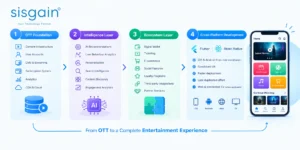
Most media companies don’t need to rebuild from scratch. Existing content infrastructure, user accounts, content management, video streaming, the subscription system, analytics, and CDN and cloud infrastructure form a working foundation. The audit question is which of these can expose clean APIs. That question sits at the heart of how OTT apps are evolving without a costly rewrite.
Add an Intelligence Layer
On top, add AI recommendations, user behaviour analytics, personalization, search intelligence, content discovery and engagement analytics. This layer improves what viewers see today and produces the data that every later phase depends on.
Introduce the Ecosystem Layer
Next come the digital wallet, ticketing, e-commerce, social features, loyalty, third-party integrations and partner services. Treat each one as a service attached to the shared identity and wallet, not as a separate app. That discipline is the practical difference between OTT app and super app.
Use Cross-Platform Development for Faster Expansion
Flutter and React Native both let one team ship iOS and Android from a shared codebase, with consistent UX, faster deployment and less duplicated effort. Where it is technically appropriate, the same investment extends to web and connected-screen experiences, although TV platforms often still need platform-specific work for playback and remote navigation. Choosing a cross platform app development company in Dubai with video, payments and live-event experience lowers the risk of rework later.
Architecture matters as much as framework. If the system can’t absorb new integrations, each phase turns into a rebuild, which is why technology choices belong in the same conversation as how OTT apps are evolving and where the OTT apps vs super apps decision lands for your business.
Monetization Opportunities Beyond OTT Subscriptions
Understanding how OTT apps are evolving commercially means looking past the subscription line to every moment where a viewer might spend.
Subscription and Advertising Models
SVOD (subscription), AVOD (ad-supported) and TVOD (pay per title) remain the base, and many platforms now run hybrids, such as a free ad tier with paid upgrades. Dubai+ is free and ad-supported, which shows how mainstream the AVOD route has become. On the revenue side, the difference between OTT app and super app is that an OTT app usually commits to one of these models, while a super app layers several.
Microtransactions and In-App Purchases
A wallet makes small payments practical: premium content, live-event access, exclusive features, digital goods and fan experiences such as a signed-shirt draw or a backstage Q&A. Because each purchase is small, checkout has to take one tap; any more friction and the sale disappears.
Commerce and Transaction-Based Revenue
Tickets, merchandise, food delivery, brand partnerships and affiliate commerce let the platform earn a margin or commission on spending that already surrounds the content. A broadcaster that sends viewers to a third-party ticketing site earns nothing; a super app keeps the transaction and the data.
Why the Super App Model Can Increase Customer Lifetime Value
Customers open a super app more often, so there are more transaction moments per month. Retention improves because switching means losing wallet balance, tickets, history and community. Cross-selling gets easier, and first-party behavioural insights sharpen pricing and offers. This is where OTT apps vs super apps becomes a financial argument: an ecosystem creates more revenue opportunities per customer than a subscription-only OTT model can.
Technology and Security Considerations for an Entertainment Super App
An ecosystem is only as strong as its foundations, and this is where the OTT apps vs super apps choice becomes an engineering decision rather than a branding one.
Scalable Cloud and Video Infrastructure
Live events create sharp traffic spikes, and a kickoff or a finale can multiply concurrent viewers in minutes. A CDN, cloud architecture with auto-scaling, and tested video delivery keep playback smooth when the wallet and ticketing services are busiest too.
API-First Architecture
Payment APIs, commerce integrations, ticketing, social services and third-party partners all connect through documented APIs. Because partner systems rarely fit off-the-shelf tools, many media teams work with a custom software development company in Dubai to design the integration layer once and reuse it for every new service.
DRM and Content Protection
Studios and sports rights holders expect digital rights management, encryption and secure streaming, typically through Widevine, FairPlay and PlayReady across devices. Anti-piracy controls, concurrent-stream limits and account protection address leakage and credential sharing.
Data Privacy and Payment Security
UAE data protection considerations include the federal Personal Data Protection Law (Federal Decree-Law No. 45 of 2021) and, for some entities, DIFC or ADGM regimes. What is an entertainment super app from a compliance view? A platform that handles identity, payments and personal data in one place. Plan for secure authentication, consent management, role-based access, PCI DSS-aligned payment handling and continuous monitoring. Wallet features may also fall under UAE financial regulation, so work with a licensed payment partner and confirm requirements with legal counsel.

OTT Apps vs Super Apps — Which Model Should Dubai Media Companies Choose?
When a Traditional OTT App Still Makes Sense
A focused OTT app fits an early-stage media company with a limited catalogue, a single monetization model and an MVP to validate. Prove demand first; complexity can wait. In the OTT apps vs super apps decision, simplicity is a valid choice.
When an Entertainment Super App Makes More Sense
The difference between OTT app and super app pays off with a large user base, several content categories, live sports or events, existing commerce partnerships, a strong payment ecosystem and a clear need for higher engagement and retention. At that point, a specialist super app development company in Dubai can help map partners, wallet flows and the service layer.
The Practical Approach: Evolve Instead of Rebuild
This roadmap answers what is an entertainment super app in practice, built stage by stage:
- OTT foundation. Stable streaming, accounts, subscriptions and analytics.
- AI personalization. Recommendations, search and notifications.
- Payments and wallet. One-click purchases and microtransactions.
- Commerce and ticketing. Events, merchandise and partner services.
- Social and community. Watch parties, fan groups and creator tools.
What the Future of Entertainment Super Apps Looks Like in Dubai
From Streaming Platforms to Entertainment Ecosystems
OTT becomes one component of a broader platform. AI becomes the discovery and engagement layer, wallets join the entertainment journey, live events turn into commerce moments and cross-platform experiences become standard rather than a differentiator. How OTT apps are evolving points toward platforms where video is the entry point, not the whole product.
The Next Competitive Advantage Will Be the Ecosystem
Content alone may stop differentiating platforms. User experience, personalization, transactions and partnerships create defensibility that a catalogue can’t. Dubai’s digital-first environment gives media companies room to test integrated platforms early, and the market is already watching how OTT apps are evolving beyond video. By the time the OTT apps vs super apps question is settled, platforms that built wallets, partner APIs and first-party data early will be hard to dislodge.
Final Takeaway
Dubai media companies are moving from standalone streaming to integrated entertainment platforms, and the difference between OTT app and super app is now strategic, not cosmetic. Media companies don’t need to abandon OTT, and OTT apps vs super apps is less an either-or choice than a sequence. The stronger path is to build an OTT foundation that grows into an ecosystem, backed by scalable architecture, AI, cross-platform delivery, payments, commerce, security and a clear monetization plan.
Planning your move from OTT to super app? Work with a media and entertainment software development company in Dubai to plan the roadmap, architect the platform and build it in phases.
FAQs
1. What is an entertainment super app?
An entertainment super app is a single application that combines streaming with payments, ticketing, commerce, social features and personalised recommendations under one login and wallet, turning a video service into a connected entertainment ecosystem.
2. What is the difference between OTT app and super app?
An OTT app mainly delivers video through subscriptions or ads. A super app adds a shared wallet, commerce, ticketing and community features, so one platform serves viewing, buying and interacting with several revenue streams.
3. OTT apps vs super apps: which is better for a Dubai media company?
An OTT app suits a small catalogue or MVP. A super app suits larger audiences, live sports, partnerships and payments. Most companies do best by starting with OTT and adding super-app layers gradually.
4. What should media companies know about how OTT apps are evolving?
OTT apps are moving beyond video delivery toward AI discovery, in-app payments, live-event commerce and social features, because audiences expect connected experiences and platforms need more revenue sources than subscriptions alone.
5. How do entertainment super apps make money?
They combine subscriptions and advertising with pay-per-view, microtransactions, event tickets, merchandise, food ordering, brand partnerships and affiliate commerce, all processed through a wallet that raises revenue per user and retention.
6. Can an existing OTT app be upgraded into a super app?
Usually yes. Audit accounts, content management, subscriptions and analytics for clean APIs, then add personalization, a wallet, ticketing, commerce and community in phases rather than rebuilding the platform from scratch.
7. Should we use Flutter or React Native for an entertainment super app?
Both support shared iOS and Android codebases. The better choice depends on your team’s skills, video player needs, native integrations and TV plans, so prototype playback and payments before committing to either framework.
8. How long does it take to build an entertainment super app?
It depends on scope. A focused first phase often takes a few months, while a full ecosystem with payments, commerce and community usually rolls out over a year or more in planned stages.
9. Are payments in an entertainment super app secure?
They can be, if built with PCI DSS-aligned processing, tokenised cards, strong authentication, licensed payment partners and compliance with the UAE Personal Data Protection Law, plus continuous monitoring for fraud and misuse.
10. How big is the streaming market in the UAE?
Analysys Mason forecasts UAE pay-TV and streaming spend rising from AED 4.6 billion in 2025 to AED 5.7 billion by 2030, while Mobility Foresights projects the OTT platform market reaching $5.38 billion by 2031.
About The Author