

Barcodes help businesses identify products, track inventory, manage shipments, and improve operational efficiency. However, creating a barcode that looks correct is not enough. It must also contain the right information and remain readable by the scanners used throughout the supply chain.
This is where barcode verification and barcode scanning become important. Although these processes are closely related, they serve different purposes. Scanning captures the information encoded in a barcode, while verification measures barcode quality against applicable technical standards.
Understanding the difference can help businesses reduce scanning errors, improve quality control, and avoid delays in warehouse, retail, manufacturing, and distribution operations. Pointus Solutions helps businesses explore barcode printing solutions, while Shop Barcode provides access to relevant Printing Products for different business requirements.
Table of Contents
- What Is Barcode Scanning?
- What Is Barcode Verification?
- Barcode Verification vs. Barcode Scanning: Key Differences
- Why Barcode Verification Matters for Businesses
- When Should Businesses Use Scanning and Verification?
- How to Improve Barcode Quality
- Frequently Asked Questions
- Conclusion and Call to Action
1. What Is Barcode Scanning?
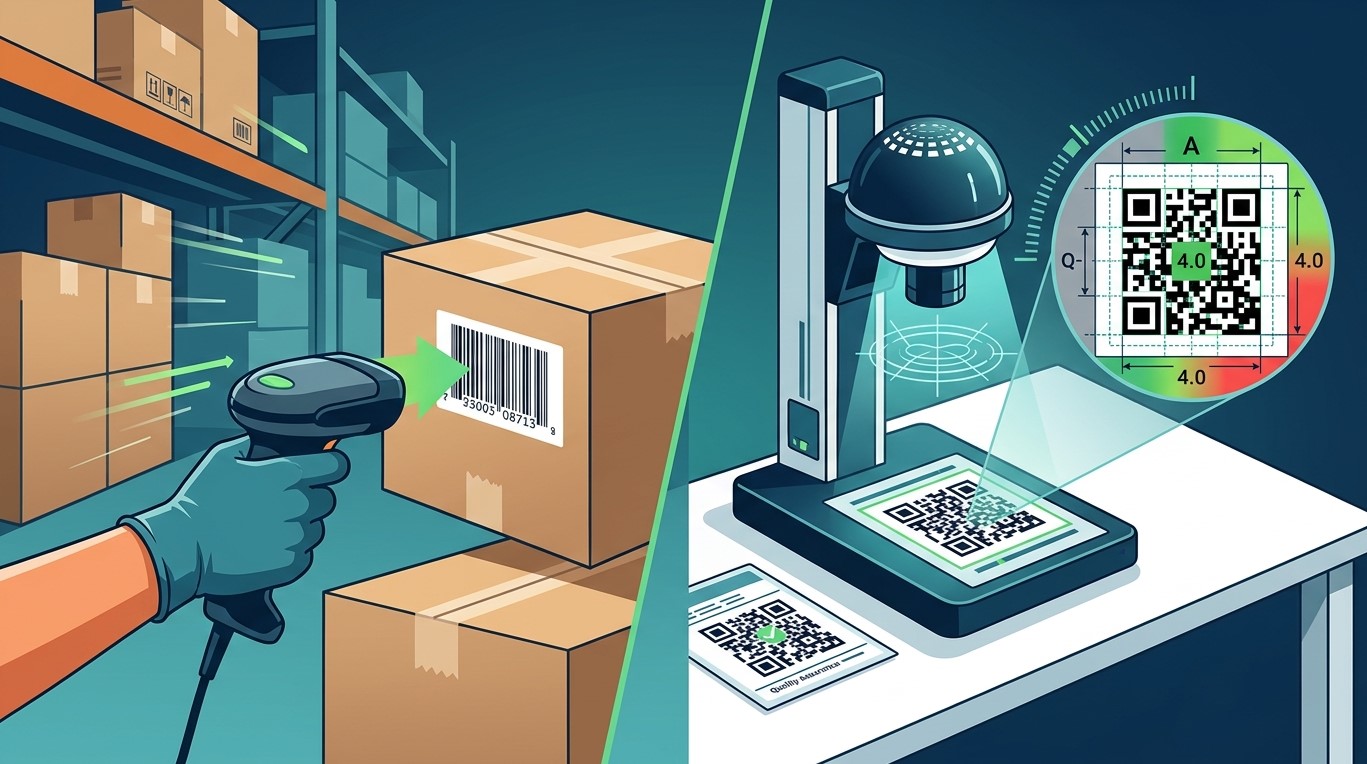
Barcode scanning is the process of reading a barcode to retrieve its encoded information. A barcode scanner uses optical technology to capture the barcode pattern and convert it into data that a computer, point-of-sale system, or inventory application can process.
For example, when a cashier scans a product at checkout, the system reads the barcode and retrieves the corresponding product record.
How Barcode Scanning Works
The process generally involves three steps:
- Capture: The scanner reads the barcode using a laser or imaging technology, depending on the device.
- Decode: The scanner interprets the pattern and extracts the encoded data.
- Transmit: The decoded information is sent to the connected system for processing.
Common Applications of Barcode Scanning
Businesses use barcode scanners for various daily activities, including:
- Checking products in and out of inventory.
- Processing retail transactions.
- Tracking packages during shipping.
- Recording goods received at warehouses.
- Identifying assets and equipment.
- Managing order picking and packing.
Barcode scanning is primarily concerned with whether a particular scanner can successfully read a barcode and retrieve its encoded data. A successful scan, however, does not necessarily prove that the barcode meets all applicable print-quality standards.
2. What Is Barcode Verification?
Barcode verification is a quality-control process that evaluates a barcode against relevant technical specifications. It uses a specialized barcode verifier to measure characteristics that affect readability and determine how closely the symbol meets the required standard.
Unlike a conventional scanner, a verifier can provide a structured quality assessment rather than simply reporting whether the barcode was successfully decoded.
Depending on the barcode type and applicable standard, verification may assess characteristics such as symbol contrast, edge definition, modulation, defects, and quiet zones.
How Barcode Verification Works
A typical verification process includes the following steps:
- Inspect the barcode: Examine the printed symbol using a suitable verification device.
- Measure quality: Evaluate relevant characteristics according to the selected standard and configuration.
- Assign a grade: Produce a quality grade or assessment based on the applicable methodology.
- Review results: Identify potential defects and determine whether printing adjustments are required.
Standards such as ISO/IEC 15416 for linear barcodes and ISO/IEC 15415 for two-dimensional symbols are commonly used for barcode quality assessment.
Verification can help businesses identify issues such as insufficient contrast, printing defects, incorrect symbol dimensions, or inadequate clear space around the barcode.
However, verification has limits. A print-quality grade does not automatically establish that the encoded business information is correct. Data content, allocation, formatting, and other requirements may need separate checks.
3. Barcode Verification vs. Barcode Scanning: Key Differences
Although both processes support barcode reliability, their objectives and results are different.
| Feature | Barcode Scanning | Barcode Verification |
|---|---|---|
| Main purpose | Read encoded information | Measure barcode quality |
| Equipment | Barcode scanner or reader | Specialized barcode verifier |
| Primary result | Decoded data or a read failure | Quality grade and assessment |
| Quality measurement | Does not provide a standards-based print-quality grade | Measures specified quality parameters |
| Typical use | Daily business transactions | Quality control and compliance checks |
| Problem detection | Identifies whether a particular scan succeeds | Helps identify defects affecting barcode quality |
| Reporting | Usually provides decoded data or transaction results | Can provide detailed quality reports |
| Best application | Inventory, retail, shipping, and asset tracking | Printer setup, label audits, and quality assurance |
Why a Successful Scan Is Not Enough
A barcode may scan successfully on one device but fail on another. Different scanners have different optical capabilities, reading algorithms, and operating conditions. Some can decode symbols with defects that other scanners cannot read reliably.
Verification helps identify these weaknesses before labels move through the supply chain.
For example, a manufacturer might print a batch of product labels. A handheld scanner near the printer reads the labels successfully, but a retailer’s scanning equipment may struggle with the same barcodes because of poor contrast or printing defects.
A suitable verification process can help identify the underlying quality problem before the labels are distributed.
4. Why Barcode Verification Matters for Businesses
Improved Printing Quality
Verification provides measurable feedback about barcode quality. Businesses can use the results to adjust printer darkness, print speed, resolution, label materials, or other relevant settings.
This can help establish more consistent printing conditions.
Fewer Scanning Problems
Identifying barcode defects before products are shipped can reduce the likelihood of scanning failures at receiving docks, checkout counters, and distribution centers.
Fewer failures can also mean less manual data entry and less time spent investigating labeling problems.
Better Quality Control
Manufacturers and label-printing operations can use verification as part of their quality-assurance procedures. Quality reports can help identify recurring problems and compare results across production batches.
Support for Customer and Industry Requirements
Some customers and industries require barcodes to meet specific standards or minimum quality grades. Verification helps businesses assess whether their printed symbols meet those requirements.
The required grade depends on the application and relevant specification, so businesses should confirm the requirements before testing.
Reduced Waste and Rework
Detecting poor-quality barcodes early can prevent large batches of labels or packaging from being rejected, discarded, or reprinted. This can save materials, employee time, and production resources.
5. When Should Businesses Use Scanning and Verification?
Scanning and verification are complementary processes. Businesses should choose the appropriate method based on the task.
Use Barcode Scanning for Everyday Operations
Scanning is appropriate when employees need to retrieve information or record a transaction. Common examples include inventory counts, order fulfillment, retail checkout, shipping, and equipment tracking.
It is also useful for checking whether a barcode returns the expected information in a particular application.
Use Barcode Verification for Quality Assurance
Verification is particularly valuable when businesses:
- Introduce a new barcode label design.
- Configure a new printer or printing process.
- Change label materials or printing supplies.
- Produce labels for customers with formal quality requirements.
- Investigate repeated scanning failures.
- Need documented evidence of barcode print quality.
Use Both for a More Reliable Process
For many businesses, the strongest approach combines both methods.
First, verify barcode quality where required to assess compliance with the applicable specifications. Then scan sample labels using the actual equipment and software used in daily operations.
This combination checks both the barcode’s measured quality and its practical performance within the intended workflow.
6. How to Improve Barcode Quality
Businesses can take several practical steps to improve barcode readability and reduce defects.
Choose Compatible Printing Equipment
Select a barcode printer that supports the required label dimensions, barcode size, resolution, and printing volume.
Use Suitable Labels and Ribbons
Choose label materials and ribbons that are compatible with the printer and the intended environment. Incorrect combinations may result in poor contrast, smudging, or inconsistent printing.
Maintain Consistent Printer Settings
Adjust print speed and darkness according to the manufacturer’s recommendations and the selected media. Excessive heat or unsuitable settings can damage print quality.
Maintain Printing Equipment
Clean printheads, rollers, and sensors according to the manufacturer’s maintenance instructions. Replace worn components when necessary.
Follow Barcode Design Requirements
Use appropriate barcode dimensions, sufficient contrast, and adequate quiet zones. Avoid placing text, graphics, folds, or other elements where they could interfere with scanning.
Test Before Full Production
Print sample labels, verify their quality when necessary, and scan them using the intended equipment. Investigate any failures before starting a large print run.
Businesses looking for suitable equipment and consumables can explore Shop Barcode and its available Printing Products through Pointus Solutions to identify options that match their printing requirements.
7. Frequently Asked Questions
1. What is the main difference between barcode verification and scanning?
Barcode scanning reads the information encoded in a barcode. Barcode verification measures the symbol’s quality against applicable technical standards and provides a quality assessment.
2. Can a barcode scan successfully but fail verification?
Yes. A scanner may read a barcode with print defects, but a verifier may determine that the symbol does not meet the required quality standard. Other scanners may have difficulty reading the same barcode.
3. Do all businesses need a barcode verifier?
Not every business requires its own verification device. The need depends on print volume, customer requirements, industry standards, and the consequences of scanning failures. Some businesses may use an external verification service.
4. Which standards are used for barcode verification?
ISO/IEC 15416 is commonly used for linear barcode quality assessment, while ISO/IEC 15415 applies to two-dimensional barcode symbols. The correct standard depends on the barcode type and application.
5. Does barcode verification confirm that the data is correct?
Not necessarily. Verification evaluates specified aspects of barcode quality and may assess certain data-structure requirements depending on the device and configuration. Businesses should separately confirm that encoded information is accurate and appropriate for its intended use.
6. How often should businesses verify their barcodes?
Verification frequency depends on the business’s quality requirements and printing process. It may be performed when setting up printers, changing materials, introducing new designs, investigating defects, or conducting routine quality checks.
7. Can better barcode printers eliminate the need for verification?
No. Suitable printers can help produce consistent barcodes, but print quality can still be affected by settings, supplies, maintenance, and environmental conditions. Verification remains useful when objective quality assessment or compliance evidence is required.
8. Conclusion and Call to Action
Barcode verification and barcode scanning serve different but equally useful purposes. Scanning helps businesses capture barcode data during everyday operations, while verification measures barcode quality and helps identify defects that could affect readability and compliance.
By combining suitable printing equipment, compatible supplies, regular maintenance, barcode scanning tests, and verification where appropriate, businesses can improve label reliability and reduce avoidable operational problems.
Looking to improve your barcode printing quality? Explore Pointus Solutions for barcode printing options, visit Shop Barcode, and discover relevant Printing Products to support your business’s labeling and identification needs.
About The Author